10 Most Disrespected Titles In WWE History
Prizes that aren't worth winning.

Once upon a time, a wrestling title was the be-all and end-all of sports entertainment. The champ commanded the biggest purses, headlined any card going, and was by definition the top star of the business.
If belts don’t hold such importance nowadays, when used right, they can elevate stories greatly. Roman Reigns, Gunther, Bianca Belair - all three have seen their status buoyed or cemented by lengthy, engaging runs holding titles that meant something - and therein lies the rub. It’s tricky to build a championship - but incredibly easy to ruin it.
Throughout WWE’s history, plenty of titles have been introduced only to be wasted, squandered, or treated with outright contempt. These can be belts designed for a quick pop then swiftly forgotten, or solid ideas that don’t have the roster to back them up. In some occasions, they’re outright jokes.
In some instances, these titles were never going to be more than a quick bit of fun, but in others they reflect the worst of WWE - sloppy booking, lack of forethought, grubby politics. A wrestling championship should be more than a mere prop - in some instances, it’s a whole lot less.
10. Women’s Tag Team Championship

Perhaps the most cursed titles currently on offer, the Women’s Tag belts got off to a solid start, with Bayley and Sasha Banks triumphing in an Elimination Chamber match to decide the inaugural holders. The pair of Horsewomen vowed to legitimise the nascent belts, which they lost six weeks later to the IIconics.
From there, the curse has been real. The belts have fallen victim to a cavalcade of reign-ending injuries, with Sonya Deville most recently falling foul of the hex. Beyond that, there’s the usual selection of matches thrown together with no build, Can They Co-exist?, and multi-man matches that often don’t deliver.
Most problematic is creative’s propensity for throwing teams together at random. During the championship’s run, the number of actual, established duos can be counted on two hands. Instead, WWE jams together whichever workers have nothing else on - Chelsea Green and Piper Niven, why not? - and the results speak for themselves.
Unlike plenty other belts on this list, there’s no reason the Women’s Tag Team Championship shouldn’t work - but the same mistakes seem to transpire over and again.
9. International Heavyweight Championship

Here we have a title lost not due to negligence, bad booking, or lack of star power, but good old fashioned boring office politics. For a long while, WWE and New Japan Pro Wrestling were able to enjoy an off and on creative partnership, leading to the odd supercard and the International Heavyweight Championship (low key one of the best looking belts in the business).
The first half of the ‘80s saw the title switch hands sporadically, but often involving genuine legends of Japanese and North American wrestling. Tatsumi Fujinami had three stints. Tatsumi Fujinami was around, and even inaugural WWE champion Buddy Rogers took part in the first title match.
Then, business got in the way. As times moved on and Vince McMahon turned an eye on global domination, he no longer wished to do business with, or even acknowledge the existence of, NJPW. There’s barely a mention of the International Heavyweight Championship on their website, no suggestion that anyone would be interested in this part of wrestling’s past.
For the most part, they’re probably right - the average modern WWE fan likely doesn’t care too much about some old strap. But it’s part of the storied tale of the federation - and for the sake of nerdy wrestling completionists everywhere, it ought to be acknowledged.
8. Cruiserweight Championship

Unlike a lot of the titles on this list, the Cruiserweight Championship actually started quite well. Even disregarding its WCW lineage pre-takeover, 2002-03 saw the likes of Tajiri, Jamie Noble, Rey Mysterio and Chavo Guerrero tussle for the gold in exciting, often opening contests, just like Ted Turner used to do it.
So what happened? Well, Vince McMahon took a look at his wrestlers, dismissed them as puny, and turned his attention back to the big boys. A few years in, WWE had completely lost interest in the division. It was defended sporadically, almost always changing hands in a multi-man match. Then Hornswoggle won it. Then they got rid.
As for the belt of the same name (but distinct lineage) introduced in 2016 - well, that’s basically the same story. Some great moments - the Cruiserweight Classic - some great workers, but a lack of consistent interest. The little guys were shunted onto their own show (the derisively titled, seldom pushed 205 Live). Far too much effort was put into building Enzo Amore, of all people.
In 2022 it was retired. It was also purple, and looked impossibly cheap. It was, intermittently, fun while it lasted.
7. Intercontinental Tag Team Championship

Not to be confused with the International Tag Team Championship, which lasted three years (over two stints), WWE’s Intercontinental Tag Team titles were part of WWE’s latter attempt to join forces with a Japanese organisation, this time the lucha-centred UWF.
To say this was the wrong horse to back is an understatement. UWF lasted five years, and while some great names passed through its gates - Jerry Lynn, Ultimo Dragon - it didn’t leave behind many matches of note. So to say that its brief partnership with WWE and the creation of the Intercontinental Tag titles was maybe its most obscure offering is really saying something.
The belts were awarded to Perro Aguayo and Gran Hamada in January of 1991. Then the titles were abandoned. That’s about all the information anyone bothered to note down about these belts - not the location, not the reason, not the process that led the company to scrapping the whole thing. It’s a miracle we even know the date, to be honest.
Did the belts actually get made? Were they physically handed to Aguayo and Hamada in a ceremonial fashion? We’ll probably never know. Even by WWE standards, that’s some short term booking.
6. Women's Championship

While there have been women’s belts that WWE has treated with less reverence (on which more later), few titles can boast as many significant moments of disrespect than the company’s inaugural Women’s Championship.
Firstly, the barren years in which, even by their standards, WWE didn’t care about women’s wrestling. The deeply problematic (but nonetheless Fabulous) Moolah had a stranglehold on the title for the best part of 30 years as the company made little effort to bolster their ranks. The Rock ‘N’ Wrestling era saw Wendi Richter and Leilani Kai do what they can, but disinterest saw the belt simply deactivated in 1990.
Three years later, much the same. Alundra Blayze and Bull Nakano had some great matches, but few other challengers. Then there’s the Madusa incident, with Blayze leaving WWE to join WCW in her previous gimmick, whereupon she’d drop the Women’s Championship in the garbage. The problem here isn’t so much the incendiary incident itself as the fact WWE let one of its champions leave the company while still holding the belt.
From there, the company has ditched the belt for lengthy periods, occasionally given the shine to major talents like Trish Stratus, Lita, and Molly Holly, but more often than not relegated the belt to throwaway three minute matches at best. And the worst part of it - for WWE’s women, it gets worse still.
5. Canadian Championship

We’ve seen titles created more or less for one wrestler plenty of times - Triple H lobbying to bring back the Big Gold Belt, for example, or the Million Dollar Championship. The problem with being awarded a belt, though, is: what do you do once you’ve won it?
In the mid ‘80s, Dino Bravo began billing himself as the Canadian Champion. Taking this to its logical conclusion, WWE made this official, giving the stoic strongman a belt to defend on the house show circuit. They did this for a bit, got bored of it, gave up, and scrapped the whole thing. Bravo left the company for a while, then returned in a midcard role.
The problem, other than WWE’s disinterest in actually doing anything with this idea, was that, for all his talents, Bravo didn’t possess the kind of charisma needed to make a new belt into a thing. He just plodded on, same as ever. It’s hard to establish a title as a prize worth winning then the guy carrying it doesn’t seem to want it himself.
4. Divas Championship

A belt’s design isn’t all-important. Take the Universal Championship, a blue monstrosity elevated by good booking. Sometimes, though, aesthetics can’t be overcome, and there’s no better example of this than the butterfly shaped title known inexplicably as the Divas Championship.
The rebranding of “women” to “divas” is another conversation altogether, but the top prize for the division was, from the off, impossible to take seriously. That was kind of the point - on its creation, WWE’s women’s division was running on fumes, with quality workers like Mickie James on her way out and Natalya and Beth Phoenix yet to make their mark.
When the bench filled up a little, the problem remained the same: it’s all well and good to have Paige and AJ Lee working matches, but they’re ultimately fighting over a belt that no one could possibly hoist with pride.
It took until 2015 for WWE to see sense on this matter and consign the Divas Championship - and, thankfully, the term “diva” - to history. Giving their female talent the scope to have actual matches for worthwhile prizes has paid dividends - who’d have thunk it.
3. 24/7 Championship

How disrespected was the 24/7 Championship? Even for a joke belt, it was treated with disdain. The slime green number was created as a throwback to the glory days of the Hardcore Championship, with its any place, any time chaos. For a multitude of reasons, that didn’t work.
Firstly: it’s not the Attitude Era anymore. A hardcore match used to mean a shopping trolley full of violent nonsense; now it means a couple of kendo sticks, often spray painted in line with a gimmick or TV show. More importantly, the Hardcore belt actually had good matches amidst the plunder - ‘Mania X-Seven, Jeff Hardy vs RVD.
The 24/7 belt was primarily an excuse to gain celebrity engagement. This worked precisely once - Bad Bunny donning the strap on SNL. That aside, we were treated to sportscasters, Santa, Mayor Kane, and The Gronk.
Worst of all, though, the 24/7 belt wasted the time and energy of plenty of genuinely talented superstars - Drew Gulak, Shelton Benjamin, Cedric Alexander. R-Truth milked it for all the fun it was worth (no one could have done a better job), and then Nikki Cross threw it in the trash and that was the end of that sorry saga.
2. ECW Heavyweight Championship
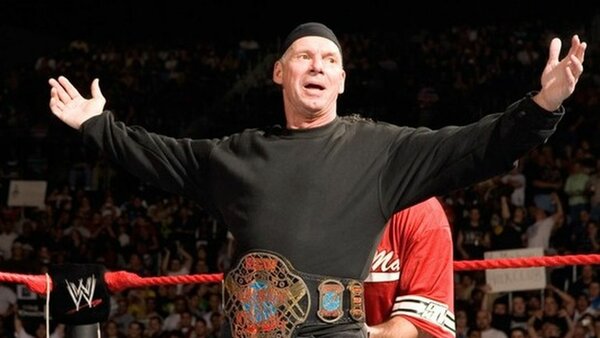
If there’s one thing you can rely on WWE for, it’s a good dose of spite. After winning the Monday Night Wars and acquiring WCW and ECW, Vince McMahon could do anything he wanted with the upstart brand from Philadelphia. Milk its archives, keep it running in its own right - or simply ruin it.
The ECW title under WWE auspices is a who’s who of who isn’t at all related to the promotion. After a strong start - reigniting the brand with RVD on top - things went wrong incredibly quickly. Drafting Big Show and Bobby Lashley onto the new show was not what the rabid fanbase wanted, to say nothing of making Vince himself the durag-sporting champ.
CM Punk and, later, Christian did what they could to prop the belt up, but the brand was dying and its title along with it. Soon it was being traded in ludicrously short matches, jumping across WWE’s various brands, and finally being put out of its misery not four years into its second run.
Never has WWE seemed to feel so obliged to do something as its ECW programming, and the joylessness of the whole thing just pours out of the screen.
1. European Championship

WWE’s tertiary men’s belt could hardly have started life better. British Bulldog vs Owen Hart in a tournament final, fought in Berlin. Sure, “European Championship” is a bit of an arbitrary name, but that? That works.
It was all downhill from there pretty sharpish. First, Shawn Michaels politicked his way into taking the belt from the Bulldog in front of a UK crowd. Then, not a year into its existence, he laid down for Triple H, allowing his DX stablemate to pin him for the belt, which was now objectively worthless.
The list of European title holders is genuine hall of fame stuff, which makes the belt’s treatment even more bizarre. Its nadir came in 1999, when a grass-green Shane McMahon decided he’d like a go with the belt. He won it off X-Pac, then decided he didn’t care about the trinket, leaving it in a gym bag for Mideon to find three months later.
In terms of match quality, the European Championship is way above a lot of other belts on this list, and that’s why the title’s treatment is so odd. They didn’t denigrate it because of a lack of ideas or personnel; they didn’t even lose interest in a hurry. They treated it like a joke just because.