10 Part-Timers Who Screwed With The WWE Roster
Nostalgia. It’s not what it used to be.

It's the perennial debate every year when WrestleMania rolls around: the rights and wrongs of WWE legends and part-timers returning to slide into the upper reaches of the card over the full time roster, who invariably take a back seat. The subject has become even more relevant as the company has decided to bin off their current roster to appease the whims of Saudi Princes throughout 2018, despite the men involved being less mobile than a church.
Now, the argument 'for' is that the involvement of stars from the past boosts the buyrate and the gate, meaning bigger business and more money for the participants. That's just a one night cash grab, though. Had WWE concentrated on building up their roster, they'd have contemporary stars to fill those roles. The fact is, when business was booming, it was due to contemporary stars. The '80s' Golden Era and the '90s' Attitude Era didn't rely on nostalgia acts and middle-aged wrestling legends to sell tickets. They had their own stars: amongst them Hulk Hogan, Steve Austin, The Rock, Triple H, The Undertaker.
Nowadays we have those stars too: the exact same stars, that is. Like legends of heroes past that proclaim they'll return in our hour of need, every time Vince McMahon needs a WrestleMania buyrate out come the big guns. The big, old guns.
But it's not just WrestleMania. Due to years of shortsighted booking, WWE's star power is so slight that they're paranoid they can't sell out even the mid-size events. The focus today might be on the brand, yet where's the confidence it can get bums in seats for a rare appearance in, say, Australia?
There is none. And so the wrinkly weekend warriors are called in again. The booking is as shortsighted as ever, no new stars are made and the cycle continues. WWE have been allowing part-timers to mess with the people that work for them full time for years.
10. The Beast Eats The WWE World Heavyweight Championship... And Has The Universal For Dessert
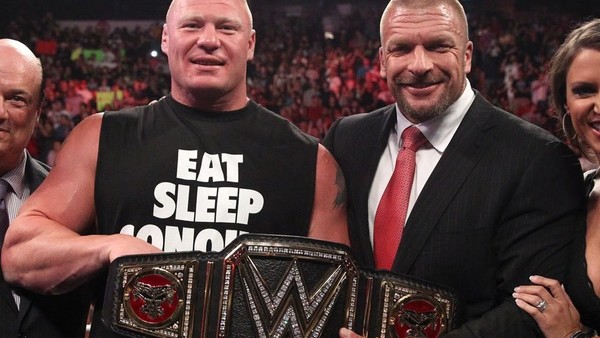
There was dancing in the streets when Brock Lesnar annihilated John Cena to take the WWE World Heavyweight Championship at SummerSlam 2014. Then reality began to set in again. Brock was a part-timer: he might be a regular fixture on WWE television, but 'regular' didn't necessarily mean 'frequent'.
Between SummerSlam and Brock losing the title at WrestleMania 31, there were thirty-odd episodes of RAW and six pay-per-view events (not including NXT specials). Lesnar appeared on very few episodes of RAW, and prior to WrestleMania 31, only defended the title at Night of Champions and the Royal Rumble - events that were four months apart. It was as if the newly created WWE Title belt had become invisible.
Why was this a problem? Well, from the opening promos to the constant replays and the main event itself, Monday Night RAW's story structure is based around the WWE World Heavyweight Championship and whoever is holding it. Removing the champion from the story doesn't just create space for a random 'someone else' to step up and fill it: it requires a character of equal or greater value to become the central protagonist or antagonist.
Brock Lesnar's weeks-long absence from the product simply threw into glaring focus how few characters on the roster were equipped to carry the thrust of the WWE narrative. This was suddenly a TV show without a main character, just a supporting cast fumbling around in his absence. The lack of depth on the roster was exposed. Actual stars Cena, Seth Rollins and Randy Orton were all competing over a number one contender position against an absentee champion, and it was months before any of their posturing would see fruition in that Royal Rumble title match. The only other potential star, Dean Ambrose, was too busy being frightened by ghosts and having televisions explode in his face.
Pay-per-views without Lesnar featured a hodge-podge of glorified SmackDown-style main events with worthless gimmicks attached. It was a shambles. Then, obviously, WWE repeated the entire trick with the Universal Championship for nearly all of 2017 and 2018, with the vague hope it'd finally get Roman Reigns over when the perennial contender took the belt back home. Surprisingly, it did not.
9. The Dead Man Kills The Hopes And Dreams Of The Undercard

When The Bella Twins came back to WWE in March 2013, one of the perks they were promised was a match at that year's WrestleMania. That match - an eight-person mixed tag with Team Rhodes Scholars versus Tons Of Funk & The Funkadactyls - never took place, although it was on the advertised card. In point of fact, all eight of the participants were warming up and ready to go backstage only a short time before their scheduled start. The Bellas even tweeted a picture of their team backstage engaged in a group hug as they psyched themselves up. Everything was hunky dory... until they were told that the preceding match had run significantly over time.
As a consequence, the mixed eight-person tag was cancelled with minutes to go, and eight WWE performers missed out on their WrestleMania moment. The match that overran? The Undertaker vs. CM Punk. The actual bout went twenty-three minutes - but nearly forty when you factor in the video package, entrances, and so on. There's no word on how long it was supposed to run, but there was no buffer at the end of the card, and no space elsewhere to cut by that point in the night.
Sure, the Punk/'Taker match was probably the best thing on the show, and if they needed to go long and kick a nothing tag match off the card to tell that story, then so be it. And that's fair enough for posterity: but we're thinking about times that part-timers screwed with the main roster, not with the fans. This definitely qualifies, as the four men and four women played the match out in full on free television the next night as a lame duck consolation prize. Hopefully they still got the payday.
8. The Return Of The Prodigal Son

Bret Hart's interminable grudge match with Vince McMahon at WrestleMania XXVI - if you can call that farrago a 'match' at all - lasted for only eleven minutes, but with entrances and introductions, that expanded to twenty. Leaving aside for a moment the fact that those twenty minutes seemed to last twice as long, if not more, the match was a monumental waste of time. Hart couldn't work: he was physically and legally incapable of wrestling even the most basic of matches, let alone the intense kind of brawling showdown that the feud was calling for. The story of the match also included cameo performances from the Hitman's dysfunctional family - who, for the most part, the crowd didn't know and didn't care about.
Meanwhile, the plan was that Vince intended the sustained, one-sided dull-as-dishwater clobbering from Hart to turn him babyface: that it would deliberately go on a little too long, and shift audience perceptions in his favour. The problem was that the Mr. McMahon character had acted like such an a-hole throughout the course of the angle that he couldn't have turned babyface if hed literally transformed into a giant baby in the centre of the ring.
This is the match that McMahon chose as one of the tentpole bouts of his annual sports entertainment extravaganza: a poorly conceived, poorly paced, poorly executed glorified RAW beatdown segment with two non-wrestlers and a string of non-entities which dragged on too long on purpose.
Meanwhile, everyone else on the card was marginalised to make room. Ten men took part in that year's Money in the Bank ladder match, at least three too many, making it a hopelessly muddled, contrived mess. Twenty-six WWE superstars competed in a jobber-level eight minute dark battle royal. CM Punk's grudge match against Rey Mysterio got six minutes. The tag team title match got three minutes. Even Triple H only managed to scrape twelve minutes for his own grudge match with Sheamus. The result was that the roster left WrestleMania XXVI shortchanged to the point of robbery.