10 Startling Stories From WWF's New Generation

Vince McMahon viewed The Ultimate Warrior as his biggest WCW-battling tool...

1995 was not a good year for the World Wrestling Federation. Across the board, business was down, and creative ideas were at an all-time low. Still reeling from the effects of a steroid-related trial which nearly put him in jail in the early-1990's, Vince McMahon had no idea how to successfully transition his business away from names like Hulk Hogan and the musclebound beasts of before. It was reasoned that smaller, more realistic workers like Bret Hart and Shawn Michaels were the future. Even so, McMahon still wanted to maintain the cartoon-like carnival atmosphere of the WWF he had fostered, which is precisely why he wheeled out countless hokey gimmicks like Mantaur and Kwang. Post-Hogan, Vince dubbed his product the 'New Generation', something which would last right up until the advent of the more successful 'Attitude' Era. The then-WWF was a struggling entity, one which had lost a lot of shine. This article focuses on various stories from the 'New Generation' era. Most of these entries happened behind the cameras, but many were directly influenced by what was going on in front of them. Vince McMahon's juggernaut was an ailing beast by 1995, and the boss was running out of ways to make money. That panic led to many of the following things happening....

Please note: Many of these stories were found reading James Dixon's excellent book Titan Sinking: The Decline Of The WWF In 1995. It's a cracking read and comes highly recommended with its sequel Titan Shattered: Wrestling With Confidence And Paranoia released recently.


10. Old Heat Resurfaces For Randy Savage Towards The WWF
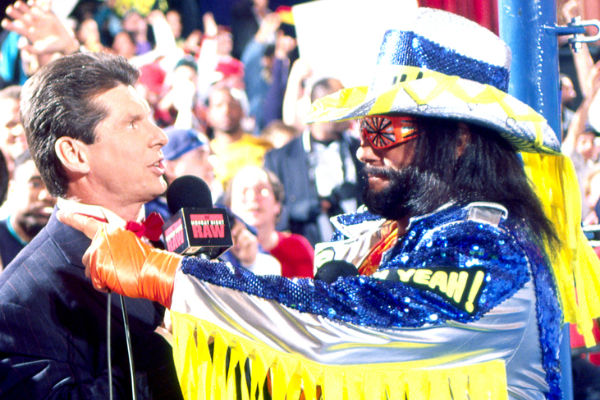
Randy Savage was not a happy camper in the mid-1990's. Having been downgraded to playing the role of announcer, Savage was viewed as someone who was no longer in his prime by Vince McMahon. This troubled the wrestler, who felt he still had many years left in the tank, performing at a top level. That didn't matter, because the man in charge disagreed. Just beneath the surface, there was bubbling tension between both parties. In 1987, Savage had been outraged that his father (Angelo Poffo) hadn't been allowed a slot in a Battle Royal featuring other older names. Randy had promised his dad he would try and sort things out, but the WWF weren't interested. That irked the 'Macho Man', and his brother Lanny reasons that he changed his mentality towards the company that day. Fast-forward to 1994, and Savage wanted out of the promotion. Agreeing to join WCW, he was no longer content with sitting behind the announce desk. McMahon was supposedly badly hurt by the entire scenario, feeling Savage had a job for life in his company. Randy Savage simply did not agree that he should be put out to pasture during the 'New Generation'.

9. Bret Hart Was Close To Joining The Kliq In September, 1994

One of the most classic stories coming out of the mid-90's is that The Kliq called the shots in the WWF locker room. Led by Shawn Michaels and Kevin Nash, the pair were joined by the likes of Scott Hall, Triple H and Sean Waltman. Looking out for one another, they were considered a nuisance to many wrestlers looking to make a name for themselves, because they only wanted to work with one another. Later, Bret Hart would come up against the group, but it wasn't until he developed personal problems with Michaels that trouble surfaced. Generally speaking, Hart was able to get on well with the band of brothers, so much so that he would regularly hang out with them on the road. In September, 1994, Hart was drinking with some of them, and that's when talk of a Kliq started. Incredibly, Nash and Michaels wanted Bret to be their figurehead, because he was then the WWF Champion. They reasoned that he could fight their corner with management, and they respected him as an in-ring performer. At the time, Nash was on the cusp of being Vince McMahon's chosen champion, which wasn't really common knowledge at the time. Things may have been very different had Bret agreed to the pact.

8. Vince McMahon Sent Ted Turner Faxes Criticising Nitro Decision

When World Championship Wrestling announced that they were launching Monday Nitro in September, 1995, the WWF were not worried one bit. Over at Titan Towers, Vince McMahon and his assorted officials felt WCW were silly for attempting to go up against Monday Night Raw each week, and felt it would surely only be a matter of time before it was regarded a failed experiment. They were wrong, Nitro provided wrestling fans with a true alternative to the sugar-coated WWF product. Stars were thin on the ground in the WWF, and that's something WCW would take advantage of. Their competitive ratings didn't sit well with McMahon, who decided to cry foul that WCW had merely stolen all his top stars and were cheating wrestling fans by airing on the same day. Over at WCW, Ted Turner was giggling away as he received fax correspondence and letters from McMahon. In each document, Vince criticised Turner for going head-to-head with him, which proved to Ted (and WCW's creative lead Eric Bischoff) that the WWF were feeling threatened by what was going on in Atlanta. They were right, the WWF were.

7. Scott Hall Requested To Work In Japan 15 Weeks Per Year

Grossly unhappy at the lack of progression in his pay packet, Scott Hall couldn't shake the feeling that he was in limbo by 1996. Whilst his friends, Shawn Michaels and Kevin Nash, had been pushed up the card and into the main event scene, Razor Ramon was getting set to face Goldust in a feud over the Intercontinental Title. This felt like retreading old ground for Hall. Approaching Vince McMahon, he asked what he had to do in order to get on the same pay scale as his peers. McMahon had remarked that he was delighted with the man's in-ring work and promo ability, so it confused Hall that he was struggling to progress. When Vince knocked back the suggestion that he handed a bigger amount of money each year, Scott made another plea. For 15 weeks each year, he wanted to shoot off and work in Japan. Hall's thinking behind this was that he wouldn't be in competition with McMahon's WWF, but would also be able to supplement his income. The head honcho that employed him in North America was not interested. This could be the moment Hall decided he would look elsewhere in the country, seeking advice from his friend DDP over in WCW.

6. Yokozuna Called Out Shane Douglas

There's a case to be made that Troy Martin was never going to be a success in the WWF during the mid-1990's. Shining as Shane Douglas in the upstart ECW, the man was considered average at best by the likes of Shawn Michaels. The WWF star didn't see what all the fuss was about, pointing to the fact that Douglas routinely swore during his promos, which struck HBK as being lazy. When the guy did arrive in the WWF, he was recast as the flat Dean Douglas. The intellectual gimmick was mid card fodder at best, and there was little chance of upward mobility. That said, the man's case was not helped by The Kliq, who were uninterested in working alongside Douglas. After skipping a house show match against Razor Ramon due to a herniated disc in his back, the Dean ran into all sorts of problems. Triple H filled in for him against Razor on the show, even though he had already wrestled earlier. To his surprise, Douglas was accosted by Yokozuna, who called him out in front of everyone for faking an injury. Yoko also wondered if his target had watched Hunter vs. Ramon, citing that the match was what Razor required from an opponent. From that point on, Dean Douglas found his time limited in the WWF.

5. Vince McMahon Was Seriously Irritated Following In Your House 4

Launching in May, 1995, the 'In Your House' series of events were supposed to provide more money for the WWF. They did, eventually, but the first run of shows could hardly be considered a success. Buyrates were low for the budget range of pay-per-views, and they continued to fall with each passing one. By In Your House 4, the WWF were low on ideas to make them appealing to fans. For the October, 1995 event, Diesel defended the WWF Title against the British Bulldog. In another marquee attraction, Shawn Michaels had been set to defend the Intercontinental Title against Dean Douglas. An altercation with thugs at a bar put Michaels on the injury list, and he decided to forfeit the belt instead. From there, Razor Ramon went on to beat Douglas for the title. Fans were less-than-receptive towards the show overall, and they were not alone. Throwing down his headset after providing commentary on the event, Vince McMahon stormed backstage. Feeling the entire card had been below par, McMahon later held a crisis meeting with his talent to discuss where the promotion was going from that point onward.

4. Diesel Stopped Mabel From Being Fired Post-SummerSlam 1995

Just a few months before In Your House 4, McMahon had been left similarly frustrated by one of his big pay-per-view shows. At SummerSlam 1995, the gigantic Mabel (who had earlier won the King Of The Ring in June) clashed with Diesel for the WWF Title in the main event slot. They failed to follow up on a red-hot Ladder Match for the Intercontinental gold between Razor Ramon and Shawn Michaels. It was Vince's choice to have the Heavyweight Title bout go on last. It was a poor decision, because the awkward Mabel was not the kind of guy who could get a good match out of Kevin Nash. Worse yet, during the collision Mabel did something the champion had specifically asked him not to. Known for injuring many of his peers, the big man kicked his legs out and sat all of his weight down on Diesel's back. The champ was incredulous, because he had informed Mabel not to perform the move. After the event, Nash was surprised to hear McMahon tear into Mabel and threaten to fire him. Stepping in, he said that the boss would have to sack him too, because he wouldn't stand to see someone lose their job over a simple mistake. Calming down, McMahon decided not to fire Mabel. In essense, Kevin Nash helped his opponent at SummerSlam keep his job.

3. Vince McMahon Gave Marc Mero First-Of-A-Kind Contract

By the time the WWF signed Marc Mero to a bumper contract in early-1996, Vince McMahon was already keenly aware that he was about to lose at least one of his big talents. Scott Hall had told his employer that he planned on joining WCW, because they were offering a lot more financial security that the WWF. Signing Mero was a direct consequence of McMahon feeling he needed to pad out his roster. Much to the chagrin of Mick Foley and Steve Austin, who had been forced to undertake deals for significantly less money, Mero signed a big contract. His deal with the WWF was actually somewhat of a departure from the way Vince McMahon usually conducted business. So desperate was he to get more talent in the door, he gave Mero some guarantees that he normally wouldn't. Namely, Marc Mero's deal is considered one of the first to include the classic 'downside guarantee'. This told a wrestler that they would receive a certain amount of money before even performing, something McMahon didn't really like to do. Of course, Mero's deal wasn't as big as those held by The Undertaker, Bret Hart or Shawn Michaels, but it was still a different way for the WWF to do business.

2. The Ultimate Warrior Was Supposed To Be In The 1996 Royal Rumble

Scanning the lineup for the 1996 Royal Rumble match makes for fascinating reading. The likes of Dory Funk Jr, Takao Omori and Aldo Montoya were all entrants. In addition, the WWF had brought back several aging stars like Jake 'The Snake' Roberts and Bob Backlund. Even a non-WWF talent like Doug Gilbert was given a shot in the bout. It was an auspicous cast of characters, symptomatic of the lack of star power Vince McMahon had at his disposal. Eventually, the mountainous Vader was signed just in time to be part of the show, but he wasn't the initial plan McMahon had in mind. Instead, the WWF wanted to bring back The Ultimate Warrior and put him in the Royal Rumble. There was only one problem, the company couldn't come to an agreement with Warrior, who reasoned that they needed him much more than he needed them. The wrestler would return in time for WrestleMania XII, but he barely made a difference to the fortunes of the promotion. This irked McMahon, who had made several concessions in Warrior's contract, such as agreeing to plug his outside ventures. If Warrior had been in the match, it'd be interesting to know whether or not it would have changed the planned outcome, a Shawn Michaels victory.

1. Razor Ramon Was Initially Booked Against The Undertaker At €˜Mania XI

By the time WrestleMania XI rolled around in the Spring of 1995, the event had lost must of the luster which had made it such a huge deal previously. For talent, it was still the biggest pay day of the year, even more so if a performer was higher up on the card and in a featured bout. Such a thing was promised to Scott Hall, who was - as Razor Ramon - set to feud with The Undertaker on the show. This would have necessitated a Razor heel turn, something Hall was eager to do. He was friendly with Undertaker behind the scenes, and felt the pair could have an interesting dynamic. Out of nowhere, Vince McMahon pulled the proverbial rug out from underneath Hall. The card was changed, and 'Taker faced King Kong Bundy instead. For his part, Razor would face Jeff Jarrett for the Intercontinental Title. For Scott Hall, this was a clear demotion from the spot he was under the impression he was getting on the show. A match against Undertaker would have been huge. The pair hadn't really faced one another, only battling on house shows and as part of a Coliseum Video exclusive in 1992. McMahon decided against the feud, because he didn't want Razor Ramon to turn heel. What other fascinating WWF 'New Generation' stories do you know? What are your memories of that era? Let us know what you think down in the comments section below!

Contributor

Lifelong wrestling, video game, music and sports obsessive who has been writing about his passions since childhood. Jamie started writing for WhatCulture in 2013, and has contributed thousands of articles and YouTube videos since then. He cut his teeth penning published pieces for top UK and European wrestling read Fighting Spirit Magazine (FSM), and also has extensive experience working within the wrestling biz as a manager and commentator for promotions like ICW on WWE Network and WCPW/Defiant since 2010. Further, Jamie also hosted the old Ministry Of Slam podcast, and has interviewed everyone from Steve Austin and Shawn Michaels to Bret Hart and Trish Stratus.