10 Things You Didn't Know About WWE No Way Out 2000
"Retirements", injuries, regrets, subtle pushes and backstage drama...

What do you remember about No Way Out 2000?
Mick Foley taking yet another mighty, dangerous and downright scary fall through Hell In A Cell? The fact he and Triple H used everything from steel chairs, ring steps, barbed wire bats, fire and the cage itself during their main event? A sparkling opener between Chris Jericho and Kurt Angle? Big Show beating The Rock thanks to Shane McMahon?
The February pay-per-view was sandwiched in between Royal Rumble and WrestleMania, but it still managed to stick out as another shining example of the WWF's purring product. Vince McMahon and company could do no wrong that year, and this so-called 'B' show was further evidence that they were top dog and WCW was going down the sh*tter.
What about the things you might not know though? No Way Out 2000 has tons more lore than one might think; it was an event riddled with backstage politics, painful injuries and subtle set up for feuds to come months later.
Here's some insight into a show that had way more to offer than just one HIAC match...
10. The Attendance Was Remarkably Small
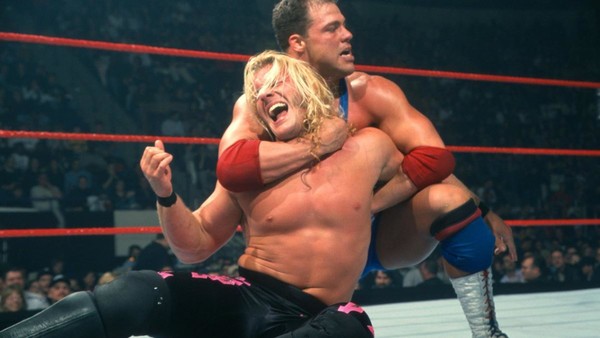
Despite booming popularity amongst wrestling fans and all that monster business the company were doing at the turn of the millennium, the WWF chose to host No Way Out 2000 in the relatively humble confines of the Hartford Civic Center (known as the XL Center today).
The crowd wasn't exactly massive.
12,551 fans bought tickets to see the pay-per-view in person. According to Wikipedia's notes on the venue, it's capable of holding approx 3,000 more than that for basketball. Basically, this means that the WWF didn't sell it out in February 2000, which is rather surprising considering how hot they were at the time.
That 12,551 paid $451,625 at the gate (an average ticket price of just $35) and bought a further $97,000 in merchandise on site. This all sounds remarkably small for a show that took place on what has become known as the 'Road To WrestleMania'.
9. The Buyrate Was Higher Than Some Major Shows

Side note: The numbers here, and those in the previous entry, were all ripped from Dave Meltzer's Wrestling Observer.
No Way Out 2000 pulled a respectable 480,000 buys on pay-per-view. The month prior, January's Royal Rumble had logged the exact same number, and WrestleMania would go on to draw 675,000. Meanwhile, both SummerSlam and Survivor Series attracted 420,000 each.
That means the Hell In A Cell match between Triple H and Cactus Jack was a big enough attraction that it outdrew two of the traditional 'Big Five' on pay-per-view (King Of The Ring, the final event to make up that quintet, pulled a massive 605,000 buys). That's actually huge for a 'B' level pay-per-view.
Of the other 'B' level shows that year, Backlash (675,000), Unforgiven (605,000) and No Mercy (550,000) were higher. Conversely, Judgment Day (420,000), Fully Loaded (420,000) and Armageddon (465,000) were slightly lower on the buyrate scale.
8. Billy Gunn Was Hurt Going In
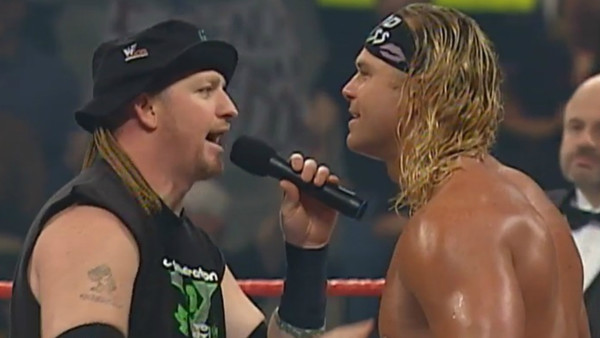
The popular narrative for years was that Bubba Ray Dudley injured Billy Gunn by smashing him with a lead pipe during their Tag-Team Title match. That isn't strictly true. According to Jim Ross on his 'Grilling JR' recap of the event, Gunn was already hurt before No Way Out 2000.
He'd already had some rotator cuff surgery before the show, and was scheduled to have some more afterwards. The injury was severe, and it's why the company kept his workload to a minimum on the pay-per-view; The New Age Outlaws vs. The Dudley Boyz went just over five minutes in length, and Road Dogg chopped most of the wood for his team.
Billy was in immense pain.
He wasn't the only one who worked through injuries that night. Kane had a problem with his leg that he had to deal with, and Eddie Guerrero patrolled ringside for The Radicalz despite suffering a nasty broken elbow injury on TV a few weeks earlier.
7. Eddie Guerrero's Injury Caused Serious Doubt Backstage
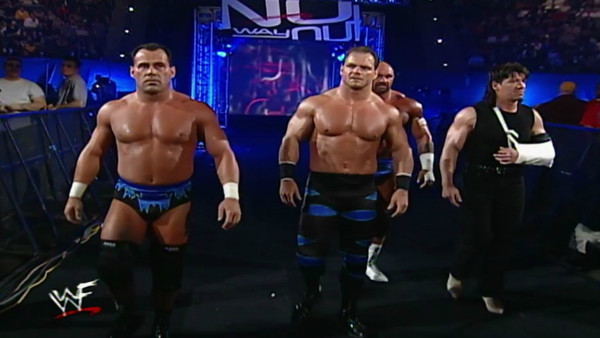
Guerrero's arm injury caused some unnecessary heartache for both Jim Ross and Bruce Prichard.
JR said on his podcast that some viewed his decision to hire Eddie, Chris Benoit, Dean Malenko and Perry Saturn with skepticism. He thinks that the crappy booking (The Radicalz lost pretty much immediately after bolting from WCW to join the WWF) was a test to see how much the foursome could stomach.
When Guerrero landed badly on his elbow and was removed from the picture temporarily, Ross and Prichard got a few dirty looks. The general consensus was that they'd gone to bat for these incomers, and now one was so clumsy he'd injured himself during his debut match. It's amazing to think people talked about Eddie that way.
His injury fanned flames of doubt that already existed behind the scenes in the WWF. Some seriously thought that he couldn't cut it 'in the big time', and both JR and Bruce had to fend off accusations that they'd wasted some of the budget.
6. Why Tazz Worked With Big Boss Man
The Radicalz weren't alone when it came to fighting politics in their new home.
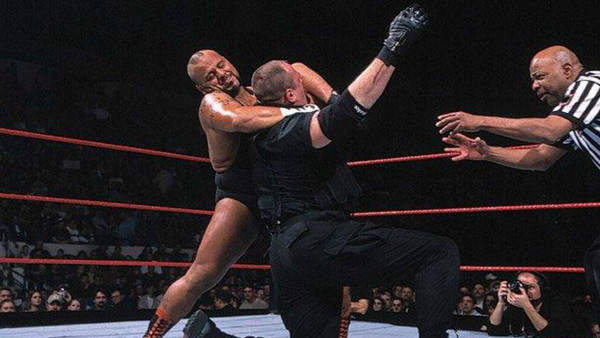
Tazz, who had debuted by beating Kurt Angle at Royal Rumble, was demoted to working a short DQ win over Big Boss Man at No Way Out. That wasn't an accident, and it wasn't a decision taken just to get the ex-ECW man on the card either. He was deliberately relegated to a nothing feud.
Some talents had started to complain that his work looked dangerous (something that would surely, and probably rightly, have angered Tazz). Worse, Bruce Prichard told on his 'Something To Wrestle With' show that Vince McMahon himself hadn't been keen on some of his release-style suplexes at the Rumble.
The WWF didn't really know what to do with their new property, so they stuck him in a meaningless match-come-angle with Boss Man and Prince Albert. This was a rather dramatic fall from grace for someone who had legit popped MSG a mere month earlier.
5. Jim Ross Regrets His Wording On Mark Henry & Viscera
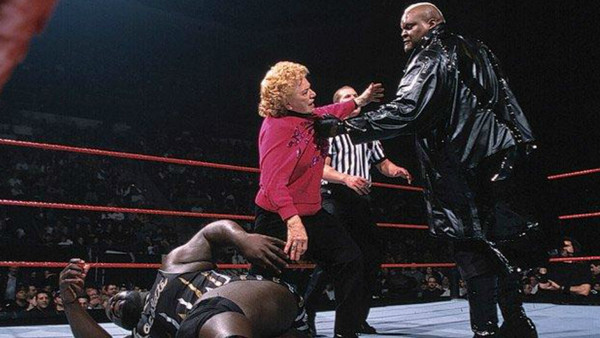
Before the Mark Henry vs. Viscera match, Jim Ross shot off a line on commentary about how the bout "wouldn't be worth many stars". That was a direct dig at match quality, and a prediction that Dave Meltzer might not shower the big man brawl with much praise.
It's one JR regrets.
He said on his podcast he was only trying to be funny, but he doesn't think it came across well from someone who was supposed to protect talent. In fairness, Ross was struggling for something to say about a match that hadn't been heavily promoted on television and was never going to be Flair vs. Steamboat.
Still, Jim cringed when he re-watched the pay-per-view and heard his line before recording that recap pod. It wasn't his most professional moment, and he reckons he should've found something else to say that didn't sh*t all over Viscera or Henry's hard work.
4. It Was Mark Henry's Last Pay-Per-View Until 2003

The match was so poor that Mark Henry disappeared for almost four years.
No, that's not actually true, and yes, it's almost as poor a throwaway joke as JR's. Seriously though, No Way Out 2000 would end up being Mark's last WWF/WWE pay-per-view until Survivor Series 2003. That's crazy to think about - the future World Champ was sent down to OVW for "conditioning and wrestling skills training".
In other words, the company wanted him to shed some weight and brush up on his in-ring work. When he was finally called back up in 2002, Mark worked as a babyface on SmackDown for a while before suffering a knee injury and another OVW demotion. He'd have to wait (again) for that sought-after pay-per-view payday.
Eventually, Henry joined the rest of 'Team Bischoff' against 'Team Austin' at Survivor Series '03. He'd go on to job for Booker T at Armageddon after that. Those shows were his only two pay-per-views from February 2000-November 2003.
3. JR Wanted Mick Foley To "Slow Down"
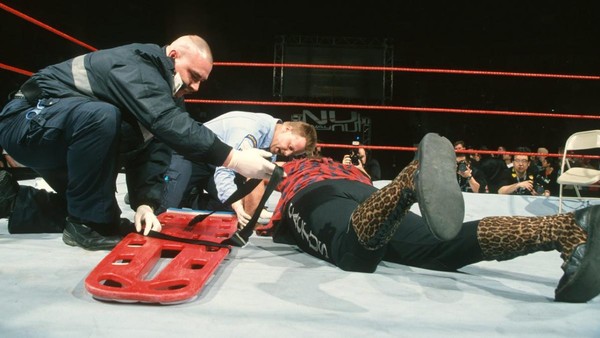
Few were foolish enough to believe that No Way Out 2000 would genuinely be Mick Foley's final ever match, but most backstage hoped he'd work a reduced schedule from that point on. Jim Ross was one of the worried parties who thought ol' Mick should "slow down" after putting his body (almost literally) through hell.
The announcer could see that Foley's body was deteriorating badly following years of abusive bumps and hard-hitting matches. Once his Hell In A Cell war with Triple H was over, Jim hoped, Mick would see sense and give himself some respite. The onus was also on the WWF to help Mick acclimatise to fewer matches.
Foley had smartly saved his money and could afford to relax. That financial security, along with the dreadful toll such painful gimmick matches were having on his well-being, was why JR wanted him to chill out for a bit. Of course, Mick would be enticed back by the lure of a WrestleMania main event berth one month later.
Money talks, and the lure of the pop is real.
2. How The Announcers Found Out About Foley's Bump

That reaction from the commentary team at King Of The Ring 1998 was as organic as they come; when JR shouted his famous line, "With God as my witness, he's broken in half", he wasn't working. Neither was Jerry Lawler when the colour man blurted out, "That's it, he's dead". They were whipped up in the frenzy of sheer drama by Mick Foley's big-bumping style.
At No Way Out 2000, they were only slightly more prepared.
Earlier in the day, both Ross and Lawler were camped out behind their announce desk taking notes and talking about storylines. A few feet in front of them, WWF workers diligently prepared the ring for Mick's latest stunt, and it was obvious that they were rigging the canvas for something memorable. Immediately, JR and 'King' agreed that it must be something to do with Foley.
They didn't ask any questions though. The legendary pair preferred no to know exactly what was happening towards the end of matches. They might know the end result, but they wouldn't know how workers planned on getting there. In other words, they didn't know Triple H was going to backdrop Cactus through the cage roof.
1. Steve Austin's Rikishi Feud Was Already Booked

Steve Austin wasn't involved in events at No Way Out 2000, but the WWF were making plans for his eventual return. Amazingly, Jim Ross said on 'Grilling Jr' that Austin's next big feud was already mapped out as early as February, and the creative team knew who was going to be framed for running Austin over at Survivor Series 1999 by then.
Rikishi didn't do it "for The Rock", he did it because that had been the plan all along.
The big Samoan had been identified as the ideal candidate to turn heel and receive a big push. Austin, however, wasn't too keen on working with Rikishi and didn't think the rivalry would be as good as those penning TV did. The WWF pressed on nonetheless, and they prepared 'Kish by having him score a pin over The Radicalz at No Way Out.
This was all part of a multi-layered plan to build Rikishi up as a babyface fans could believe in. Then, when the time was right, he'd be outed as a cold, callous beast who tried to maim or even kill 'Stone Cold'. For the record, Austin was correct about the resultant feud.
What do you remember about No Way Out 2000? For more like this, check out 9 Ups & 2 Downs From WWE SmackDown (13 March) and Ranking The Last 10 WWE Intercontinental Champions From Worst To Best!