10 Things You Didn't Know About WWE Saturday Night's Main Event
Iconic network television show returns, but what's the real story behind it?

When WWE brings back Saturday Night’s Main Event this weekend, it’s not just embarking on another navel-gazing nostalgia tour. Sure, that is part of this venture, but isn’t the entire story – and fans would be forgiven if they didn’t understand the significance of that is about to unfold.
Nearly 40 years ago, the then-WWF launched a revolutionary program that contributed mightily to the company’s rapid evolution and expansion as the sports entertainment juggernaut that we know today. Saturday Night’s Main Event brought the WWF into the mainstream in a way that promoters could only dream about, and it helped set the table for PPV growth and new television programs like Monday Night Raw.
Nothing like SNME existed before 1985: a national network program that beamed into millions of homes several times a year, helping to make wrestlers such as Hulk Hogan, “Rowdy” Roddy Piper, “Macho Man” Randy Savage and Andre the Giant household names and “WWF” synonymous with the term “professional wrestling.” The NBC program changed the game for the WWF in ways that even the company couldn’t have predicted.
But how did Saturday Night’s Main Event get its start? And why was it so revolutionary? As WWE prepares to relaunch the popular show, it’s worth digging into the past to understand why this should be treated as a huge deal, and it might explain why the company is seemingly going all-out with big matches and a ton of promotion.
Let’s get to it…
10. The How And Why

To understand the basis for Saturday Night’s Main Event and how unprecedented it was, you have to cast your mind back nearly 40 years ago, at a time when wrestling still was almost entirely a regional network of territories.
The WWF had already begun its national expansion, airing two specials on MTV and holding WrestleMania I in March 1985. Based on the success of those shows (and the high ratings of the MTV programs), Dick Ebersol, who was then the executive producer of Saturday Night Live, approached the WWF about creating a wrestling show that would broadcast in the slot that SNL occupied rather than air a rerun of the sketch comedy show. The first Saturday Night’s Main Event would air in May 1985.
The notion of putting wrestling on network television in a time slot that was reserved for one of the most popular programs of the era might have seemed impossible just a year or two earlier, but Ebersol saw enough from the two MTV programs to justify taking a chance. Had it not been for that and the success of WrestleMania I, WWF might have continued to toil away with cable TV programs.
Saturday Night’s Main Event gave the WWF a major platform to launch them into the stratosphere, but their partnership with Ebersol and NBC also reshaped their entire presentation. NBC also benefited from the arrangement, showing original programming in a slot where lower-rated reruns normally would have aired.
9. Legit Marriage

Wrestling weddings are almost an oxymoron in terminology due to the sheer number of ceremonies that end with a wrestler interrupting the exchange of vows and throwing the entire proceeding into chaos.
Some ceremonies go off without a hitch, like “Macho Man” Randy Savage and Miss Elizabeth at SummerSlam 1991, while others go horribly awry, such as Stephanie McMahon and Test in 1999. But the vast majority have one thing in common: the ceremonies are part of the show and not real.
That is, except for a wedding that took place on the second episode of Saturday Night’s Main Event. The superstar who tied the knot was Uncle Elmer, a 400-plus-pound hillbilly (yes, there was more than just Hillbilly Jim – Vince had a thing for overall-clad simpleton characters).
During the October 1985 program, Uncle Elmer squashed Jerry Valiant in the second match on the card. But his night wasn’t over, as he would legitimately marry his girlfriend Joyce Stazko later in the evening during the show.
Despite being the real deal, the ceremony and reception afterward still adhered to the wrestling wedding clichés: “Rowdy” Roddy Piper objecting to the marriage, Jesse Ventura burying the happy couple from commentary during the wedding, and The Body following up in person at the reception… only to end up face-first in the cake.
Uncle Elmer and Joyce would remain married until his death in 1992.
8. Setting The Standard For WWF Television

Perhaps one of the WWE’s biggest strengths has been its high production values. Even when Raw and SmackDown were in the toilet throughout the years, you could always rely on them to still produce a visually appealing program (Kevin Dunn’s insane camera cuts notwithstanding).
But fans who have only known WWE programming during the past 30 years would be shocked to watch pre-1985 WWF shows and view the difference in how their favorite sports entertainment was filmed and presented. Even the first WrestleMania looks stylistically and visually different from all future WrestleManias.
The reason: Saturday Night’s Main Event.
Up until that point, WWF was still a regional wrestling company trying to grow and expand into a national empire. But their appearance on television still resembled a local cable access show, compared to what it would become.
The partnership between NBC and WWF opened the wrestling company up to the world of professional television production: better lighting of the ring and crowd, improved camerawork and other increased production values. If NBC was going to put wrestling on network television, they were going to make the product shine for a national audience.
The presentation overhaul became the standard for WWF television going forward and soon became a major strength for the company, which carries on to this day.
7. Early Main Events

Ask a wrestling fan which match on a card is the main event and they invariably will answer that it’s the last match of the night, naturally.
However, that’s not how Saturday Night’s Main Event was structured. While WrestleMania and other WWF PPVs in the 80s closed out with a Hulk Hogan WWF Championship defense or other major match, SNME’s biggest match often was the first or second bout to air during the program. Hogan wrestled at each of the first 10 Saturday Night’s Main Events and competed in the first or second match in nine of them.
In many cases, SNME consisted of two high-profile matches to open the show, and then the card ramped down in match strength and significance. In some cases, you could see the audience thinning out as the show wound down.
After all, if fans (in attendance or watching on television) just watched a Hogan title defense and a Randy Savage match, why would they stick around for “main events” like Junkyard Dog versus Pete Doherty (SNME 1), Kamala versus Leaping Lanny Poffo (SNME 7) or Blackjack Mulligan versus Jimmy Jack Funk (SNME 9)?
This likely was tied to the airtime of Saturday Night’s Main Event, which broadcast at 11:30pm on the East Coast. Forcing fans to wait until well after midnight for a Hogan match might not have been the best strategy for audience retention. Even Saturday Night Live famously front-loads its more popular sketches in the first 45 minutes, with the quality typically dropping off as the show reaches the end of its 90 minutes.
6. Reboot #1
As WWE prepares to relaunch Saturday Night’s Main Event, the company is leaning into the nostalgia of yesteryear, with promo packages blending footage and the iconic music from the 80s and 90s program with today’s stars.
But fans getting swept up (when they aren’t asking who Jesse “The Body” Ventura is) might not be aware that this isn’t the first time WWE has brought the iconic program back to the airwaves. And really, you can’t blame them since WWE isn’t really calling attention to SNME’s first revival.
In 2006, WWE rebooted Saturday Night’s Main Event as a special series as part of Raw’s return to USA Network, which is an NBC property. The special would air five times between March 2006 and July 2008 to diminishing returns, with ratings falling throughout the run and the show going from live (though the first episode was on a one-hour delay) to the final three episodes being taped.
Whereas the original SNME relied on televised title defenses as a major draw, the 2006 relaunch featured only one title defense across all five episodes and leaned heavily on tag team and gimmick matches to fill the cards.
After the first couple episodes, the reboot seemed to be more of an obligation for WWE (which was stretched thin with Raw, SmackDown and ECW brands) than a point of pride. One would hope that Triple H and company don’t similarly lose interest in this iteration of SNME.
5. A Title-Defending Machine

These days, seeing a men’s world champion defend his title is an almost monthly occurrence on PPV/PLE. Fans also regularly see each brand’s top champion appear and even wrestle on weekly television.
What today’s fans don’t realize is that they’re spoiled compared to fans in the 80s, who had to either buy a ticket when the WWF came to town, or hopefully catch a match on local cable. If the world champion did wrestle on a televised program, it usually was a squash. Hulk Hogan in 1984-85 defended his title on WWF Challenge and All-Star Wrestling just a handful of times against lower-level talent such as Tiger Chung Lee, Jerry Valiant, Johnny Rodz and Rusty Brooks.
Saturday Night’s Main Event changed how WWF fans experienced their world champion. In an era when there was only one PPV per year – WrestleMania – SNME provided audiences with PPV-quality title matches several times a year. Hogan defended his first WWF Championship 10 times on Saturday Night’s Main Event against mainstays such as Bob Orton, Nikolai Volkoff, Paul Orndorff, The Magnificent Muraco, Hercules and King Kong Bundy.
For 80s wrestling fans, SNME was their best bet to see the world champion defend his title in somewhat competitive matches on free television, which is something that carried over to Raw and SmackDown the following decade.
4. Hogan Not Invincible

Without a doubt, the workhorse and top draw of the original run of Saturday Night’s Main Event had to be the man who helped launch the show and propel the WWF into the stratosphere in the 80s, Hulk Hogan.
During the initial run of 31 SNMEs, Hogan competed in 24 matches (singles and tags) and two battle royals. He defended the WWF World Heavyweight Championship 14 times across two reigns. As one would expect, Hogan was extremely successful in those matches. In fact, he only lost two of those 24 non-battle royal contests, both by count-out.
The first loss, a November 1987 match against King Kong Bundy, shouldn’t surprise many. Bundy was Hogan’s WrestleMania 2 opponent and a member of the Heenan Family, so a count-out loss only helped further the ongoing story of Hulk battling The Brain’s charges. Hogan would win a rematch against Bundy at the January 1988 Saturday Night’s Main Event, avenging that blemish.
But Hogan’s other SNME loss is the thing of lore.
In November 1989, Hogan lost a WWF Championship match via count-out to… The Genius. Yes, Randy Savage’s brother, the former Leaping Lanny Poffo. Genius was a comedy heel (and a damn good one), so this probably was viewed as little more than a formality, an opportunity to Genius to work his shtick and then eat the big boot and legdrop. Instead, Genius confounded Hogan with his antics, eventually scoring the upset win – with a little help from Mr. Perfect.
What makes this match truly unique is that Hogan never got his win back against Genius. Hulk almost never took a loss – even a count-out – if he wasn’t winning a rematch down the line. And losing against a mid-card comedy act on a nationally televised show in the 80s was an unheard-of instance. Genius and Perfect would take things a step further toward legendary status when they stole the WWF title and smashed it to pieces with a hammer backstage.
3. A Main Event By Any Other Name…

Some fans will swear that they saw Andre the Giant defeat Hulk Hogan for the WWF World Championship on Saturday Night’s Main Event in February 1988.
And while it’s true that Hogan’s four-year title reign ended on a nationally televised broadcast (seen by a record 33 million viewers), the program wasn’t SNME. The WWF actually launched a spinoff called The Main Event, which aired once a year (save for one year when it aired twice) on Fridays in prime time from 1988 through 1991, typically in February as a build to WrestleMania.
While it might be easy to simply combine the two programs into one because they aired on the same network and followed a very similar broadcast pattern, they were distinct programs – which makes sense considering they aired on different nights at different hours in different frequencies (SNME typically aired five times a year)
It was the initial The Main Event where Andre dethroned Hogan (with the help of Dave Hebner’s twin brother, Earl), and then immediately surrendered the title to “Million Dollar Man” Ted DiBiase. This led to the title being vacated and WWF holding a one-night tournament during WrestleMania 4.
Other episodes of The Main Event saw the Mega Powers explode when Randy Savage attacked Hogan backstage in 1989, and new boxing champion Buster Douglas serving as a guest referee for a Hogan/Savage title match in 1990.
2. Harley Race: Honorary Dudley Boy
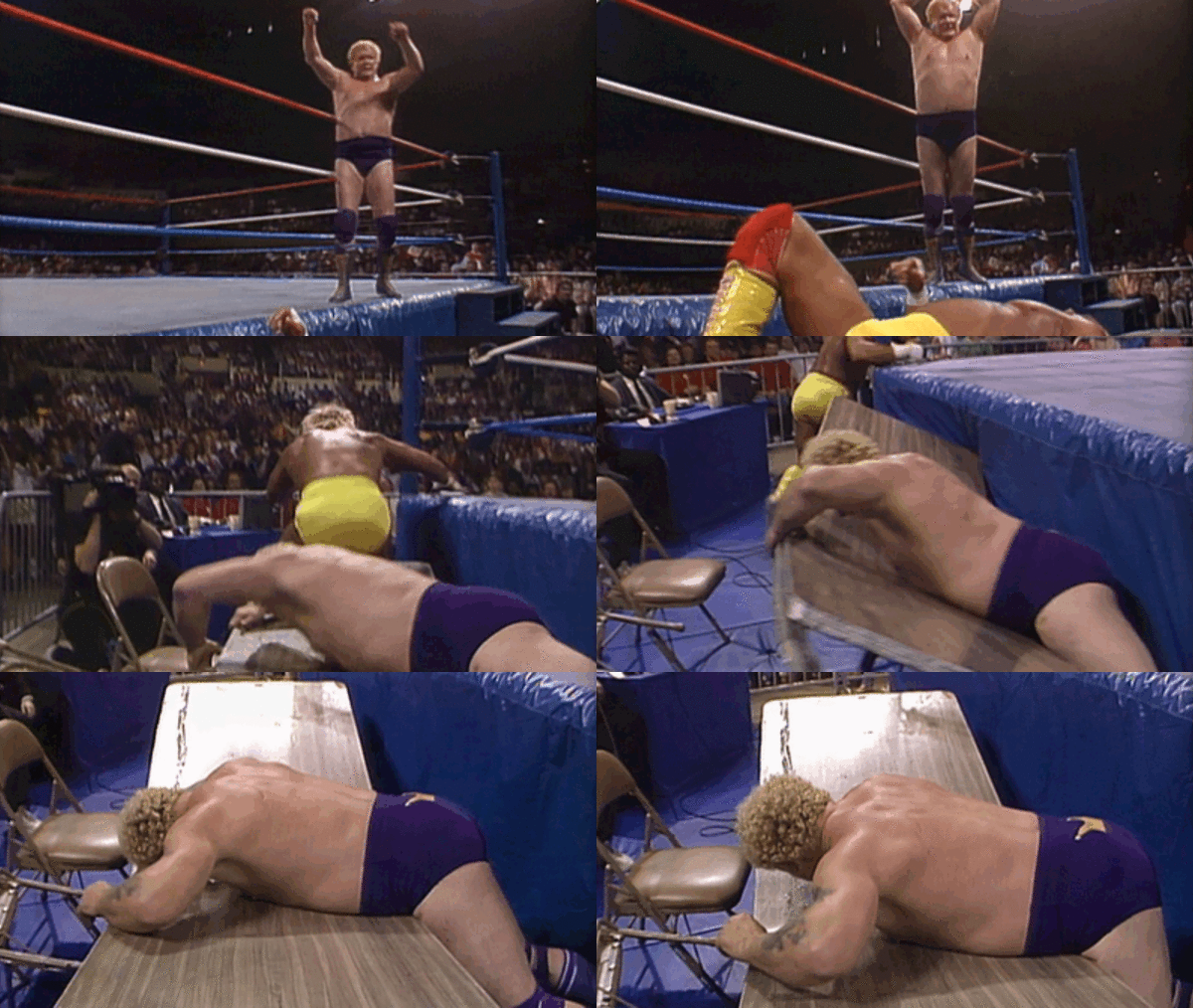
Harley Race was an undeniable tough guy. An eight-time NWA World Heavyweight Champion, Race is often in the conversation of greatest professional wrestlers ever.
Few fans would consider Handsome Harley a hardcore wrestling innovator, but Race would make hardcore history during the March 1988 episode of Saturday Night’s Main Event when he recorded one of the first table spots in wrestling, and the first in WWF history. (This also predated the fabled Terry Funk table piledriver to Ric Flair at WrestleWar 89 by a full year).
Race battled a championship-less Hulk Hogan just a month after the infamous title loss to Andre the Giant at The Main Event, and things did not go well for the King. Harley placed Hogan on a table at ringside and attempted a headbutt splash off the apron, but the Hulkster moved and Race went splat.
But this wasn’t your typical chipboard table that breaks perfectly in half upon impact that we see almost weekly on television today. Much like the table from the Flair/Funk spot in 1989, the table Harley crashed into was comprised of metal and dented when he landed on it. But it still counts as the first time a table spot graced WWF television.
The incident also took time off Race’s career, as he sustained a hernia, which kept him out of action for six months. After he returned, he would wrestle only a handful more televised bouts and a bunch of house show matches in WWF, All Japan and the NWA before hanging up the boots in 1990.
1. Dearth Of Title Changes

Watching the original Saturday Night’s Main Event programs in the 80s and 90s, fans were all but guaranteed at least one title match per episode. Only three of the 31 WWF efforts did not feature a championship defense.
But title changes were a different story. The WWF World, Tag, Intercontinental and Women’s Championships were defended 48 times, but those belts traded hands only twice: in July 1989 when the Brain Busters ended Demolition’s record-setting WWF Tag Team Championship reign, and in November 1992, when Shawn Michaels won his first Intercontinental Championship by beating the British Bulldog. That’s an incredible success rate of 95.8% for champions.
The WWF World Championship was defended 19 times and never changed hands, while the tag and IC titles were for grabs 14 times each. The Women’s Championship was defended at the very first SNME only.
WWE’s 2000s reboot only saw one title match across five episodes, which might in part explain why it flamed out so quickly. This month’s restart already has far eclipsed that total, and if WWE is feeling frisky, they could tie or eclipse the original run’s mark of two title changes in just one episode.
Given how much attention WWE has steered toward this latest revival, one would expect the company to pull off a big surprise. We're already guaranteed to see at least one new champion with the finals of the Women's United States Championship tournament, but there could be something else big in store.