10 Things You Learn Binge Watching Every WCW Nitro
Surviving all 288 episodes...

What kind of sado-masochistic fool would willingly sit through all 288 episodes of WCW's Monday Nitro in 2022? The answer is, of course: THIS GUY. Being locked up by the government during a global pandemic does strange things to people, apparently, including revisiting some of the worst wrestling ever with a smile.
Weirdo.
The thing is, this writer loves World Championship Wrestling. He always has, and anybody who reads enough WhatCulture will have been battered over the head at some point by subtle (and not-so-subtle) nods towards the fallen giant. Nitro was the lightning bolt wrestling needed in the mid-90s, and its legacy should never be forgotten.
WCW's flagship debuted on 4 September 1995 and waved goodbye to the world on 26 March 2001. During that 2,030 day span, the broadcast pioneered many of the tropes one can see on wrestling telly today. It also ripped up the rulebook and delivered some content so awkwardly comedic you'd swear Ricky Gervais wrote it.
Here's everything you can learn from watching madness unfold across five and a half years of beautiful, tragic and occasionally horrible WCW history...
10. The First Episode Is Over-Rated

Generally, Nitro's debut episode is held aloft as some sort of barometer for just how good a one-hour pro wrestling show can be. The first one stuffed every minute with big stars, industry-shattering debuts and a red hot ambience. It's also terribly over-rated.
Didn't the guy writing this say he loved WCW? He did, but read on.
Nitro's intro to the world doesn't hold up when viewed today. In fact, if anything, it shows how desperately bland most prime time wrestling programming was in late-1995. Over on WWF Raw, fans were asked to put up with regular lifelessness. All Eric Bischoff did was give things a shot in the arm and be more raw than erm...Raw.
Jushin Liger vs. Brian Pillman is a fast-paced belter, but there are better matches of the sort on offer every week in 2020. Also, the heavily-lauded Ric Flair vs. Sting battle wasn't actually that great and the Hulk Hogan vs. Bubba Rogers main comes across like a 1980s WWF hangover.
9. WWE Do A Better Job With Three Hours
WWE take a ton of flak these days for failing to prepare for life beyond the likes of John Cena or The Undertaker. Creating new stars has been a right pain in the buttocks for Vince McMahon, and it cannot be easy to fill three hours of Raw every single Monday without box office smash hits to fall back on.
Even so, WWE's effort is superior to WCW's towards the end of the 90s.
Nitro went from a two-hour format to three in January 1998, and that turned the once-slick weekly into a bloated time sink that only played to the most hardcore of WCW marks. For all the sh*t WWE takes for turning Raw into a three-hour slog in 2012, they've slowly-but-surely figured out ways to pad the broadcast.
It's still an investment best watched with one finger on the fast-forward button, but WWE has a reliable women's division and few (if any) matches are downright awful. By comparison, WCW only had Cruiserweights to lean on outside the star name mix, and ended up promoting nothing bouts aplenty to power through 180 minutes.
8. Production Should've Been Way Better
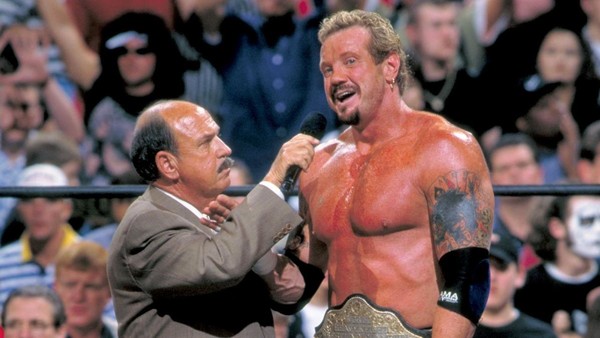
Eric Bischoff has confusingly switched between praising WWE for their production techniques in the 90s and bigging up WCW's cash-rich levels of equipment on his '83 Weeks' podcast. Listening to him talk about it all, it sounds like the Bisch knows WCW should've been blowing Vinnie Mac out of the water there.
It didn't though. Given Ted Turner's budget, the fact WCW had access to top-notch camera equipment and the backing of an entire TV network, Nitro should've looked better than it ever did. Not in terms of picture quality, but more in terms of segment-to-segment smoothness, graphics and things of that nature.
There were far too many production errors and 'dead air' moments.
This problem persisted throughout the show's shelf life, and actually worsened from 1999 onwards. It's slightly jarring to watch a company who, for a spell, were the biggest around fail to work simple production mechanics like count-ins or transitions for almost six years.
7. They Did Special Episodes Better Than Anyone
When they weren't lingering on backstage promos for too long (and thus showing people talking about their take) or stuffing ring announcers/live mics so low in the audio mix that they were barely intelligible, WCW were trying different things. Their special, one-off episodes broke the monotony of weekly TV.
A class example would be the annual 'Spring Break' shows.
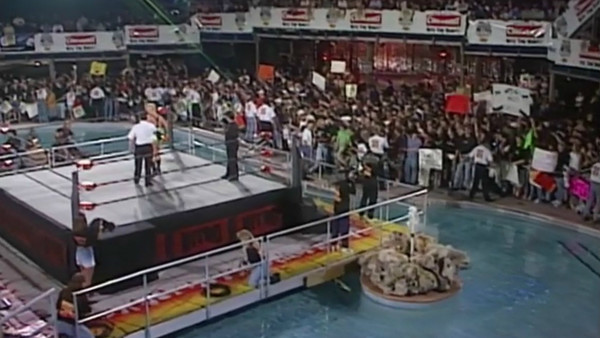
They mixed up the look of Nitro by playing before fired-up crowds in unique settings. In Panama City, for example, WCW placed the ring on a floating platform in a big swimming pool, and everyone watching knew somebody was taking a dip. Those spots added light relief to the product and, again, avoided routine tedium.
WWE has never done special episodes anywhere near as well. Their 'Old School' Raw are occasionally fun, but they're so formulaic by this point that they're barely a novelty. Thank God for AEW's Dynamite episodes on Chris Jericho's cruise earlier this year.
6. Nitro's New Look Was Welcomed
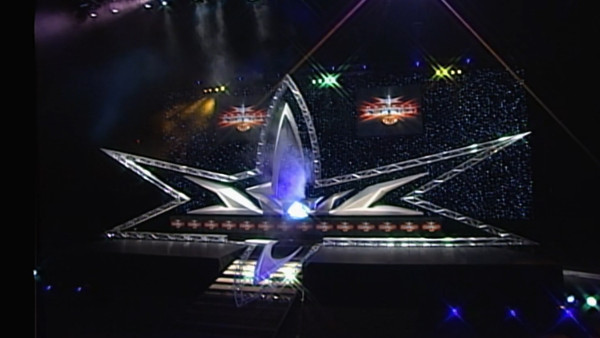
Fans weren't exactly chipper when WCW scrapped the classic Monday Nitro set and went with a new look on the 5 April 1999 episode. The more traditional stage set-up was replaced by what can only be described as a giant spaceship that was sort of/almost/kinda' shaped like WCW (or, at least, a big 'C' overlapping a big 'W').
People hated it at the time, and retrospect hasn't been kind to the replacement aesthetic. However, WCW had been using the same stage for years, so they were fully entitled to try something new in '99. It's not like WWE has kept Raw's set the exact same since 1993, so yours truly has always felt the backlash on WCW is slightly harsh.
Some were intrigued to see it at the time.
When you're rolling through every Nitro ever, it's a welcome change. Anyone who despised it didn't have to suffer the spaceship for long anyway; WCW went back to basics and changed the set again in 2000. Both tweaks freshened up the program.
5. WCW Created More Stars Than People Claim

Everyone has heard the same old stories for years, and WWE are happy to push them as fact - WCW profited from Vince McMahon's star-making abilities by poaching top names like Hulk Hogan, Randy Savage, Scott Hall and Kevin Nash. Without them, the revisionists say, the company wouldn't have come close to challenging.
There's a sliver of truth to that, but it doesn't tell the full tale. Trawling through the Nitro archives and watching everything the company tried makes it clear that they deserve far more credit for building stars than most are willing to give. Need proof? How about Sting's transition from 'Surfer' to 'Crow', or Goldberg's incredible squash match rise?
Then, there was Scott Steiner's change into a genuinely viable main event stalwart, and Booker T's journey from tag midcarder to headliner. Throw DDP into that mix as well. WCW also gave the likes of Chris Jericho, Rey Mysterio, Chris Benoit and more their first mainstream big breaks.
4. Some Episodes Were As Good As Pay-Per-View

It's not uncommon for episodes of Raw, SmackDown, NXT or AEW Dynamite to feature matches of pay-per-view quality these days. In fact, due to sagging ratings, WWE are throwing everything they can at some weeklies to try and coax fans back in. WCW did this when they arguably didn't need to.
Weirdly, during an era that focused on traditional buyrates, the company churned out some pay-per-view quality episodes of Nitro. By 1999, some Nitro broadcasts were actually better than most of the monthly specials, if only because they were offered for free on TNT and didn't cost a small fortune.
The quest for ratings supremacy increasingly trumped pay-per-view dollars from 1997 onwards.
That's why mega-matches like Hollywood Hogan vs. Lex Luger and Hogan vs. Goldberg were thrown out there on Nitro to provide a quick viewership boost. WCW's desperation becomes obvious when one creeps towards 2000; by then, there was little difference in quality between supershow and flagship.
3. Commentary Got Seriously Bad
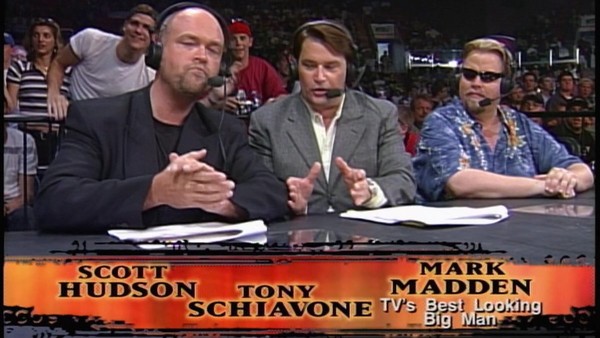
Eric Bischoff has always been seriously under-rated as a play-by-play man. Some probably didn't like his over-enthusiastic delivery or snide remarks about the competition, but Bischoff did everything in his power to put WCW over as a superior product to Raw. That's admirable looking back, and definitely preferable to what was ahead.
"TV's Best Looking Big Man" Mark Madden.
Bischoff, Tony Schiavone and others have defended Madden's smarky style as engaging and fitting for the time. It was fitting, but only because WCW stupidly thought that casual viewers cared about insider terminology or backstage politics when they were trying to zone out with a beer and watch some wrestling.
By the time Madden formed a three-man booth with Schiavone and Scott Hudson, all bets were off. Watch those guys wing their way through broadcasts and you'll be screaming for Bischoff, Bobby Heenan and Mike Tenay. Even Steve McMichael wasn't as irritatingly smart-assed.
2. The Final Episode Is Deceptively Emotional
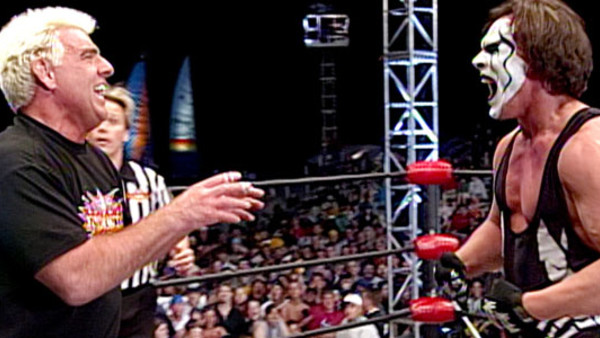
When this fan started reaching the end of 2000, he knew was what around the corner. The end was nigh for Monday Nitro, and a near 300-episode journey was coming to a close. As that final 26 March 2001 edition of Nitro started, a tear almost formed - the whole thing was deceptively affecting.
As much as he'd struggled to keep Mark Madden's insider stuff in check before, Tony Schiavone was the perfect soundtrack for that last Ric Flair vs. Sting bout. His passion shone through during Booker T vs. Scott Steiner too, almost like Tony knew this was the real end of an era for him as well as millions of others who had enjoyed Nitro.
After 287 episodes, the 288th feels like a funeral.
Nitro, a show that has burst onto the scene with so much life, began dying a slow death in 1999 that it never recovered from. In fact, there's an argument to be made that rot began to set in before that, maybe when Thunder debuted on TBS in early-1998.
1. 2000 Was Actually Kinda' Fun

This is, by far, the biggest realisation when re-watching every Nitro.
2000 was considered a laughing stock for WCW. Vince Russo's power-madness reached new heights, David Arquette won the World Title, the entire product rebooted with the 'New Blood' vs. 'Millionaire's Club' false dawn and every episode of TV seemed like it'd been written on a napkin in the middle of a hurricane.
Somehow, that 12-month nightmare was the most fun to return to. Nitro became so ridiculous and rubbish that it was hard to stop watching the writers (be that Russo, Eric Bischoff or anybody else involved) try to pull a watchable product out of the fiery wreckage they'd caused. By mid-year, you're almost begging for it to get even worse.
It does, and that's the best part. The second half of 2000 is the kind of fare that'd lead to endless '0 Ups & 98 Downs From WCW Nitro' articles today. It's glorious! Sometimes, bad wrestling is better than good wrestling, and Nitro's final full year is evidence of that.
Go and watch some of it. Not all, but some.
What are your favourite WCW Nitro memories? For more like this, check out 10 Things We Learned From A Genuine 1998 WCW Nitro Script and 10 Predictions For The State Of Wrestling In 5 Years!