10 Wrestling Storylines That Wasted Incredible Premises
In which the NXT invasion tanks.

You might expect the Nexus to appear on this list but, following Daniel Bryan's firing, the complexion of the stable wasn't exactly formidable.
The formation angle was a derangement of the senses laced with a legitimately dangerous energy, a tone expertly orchestrated by the disquieting manner in which the "Rookies" of NXT season one approached the ring. It was a great, incredibly inspired idea to have the Rookies turn on the system that had humiliated them, but they weren't a gang of studs that functioned all that effectively beyond angles. Some had much raw potential, others were limited, one was f*cking hopeless.
So how much of a wasted premise was that incendiary June 7, 2010 angle?
On strict principle, SummerSlam 2010 was trademark WWE short-term trash, but those in charge aren't quite a car full of dumbf*ck clowns, much as they do an impression of one most of the time. Maybe they knew of what would eventually happen; Wade Barrett had it in him to improve his physique, Heath Slater's endearing jobber essence was a bad fit for a stable built on intimidation, and Justin Gabriel wasn't particularly charismatic.
There are worse creative atrocities...
10. Sting Brings Down The Authority

The premise:
At Survivor Series 2014, Sting debuted in WWE to take down the Authority in an inspired continuation of his anti-nWo vigilante character. The Authority had destroyed, brazenly, any thin remaining notion of a meritocracy with insufferable, relentless condescension. They told us what was "best for business" in tedious recurring segments, which in storyline damned the surging crowd favourites (and reality, too, creating the first wave of nihilism from which no party has really recovered) - but Sting had descended from a position of judgement to damn them right back.
The scope for an epic saga was vast, one that might have culminated a year later in a traditional Survivor Series match fought between two teams led by the opposing establishment and anti-establishment. Sting's team, revealed over the months in the rafters as disillusioned, browbeaten midcarders - and later, emerging untarnished acts playing to the old, whose-side-is-Sting-on mystery - would overcome in a match with the ultimate stakes: ending the Authority and doing the exact same show but with a babyface General Manager.
The waste:
WCW sux lol.
9. The Higher Power

The premise:
The Undertaker claimed to serve a "Higher Power," and instantly, the imagination of fans leapt between Sid and Jake Roberts and any floating big name that wasn't tied to WCW nor the WWF. The jump was always so thrilling, and this was a role of considerable importance. Holy f*ckin' sh*t, dude: what if it was the Ultimate Warrior?
The waste:
Jesus Christ. This is always so needlessly difficult to parse because the answer is "Vince McMahon, even though it made no sense whatsoever". A story ridden with plot holes can't even develop a retrospective kitsch quality because Vince McMahon joined a union as it was going on, for f*ck's sake. F*ck that. So the Higher Power was revealed to be Vince. He had put his family under significant distress just to gain revenge on Steve Austin, but because of the satanic terrorism and sh*t, Linda and Stephanie pooled their shares to oust Vince from power.
"Higher power? More like, no power!" is what Linda would have said, were this penned in 2020, and imagine writing an entry on the Higher Power and being grateful for Vince Russo.
8. The Straight Edge Society

The premise:
A tremendous and perfectly in-character take on the justified-in-his-own mind heel trope, CM Punk's Straight Edge Society didn't even have to implicate the rest of the roster as druggies in the PG era. Punk, an exceptional promo, spoke in metaphor and subtext throughout his ill-fated 2009 programme with the Undertaker by comparing his parlour tricks to the ills of hallucinogenics.
The Straight Edge society symbolised the perfect contrast to earnest hero John Cena, which ultimately should have led to a grand - and vital - WrestleMania main event worked between full-timers. The top babyface and the top heel, as an exasperated Punk once ruefully said to explain his intended 2011 departure.
The waste:
Sinister psychological warfare was no match for a big mighty man.
Before its immense potential had even begun to unfold, a masked Punk was reduced to a witless bully when programmed with the Big Show - "You're not funny and nobody likes you" - and his unmasking, and stint with the mask, was sold as a punchline not unlike Kurt Angle in 2002 and Vince McMahon in 2007.
7. NXT Invades The Main Roster

The premise:
A storyline dreamt up by fans the very second NXT stood in awesome contrast to the main roster, the old philosophies that once divided Triple H and Vince McMahon would have made for incredible long-term storytelling. And we got it, ahead of last year's Survivor Series: Adam Cole defeated Daniel Bryan in a tremendous SmackDown main event to signal NXT's intention to emerge as the best, most dominant brand. WWE had positioned itself very well to tell the impossible story: an epic inter-promotional war entirely unaffected by the politics and sad flexing that damned virtually every other that had come before.
The waste:
This all unfolded in parallel with WarGames, which did not help no matter how subtly Tommaso Ciampa cast an eye towards "Goldie" when NXT presented an uneasy united front. That plot hole was a goatse, and the storytelling elsewhere was as nonexistent as the logic; beyond Seth Rollins and Kevin Owens, no inner conflict was explored, no jumps, swerves or turns teased. The Street Profits wore red - even though they'd worn yellow for 97% of their run - and not once was this questioned. They were Red Team!
WWE had the resources and full authorial control to tell an intricate, suspenseful saga with endless narrative permutations and match combinations, and they stuck a load of people in t-shirts and booked them in bland, unfocused brawls.
6. Vince McMahon's Illegitimate Son

The premise:
Can you imagine a good, impeccably built pro wrestler with the surname McMahon? One Vince McMahon might make some effort towards wishing a happy birthday on Twitter?
A dominant über heel, the embodiment of nepotism, rampaging through WWE like he was going to own the place? Who, through his bloodline, was given the grandest treatment ever afforded a WWE superstar in order to put over the favouritism angle? Like, just an absolutely f*cking insane amount of pyro, majestic entrance music, gear made entirely of gold? A preposterously committed mega-push?
That's what was made possible through the ingenious, quintessentially WWE idea to have Vince McMahon unknowingly sire an illegitimate son. Obviously, this was Mr. Kennedy's role before he sh*t-disturbed himself out of a job, but there was so much storytelling potential to explore: the mega push informed by favouritism, with McMahon Montrealing every match that looked to be going awry, a very suspicious #30 Royal Rumble entry, tensions with fellow prince Shane...
The waste:
Hornswoggle, 'cause they'd given up completely. A months-long mystery reduced to a punchline because they couldn't be a*sed to pay it off.
Sensational.
5. Kurt Angle's Illegitimate Son
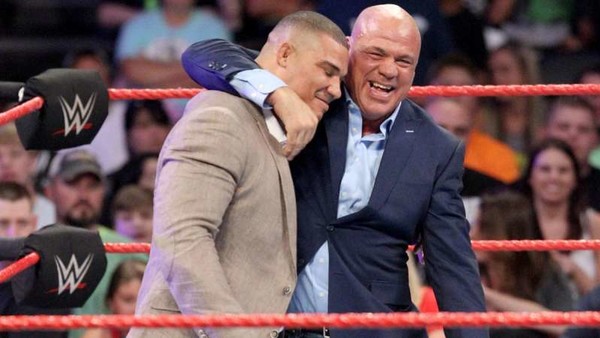
The premise:
The idea that it was too obviously not real to get over doesn't work since A) EC3 obviously wasn't Dixie Carter's nephew, but the act was so strong that it didn't matter and B) it's f*cking wrestling.
This storyline had enormous potential. Had they actually told it; the idea of Jason Jordan as a sly little sh*t eking out wins and playing dumb to his new dad to avoid punishment was in theory the perfect vehicle for Angle's trademark, piss funny obliviousness. Just imagine Angle confronting Jordan after a contentious win, appearing to look stern, only to ruffle Jordan's head with an "Attaboy!" because it was just the vacant quality Angle has about him at times. Mint.
Also mint: the idea of Angle deliberately playing dumb in cahoots with Jordan later in the arc, which in theory was another great vehicle for Angle's equally wonderful insincerity.
The waste:
None of this really happened even before Jordan's in-ring career was brought to an abrupt and sad halt; he mostly played a bland babyface who wanted to do his dad proud, which apparently involved hucking vegetables at Elias.
4. Daniel Bryan Vs. The Miz

The premise:
Daniel Bryan and The Miz despised one another - or did an outrageously good job of pretending to - personally and philosophically. Inextricably linked since Bryan's day one, their feud was bigger than the both of them, in a way; they each represented opposite ends of the shift that swept through WWE in the last decade. Miz was the smiling, slick telegenic company man who worked a style designed to withstand the immense demand. Bryan's pulsating artistry saw his career brought to a halt - a fact Miz later expressed with furious righteousness on a notorious 2016 edition of Talking Smack.
But then, two years later, Bryan embarked on an improbable, magic comeback. After a weird misstep of a diversion with Big Cass, it was on. Daniel Bryan Vs. The Miz: a programme so good WWE didn't even have to book it.
The waste:
Unfortunately, WWE booked it, and there was one good thing about it, one, when Miz replied with some rich visual poetry to Bryan's "Punch you in the face" threats at SummerSlam.
Elsewhere, there was some weird sh*te with a fake baby, a mixed tag that diluted the stakes, and they paid it off inside two minutes with a roll-up on a glorified house show in Australia.
3. The Summer Of Punk

The premise:
CM Punk, hardcore darling, articulates with savage precision the systemic issues plaguing WWE that led to his exit, thus becoming the voice of the voiceless before coining the catchphrase. He resolves to remove the WWE Championship from the waist of the gurning face of that system and take it with him in young retirement. This is thrilling, anxious stuff; we want Punk to stay, but we want him to defeat that system more. Money In The Bank is one of the all-time great nights; the match is a classic worked in a furnace, the result euphoric. All at once, the end is the beginning is the end; the catharsis only deepens the mystery. In one intoxicating presentation, WWE delivers everything one could ever ask of professional wrestling.
Now what?
The waste:
It's very naive to think that WWE would have its top title defended on a smaller, unaffiliated show now, much less in 2011, and so Punk didn't defend the title in ROH. But Christ, they didn't have to undersell every last story beat: WWE up and created a new title, Punk returned within eight days, and some very convoluted attempts to deepen the mystery followed to compensate - but "Is the very soul of WWE in the midst of transformation?" was rather more interesting than "Who texted Kevin Nash?"
2. The Bullet Club Civil War

The premise:
In a cracking slow-build that respected the intelligence of the dedicated Bullet Club fandom, the stable splintered very subtly in 2018 unbeknownst to the Elite, who were too absorbed in their own strife to notice an hilariously apathetic Tama Tonga no-selling a chair-throwing battle in their civil war. This was all phenomenally layered storytelling that only teased the agony of the unthinkable (brilliantly, in the case of Cody replacing the iconic, sacrosanct design in his own image).
The Elite never did explode, only threatening to throughout some incredible pro wrestling matches. At the G1 Special in San Francisco, Omega extended forgiveness to Cody after their main event. But, in a great twist, he offered it to the wrong party; Tonga, Tanga Loa and King Haku brutalised them in act one of a war that never made it to act three.
The waste:
The Elite left New Japan before it could conclude in any meaningful way, not that it had a strong chance of doing so. When he disengages troll mode, Tama Tonga is a very capable tag team wrestler, but his subsequent, deeply obnoxious G1 Climax run ruined what was only a tentative anticipation, given the huge gulf in quality and credibility between the two sides.
1. The Invasion

The premise:
The dream wrestling storyline nobody thought possible in waking life: the WWF Vs. WCW, at last, foreshadowed at WrestleMania X-Seven by a promotion at the pinnacle of its immense creative prowess. Steve Austin Vs. Goldberg! The Rock Vs. Hulk Hogan! The Undertaker Vs. Sting! A megastar-studded battleground the likes of which were unprecedented, all built towards via the compelling, twisting episodic television at which the WWF excelled!
Had WWE recognised WCW as a credible threat, or worked to get it back over, it might have worked. It did not.
The waste:
Bruce Prichard, as he is wont to do, didn't half talk some absolute b*llocks on WWE's Ruthless Aggression series. You can't simultaneously suck your own star-making process of the late '90s, only to then turn around and say "What could we do? WCW didn't have any stars!"
They did, but as Prichard pointed out, it was cheaper to pick the real ones up a year or two down the line following the expiration of their Time Warner deals. This lazy and cheap approach bred a level of disinterest so drastic it removed WWE from relevance, and for what?
The Two-Man Power Trip?