11 Worst Spinoff Factions In Wrestling History
For every D-Generation X and nWo, there’s an X-Factor and nWo 2000.

Wrestling fans have been subjected to some downright awful factions over the years. Vince Russo’s ‘Sports Entertainment Xtreme’ (aka S.E.X.) was not a particular highlight of TNA’s early days. The ‘League Of Nations’ in WWE existed just to give Sheamus, Wade Barrett, Rusev and Alberto Del Rio something to do on television. The less said about the pantomime theatrics with ‘The Dungeon of Doom’ in WCW, the better.
Do you even remember the nonsense that went into factions like Cosmic Wasteland, Thuggin' And Buggin' Enterprises and Misfits in Action?
It seems like for every truly great faction there was an equally terrible one ready to spinoff from it, with promoters trying to capitalize on milking once fantastic factions for everything they could. Sometimes companies were even hoping to mimic the same popularity and success with the spinoffs that the original factions once captured with fans. But the spinoff stables were often lacking the individuality and creativity that made their original counterparts so spectacular in wrestling. Fans would see through what they really were - knockoffs and rip-offs.
These are 10 dire factions creative went back to the well for to some dire results.
10. nWo 2000
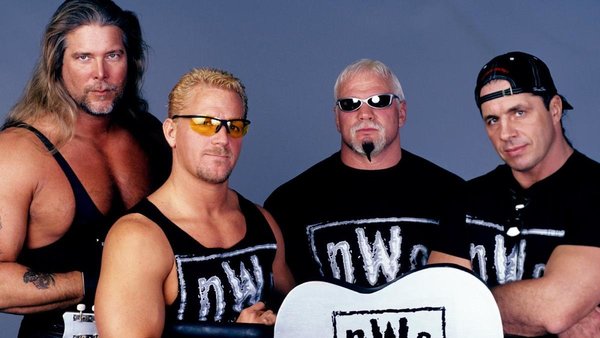
‘The Band is Back Together’ ran out of hits when ‘nWo 2000’ arrived in WCW toward the end of 1999.
nWo 2000 was just another one of many nWo spinoffs and parodies over the years. Like the bWo and lWo or nWo Wolfpac and nWo Japan, this was yet another offshoot of the original and legendary nWo which bastardized its name and aura.
With creative running dry on new ideas and Hulk Hogan donning the red and yellow colours once again as a babyface, WCW turned to Kevin Nash and Scott Hall to form a new incarnation of the New World Order with Bret “The Hitman” Hart and “Double J” Jeff Jarrett.
On Nitro, with Bret and Goldberg clashing over the WCW World title, Hall and Nash did a run-in and swerved the audience (bro) by siding with Bret and attacking Goldberg, with Jeff Jarrett following suit and smashing a guitar over Goldberg ally “Rowdy” Roddy Piper. Hart, Hall, Nash and Jarrett then did the classic spray paint and pose, signifying nWo 2000 had arrived.
Scott Steiner and The Harris Brothers would later join the group. When you think of ‘nWo’, Ron and Don Harris aren’t the first thing that comes to mind for most wrestling fans.
With its members not having much chemistry together and fans exhausted of seeing all the incarnations of nWo and lots of injuries piling up at once, the group thankfully folded after a few months.
9. The Union

The Union, or ‘U.P.Y.O.U.R.S.’ or ‘Union of People You Outta Respect, Son’, was a month-long faction in WWF that amazingly had the hodgepodge of wrestlers Ken Shamrock, Mankind, Big Show and Test coming together as a group to defy The Corporation, after feeling like Shane McMahon had gone mad with power since superseding Vince McMahon as its leader.
Their gimmick and abbreviated name has long been rumoured to be an inside reference to Jesse Ventura’s continuous fight to unionise pro wrestling.
The big issue with The Union was its members didn’t mesh well together, with all of them having different styles and personas. They worked better alone or in tag teams they naturally clicked with. The Rock 'n' Sock Connection and Jeri-Show this was not.
Other than a match at Over the Edge (1999) against Corporate Ministry members The Acolytes, Viscera and Big Bossman, The Union are a long forgotten part of the Attitude Era (for good reason).
After Vince McMahon revealed himself to be the higher power in The Corporate Ministry and with Mick Foley desperately needing knee surgery, the group quietly disbanded and its members went onto better things.
8. The Yamazaki Corporation
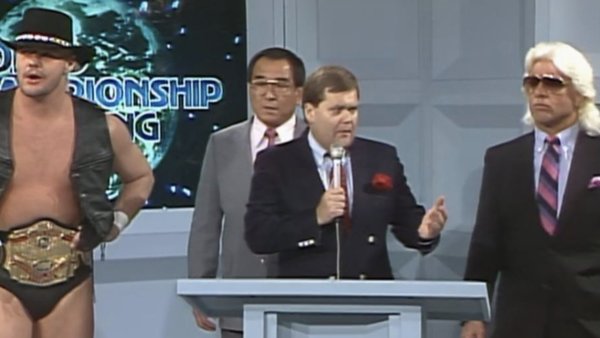
It’s agreed by many The Four Horsemen are the apex of wrestling factions, inspiring future grapplers like Steve Austin, Triple H and FTR to actually become pro wrestlers. The Yamazaki Corporation on the other hand inspired no one.
The Four Horsemen morphed into The Yamazaki Corporation in the late ‘80s due to circumstances behind the scenes, with Arn Anderson and Tully Blanchard quitting the NWA for the WWF, and J.J. Dillon later jumping ship there too to work as a front office executive.
The Road Warriors and Nikita Koloff were just some of the names suggested to fill the sizable gaps in the Horsemen but WCW went a different route. Old school wrestler George Scott was brought in to lead WCW creatively around this period, with him instead choosing to bring in his close friend Hiro Matsuda to manage the group, under the pretence Hiro bought out the remaining Horsemen contracts for Ric Flair and Barry Windham whilst representing a Japanese company called the Yamazaki Corporation. The idea was to play off Japan’s economic growth and buying sprees of American owned businesses and draw heat that way.
In their short run they brought in Barry’s younger brother Kendall Windham, Butch Reed and Michael Hayes as members, but they just couldn’t capture a shred of the magic the Horsemen could and did.
7. Harlem Heat 2000

There’s an argument Harlem Heat might be WCW’s greatest tag team of all time. They won the World Tag Team Championships an astonishing 10 times, tore it up in hellacious matches with The Nasty Boys, The Outsiders and The Steiner Brothers, and were inducted into the WWE Hall of Fame. ‘Harlem Heat 2000’ plays no part in their legacy though.
‘Harlem Heat 2000’ came to fruition after Booker T and Stevie Ray continuously argued on TV over female bodybuilder Midnight joining their group, which resulted in a match on Thunder between Midnight and Stevie. Midnight shockingly won with a small package and as per the stipulation of the match, Midnight could join Harlem Heat, which Booker T was lobbying for. Stevie didn’t take kindly to losing though, turning on them afterwards by laying them both out.
This would lead to Stevie going on to form Harlem Heat 2000 and Harlem Heat, Inc. with Big T (Ahmed Johnson), Kash (4x4 from The No Limit Soldiers) and J. Biggs (Clarence Mason). It was a mismatch of forgotten wrestlers exploiting the Harlem Heat name for all its worth.
As Booker T was climbing the ranks to win the Big Gold Belt as a solo competitor, Harlem Heat 2000 faded away into obscurity.
6. The Corre

Say what you want about The Nexus but they certainly made an impact in WWE in 2010. Wade Barrett led the team of hungry rookies in storming the ring in the famous angle to close Raw where they obliterated John Cena, CM Punk and anyone and anything at ringside. From that moment onwards, The Nexus were in central storylines and main events on pay-per-views for the rest of the year.
But Nexus would lose too many matches and too many members and too much momentum. When CM Punk took over as leader for The Nexus, Wade Barrett moved to SmackDown along with Justin Gabriel and Heath Slater. It was there that they formed the spinoff faction ‘The Corre’ with Ezekiel Jackson playing the heavy in the group.
Title wins followed, with Barrett winning the Intercontinental Championship and Heath and Slater winning tag team gold. But they were just too generic and it was evident they weren’t getting over to live crowds on TV. Unlike The Nexus, The Corre came nowhere close to headlining PPVs. After being severely beaten in an eight-man tag match at WrestleMania XXVII, The Corre broke up and went their separate ways.
5. X-Factor

X-Factor was supposed to playoff the colossal success D-Generation X had for the company the decade prior. They were led by X-Pac, who was an outstanding wrestler and contributed a lot to DX (and other factions like the nWo), but was never destined to lead a group on his own.
X-Factor kicked off their run when Justin Credible returned to the WWF after years spent in ECW and immediately beat up Eddie Guerrero on SmackDown with X-Pac. Albert, who had recently split from T & A, later joined the group as an enforcer.
They were left off the WrestleMania card, competing only in the dark match. They did feud with legendary tag teams The Dudley Boys and The Hardy Boys on PPVs that followed though, and even won some gold, with X-Pac scoring the Light Heavyweight Championship and Albert the Intercontinental title.
It wasn’t enough though. Everything that made DX rebellious and cool, X-Factor had none of that. They were lacking in entertaining promos and worthwhile storylines.
Thankfully the Invasion angle started a few months after they formed and Justin Credible left to side with ECW, effectively disbanding the X-Factor trio.
4. DOA/Los Boricuas

DOA and Los Boricuas were spinoffs from the Nation of Domination after Faarooq fired both Savio Vega and Crush. The Nation of Domination was an historic group dealing with sensitive racial prejudices and they jumpstarted The Rock’s career to superstardom. It’s safe to say DOA and Los Boricuas didn’t have the same kind of success.
Crush formed the Hells Angels biker inspired faction the Disciples of Apocalypse (DOA) with Chainz, Skull and 8-Ball playing his lackeys. It didn’t help that Crush left the group and WWF altogether after the Montreal Screwjob transpired, which led to the even less charismatic Chainz being promoted to leader of the group.

Los Boricuas was formed by Savio Vega, with Jose Estrada Jr., Jesus Castillo Jr. and Miguel Perez Jr.. Savio was the only star of the group, with WWF not even trying to get the other members over. And even then, fans were rarely reacting to Savio when associated with this lacklustre group and gimmick.
DOA and Los Boricuas wouldn’t do much of consequence other than feud against each other. Both teams did win an award though! Their feud against one another would be voted the ‘Worst Feud of the Year’ by the Wrestling Observer Newsletter.
3. The Oddities

The Truth Commission aren’t a particular high point of anyone’s wrestling fandom. They were a politically charged group that didn’t get over whatsoever with the WWF audience in the mid ‘90s. So you know a spinoff faction has to be bad when it spins off from an already terrible faction. Which brings us to The Oddities.
Don Callis as The Jackyl put together the freak show villainous group and labelled them "The Parade of Human Oddities”, with discarded wrestlers like Golga (John Tenta), Luna Vachon, Kurrgan and Giant Silva. Many believe they were a stable put together solely so Vince Russo could book them in angles with Howard Stern Show’s equally bizarre cast of characters - a show Russo loved and was hugely inspired by.
You would think for how bizarre they acted on TV The Oddities would yield some casual entertainment but they just made fans cringe in unison.
The Oddities would later be reintroduced as playful babyfaces. Golga got heavily into Eric Cartman this time around which was no accident given South Park was nearly equally as popular as the WWF was in the late ‘90s, and WWF were trying to milk their success too. It was a world away from when John Tenta was booked as a monster heel against Hulk Hogan in 1990.
Less than a year after they were formed all its members were released from their contracts.
2. The Corporate Ministry

The Corporate Ministry represented some of the worst writing and storytelling of the Attitude Era. Where Raw stopped being a wrestling show and somehow morphed into a theatrical gothic soap opera that was so convoluted it was hard to keep up what was actually happening on TV.
The Corporate Ministry materialized when The Corporation, led by Shane McMahon, and Undertaker’s Ministry of Darkness merged together to rule over the WWF. The rich and ruthless business centred Corporation and the eerie and dark gothic centred Ministry of Darkness joining forces didn’t make much sense. Regardless, they looked to take out Steve Austin together.
A nonsensical reveal by Vince McMahon to be the higher power in the group was the lowest point of it all. "It's me, Austin! It's me, Austin! It was me all along, Austin!" It ultimately meant Vince was the one responsible for having his daughter Stephanie McMahon kidnapped and nearly crucified/married to The Undertaker months prior.
Other than give the world GIFs and memes of Vince revealing himself to be the true higher power, it yielded little success.
1. nWo B-Team

Forget every other faction the nWo spinoff, this is by far the worst. Even the WWE’s version of the nWo in 2002 with Kevin Nash and Shawn Michaels that never took off produced better moments than anything the nWo B-Team produced.
They were lower card wrestlers labelled as nWo B-Team by other wrestlers and commentators on the show. Curt Hennig and Big Show monetarily being members was the only highlight. After that the faction had Stevie Ray, Vincent, Horace Hogan, Brian Adams and Scott Norton in the famous black and white colours to be.
They would often be mocked by Hogan and other members of the nWo Elite. When you’re getting mocked by Virgil for being a lower card nWo member you know you’re in trouble. There was little charisma in the group, with no one really caring. Even their theme song sounded like generic jobber music.
It’s hard to fathom how nWo at Bash at the Beach 1996 crumbled into nWo B-Team. But that was symbolic of WCW at the time, with the entire company crumbling around this time.