12 Most Historic Wrestling Moments That Happened In Las Vegas
AEW's launch is far from the only historic or even most important event to occur in Sin City.

Last Saturday saw the official launch of All Elite Wrestling with their Double Or Nothing pay-per-view from the MGM Grand Garden Arena in Las Vegas. The event represented a cataclysmic shift in the professional wrestling landscape with the start of the first major alternative - and possibly even competition - to WWE since World Championship Wrestling's closure in 2001.
While the monumental show was the most recent history-making moment to emanate from the proverbial Sin City, it was by no means the first. Interestingly, Las Vegas has played host to a number of important events over the course of multiple wrestling eras through the decades.
Beyond AEW's birth, the Nevada city has also witnessed the slow deaths of WCW, the American Wrestling Association, and even Hulkamania's original run. Furthermore, it's been the home of memorable milestones from CM Punk's shocking "pipe bomb" to the announcement of the WWE Network. In fact, the city in the desert was even ground zero for WWE's first step in its ascension to global dominance.
With that, let's take an in-depth look at the most important wrestling moments to happen in Las Vegas.
12. The First-Ever RAW Roulette Gives Us TLC IV

October 2002 saw the first-ever edition of RAW Roulette, as WWE’s flagship show was broadcast from Las Vegas. The brand’s then-GM, Eric Bischoff, oversaw an entertaining and memorable episode as each match’s stipulation came at the mercy of a spinning wheel. The main event ended up being a Tables, Ladders, and Chairs match - only the fourth in company history at the time - for the World Tag Team Championships.
Unfortunately for the reigning title holders, Kane was forced to defend the belts alone against three other teams after his partner the Hurricane was attacked backstage earlier in the night. The TLC bout which lasted twenty-five minutes - the longest to that point in time - saw Kane successfully overcome the odds as he retrieved the titles that hung above the ring.
The triumphant moment was soured as the night ended with Triple H's reveal that the Big Red Machine had killed Katie Vick in a continuation of that abysmal storyline. Still, this unique episode of RAW has proved not only memorable in subsequent years, it also started an intermittent tradition of Roulette-themed episodes with the last taking place in 2013.
11. Halloween Havoc's Home For Five Years

Halloween Havoc emanated from the MGM Grand Garden Arena from 1996 to 2000. In that time, Las Vegas saw many of WCW’s greatest matches during their ascent to dominance, as well as the company’s fall from grace on the road to closure in early 2001.
1996’s pay-per-view saw Hollywood Hogan confronted by a debuting Roddy Piper whose rambling promo went on for so long that the show ended before he could finish. The next year saw Rey Mysterio and Eddie Guerrero meet in what is still often heralded as the greatest cruiserweight bout in history but the night was again marred by Piper and Hogan's saddening "Age in the Cage" main event.
1998 featured the laughable meeting of Hogan and the Warrior in which a mistimed fireball exploded in the nWo leader’s face. Unfortunately, things got worse as no one outside of the arena saw the thrilling main event between Goldberg and DDP because the pay-per-view ran over its allotted time and was cut just as the opening bell rang.
The following two years further showcased WCW’s desperate flailing as they were then solidly losing to the WWE. In all, a look at Halloween Havoc’s five-year run in Las Vegas acts as an overlook of the company’s arc from rising competitor to reigning champ to laughable failure.
10. The AWA's Dying Days At The Showboat

The American Wrestling Association, under the guidance of owner and veteran star Verne Gagne, was once in contention to become the largest promotion in the country. Based out of Minnesota and selling out arenas throughout the 1970s and early 1980s, the AWA had an impressive roster of Jesse Ventura, the Rockers, announcer 'Mean' Gene Okerlund, and Hulk Hogan fresh off Rocky III, among others. However, crowds quickly soured on Verne’s reluctance to fully commit to Hogan as champion and the majority of the AWA’s stars soon left for the World Wrestling Federation.
By the late 1980s, the AWA’s weekly television program was broadcast on emerging sports network ESPN from the Showboat Casino in Las Vegas. The show was a sad affair with half-empty and unenthusiastic crowds watching the likes of an already aging Sgt. Slaughter, the unwanted cheap heat of Colonel DeBeers, an up-and-coming but unproven Curt Hennig, and the always-pushed but never deserving Greg Gagne.
The company once poised to lead the wrestling boom of the 1980s had fallen far and fast, and the AWA’s slow death was on full display on national television in an unpleasant reminder of what could have been.
9. Hulkamania's Last Gasp In The Federation

Often lauded as one of the worst WrestleManias in history, the event emanating from Caesars Palace is largely regarded as such because of its ending. Bret Hart, then the newly christened leader of the budding New Generation era of WWE, was completely overshadowed by Hulk Hogan. By this point in time, the Hulkster had been teasing his retirement since the previous year, prior to his 'Mania VIII match against Sid Justice.
However, when Hart was cheated out of his championship by Yokozuna and Mr. Fuji, Hogan suddenly appeared at ringside to avenge the blinded and beaten Bret. And he did so in a mere twenty-two seconds to kickoff a then-record fifth reign. While the fans that lined the bleachers which had been erected in the casino parking lot roared, the backlash from those watching at home was immediate.
The event may have ended with Hulk once again standing tall - complete with hotdogging and grandstanding as he posed in the ring - but WrestleMania IX has since come to signify the last sad hurrah of the Hulkamania era in the Federation. All of which was further marred by Hogan's refusal to face Bret Hart and officially pass the torch as originally intended.
8. The Rock And Steve Austin's WrestleMania Rematch Made Inevitable

By February 2001’s No Way Out pay-per-view, it had already been determined that 'Stone Cold' Steve Austin would be heading to WrestleMania to challenge for the WWF title after he won that year's Royal Rumble match. Having sat out the previous year’s event due to his neck injury, surgery, and lengthy recovery, Austin's Rumble win began his re-ascension to the top of WWE.
What was unclear, however, was who exactly the Rattlesnake would face come WrestleMania as reigning champion Kurt Angle first had to defend his title against The Rock in Las Vegas. While Austin spent the night in Sin City wrapping up his feud with Triple H in a Three Stages of Hell bout, the pay-per-view ended with The Rock again in possession of the WWE Championship.
It was finally clear that the Federation's two biggest stars would again do battle for the company's top prize at WrestleMania - as they had done two years prior. However, this time was different, as not only were both men now fan favorites, but 'Stone Cold' had arguably been usurped by The Rock as the fan's beloved hero during his absence. While that all came to a head at WrestleMania, it was in Las Vegas that the seeds were initially sown.
7. The First Mae Young Classic's Finale

In 2017, WWE’s first-ever all-female tournament saw competitors from all over the world descend on Florida’s Full Sail University. It was there that thirty-two women - including the likes of Rhea Ripley, Candice LeRae, Toni Storm, Mia Yim and former Straight Edge Society member Serena Deeb - fought their way through the opening rounds.
However, the inaugural Mae Young Classic’s final round didn't happen in Florida. Instead it was broadcast live on the WWE Network from Las Vegas’ Thomas and Mack Center.
Shayna Baszler had dominated her way to the tournament’s apex, making every one of her opponents submit en route. Meanwhile, Kairi Sane’s road to Sin City was far rougher as the Japanese native struggled against the likes of Toni Storm’s power advantage and the surprising tenacity of newcomer Bianca Belair.
In Las Vegas, Sane managed to once again overcome the odds when she defeated Baszler in just over twelve minutes to become the first Mae Young Classic winner. It was a surprising end to an historic tournament that showcased some of the greatest female talent from across the world.
6. "The Greatest" Is Born When Muhammad Ali Meets A Legend

The birth of Muhammad Ali's bombastic and charismatic public persona may not be a wrestling-centric moment but was in fact rooted in wrestling. Often declaring himself "The Greatest", Ali made use of wrestling tropes throughout his career as he cut promo-like interviews on countless opponents and naysayers. However, the champion boxer's gift of gab was more of a learned skill than an innate one.
Early in his career - fresh off of winning an Olympic gold medal and still known as Cassius Clay - Ali had a chance meeting with one of wrestling's most iconic performers, the great "Gorgeous" George. The two were both in Las Vegas on the same weekend in June of 1961 for marquee bouts - Ali against Duke Sabedong and George facing off with Freddie Blassie. At a radio station together to promote the bouts, Ali marveled at George's over-the-top bragging that drew not only the ire of wrestling fans but also their money in record ticket sales.
Interestingly, years later when Ali fought Antonio Inoki in a disappointing spectacle, he was cornered and managed by Blassie - crediting the "Classy" one with inspiring his charismatic caricature during that time. But it was actually "Gorgeous" George that set him on the path toward becoming the "G.O.A.T." outside of the boxing ring and helped shape the popular culture icon he became.
5. The AJ Styles Vs. John Cena Dream Match Becomes Reality

For over a decade, John Cena and AJ Styles had traveled similar yet divergent paths. Cena had been the WWE’s golden boy and top dog since 2005, while AJ Styles had been TNA’s breakout homegrown star since the company’s inception in 2002. Each man embodied their respective promotions, and as a result, a match between the two was the ultimate fantasy for many fans.
By 2016, however, the match was not only possible but made inevitable with the two finally scheduled to meet at June’s Money in the Bank pay-per-view. Las Vegas’ T-Mobile Arena played host to a long dreamed fantasy become real as Styles and Cena finally squared off in a WWE ring. For twenty-four minutes they battled back and forth with Cena kicking out of a Styles Clash, and AJ kicking out of an Attitude Adjustment. STF and Calf Crusher submissions followed but still weren’t enough to subdue either competitor.
Styles then scored the victory with help from his Club running buddies of Luke Gallows and Karl Anderson. The feud many thought impossible then continued through the summer, but Vegas saw the first-ever meeting of the two biggest stars of the modern era in a truly surreal and monumental moment.
4. CM Punk's Earth-Shattering "Pipe Bomb"

There’s not a moment more memorable, jaw-dropping, or infamous in WWE over the past decade than CM Punk’s instantly classic “pipe bomb" promo. Adorned in a "Stone Cold" Steve Austin shirt, he sat on the RAW stage and lambasted WWE, its fans, and its owner before his microphone was cut and the broadcast quickly went to black. The seemingly off-the-cuff and rebellious act quickly garnered mainstream attention for both Punk and the company.
Unfortunately, while the short-term impact was huge, the long-term influence proved far less grand. What should have begun a new era for WWE and launched the Straight Edge Superstar into the stratosphere was quickly derailed by Punk's lackluster and uninspired feuds with Triple H and even a returning Kevin Nash. By 2011's end, while he'd become a permanent marquee fixture, Punk still found himself playing second fiddle to John Cena, The Rock, and others.
The “pipe bomb" should have been the catalyst for great things in WWE but it ended up proving the company was largely unwilling to change its course. In hindsight, the moment has proved historic for its followup being mishandled in a move indicative of many of WWE's current problems.
3. The WWE Network Is Launched At Consumer Electronics Show

The WWE Network had first been advertised back in 2011 and promised to launch the following year. However, it wasn’t until 2014, during an exposition at the annual Consumer Electronics Show in Las Vegas that the WWE Network officially launched.
While iPPV and internet streaming for certain events had been around long before the Network, the launch of WWE’s own over-the-top platform was a game changer for the wrestling world and quickly revolutionized the industry as a whole. Nearly overnight, wrestling’s reliance on traditional pay-per-view was gone. Instead, for less than ten dollars a month, fans could now have access to each special event throughout the calendar year as well as to the entire video libraries of WWE, WCW, and ECW.
The unprecedented Network quickly paved the way for and gave rise to a plethora of other wrestling streaming services from companies like New Japan, Ring of Honor, and IMPACT - with individualized “networks” now the norm. However, with approximately one and a half million subscribers, WWE is the undisputed king of the hill.
2. WCW's "Big Bang" Dies With A Whimper
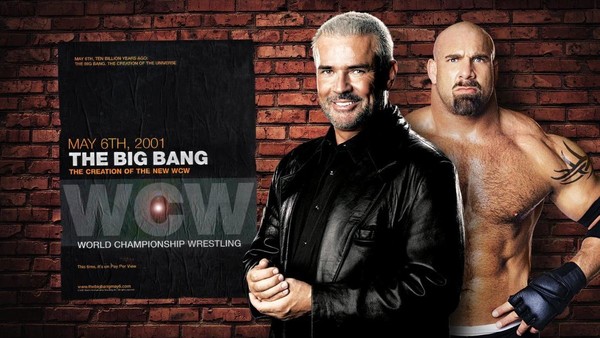
Unlike the other memorable moments on this list, WCW’s "Big Bang" is historic for not actually happening. Despite World Championship Wrestling’s continued failures and ever-declining popularity by 2001, the company still had a chance to reinvent and revitalize itself.
Before the company’s assets and tape library were sold to Vince McMahon for pennies on the dollar, Eric Bischoff was angling to outright buy the promotion himself. A deal had been set up and all but signed between WCW and Fusient Media Ventures - a venture capital group orchestrated by Eric. In fact, the purchase had been announced on WCW’s website and its Monday Nitro program. A subsequent advertisement for the pay-per-view relaunch of the company appeared in USA Today.
Unfortunately, the "Big Bang" was not to be. Turner executive Brad Siegel had cancelled all wrestling programs on the network's channels causing Bischoff to abandon his planned purchase of WCW. The "Big Bang" could have potentially been the moment WCW climbed its way out of the doldrums and possibly even back to the top. Instead, it has gone down as one of the greatest what-ifs in wrestling.
1. Vince McMahon Withdraws From The NWA Ahead Of National Takeover

1984 saw Vince McMahon and the World Wrestling Federation launch to national consciousness thanks to the rise of Hulkamania. It was the year that laid the groundwork for WrestleMania and the WWF’s official takeover of the national wrestling scene.
However, McMahon’s national expansion was actually kicked off in a Las Vegas hotel the year prior. Unbeknownst to many, Vince Sr. had rejoined the National Wrestling Alliance board in 1971, and his son’s first show of independence upon purchasing the Federation was to once again and finally withdraw from the Alliance. In 1983, Vince - with his father and Jim Barnett alongside him - strode into the NWA’s annual meeting of promoters and announced to everyone in attendance that the WWF would no longer be part of the Alliance.
It was a power move in what would soon become a war for territory as Vince expanded his Federation across the nation. Frankly, there is no one moment more significant in wrestling history than the day Vince McMahon took the first step on the path to WWE's current status as the undisputed champion of the industry.