14 Ups & 4 Downs For AEW In 2020
In which Jon Moxley, Kenny Omega, and so many other men ascend to greatness. But the women...?
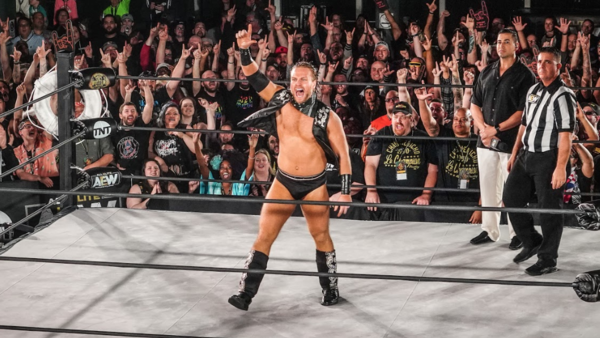
This is a take that won't do away with those bias accusations, but f*ck it: a list like this can't just comprise of moments of individual brilliance, because we'll all be here longer than it takes MJF to cut a promo. Those promos are still pretty good, MJF, and don't worry! You'll get the praise you long for imminently!
Just consider the abundance of low key wonders to illustrate that point:
Hangman Page swigging from a pitcher in a marvellously irreverent sight gag; a remarkable spree of ****-level TV bangers so consistent that greatness has become the norm (PAC Vs. Darby Allin; Le Sex Gods Vs. Best Friends; Ricky Starks Vs. Darby Allin; so many more); Chris Jericho calling Vanguard a "piece of sh*t"; the initial presentation of Anna Jay and how that fed so perfectly into the turn and the insidious motives of the stable that led her astray; Lance Archer sending some poor motherf*cker head-first into a ceiling; Wardlow taking down Luchasaurus with a flying headscissors; Marko Stunt dying, RIP, in a pair of ghoulish squashes; Chris Jericho blasting Clownico le Clown flush in the temple with the Judas Effect; Fénix taking your breath away every time he stepped in the ring; Sammy Guevara eating a superkick from a springboard in an all-timer of a sell; Orange Cassidy's iconic smirk in the face of PAC, who almost broke into a smile himself just like everybody else did.
AEW is better than even the more positive critics receive it. But it's not quite perfect.
Downs...
4. Matt Hardy's Run
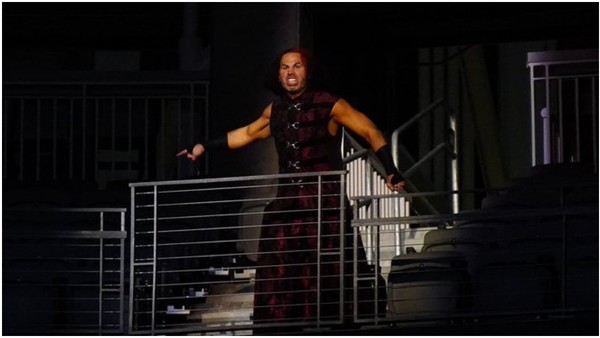
AEW is the self-styled buffet of professional wrestling, but Matt Hardy and his BROKEN universe has always felt incongruous to it. AEW promised a variety of disciplines presented under a meaningful sports-adjacent framework captured with an acknowledged camera. You get lucha libre. You get the best of the hybrid modern style. You get blood, guts, and brawling.
You get the full professional wrestling on TV experience: great promos, great angles, great matches, great hooks.
Hardy's heightened gimmickry feels less like a classic staple WWE abandoned, and more like a passé trend that felt far more ancient than the Dog Collar and the whip-lashing because the BROKEN Universe is not timeless.
Even when not visited by disaster, Hardy's in-ring suffered. He worked a dud with Santana and only approached the gentleman's three with Sammy Guevara. The run wasn't an unqualified disaster - Hardy was terrific value in the build towards and at Double Or Nothing itself - but the character was untenable (and unwanted) in this context.
But, as you'll read, Hardy has recovered - and that Up has more weight than this Down...
3. Miro's Run

The storyline - Twitch streamers pal up! - is more cute than it is effective.
Miro hasn't transcended this weird soft launch in the ring, either; his debut tag match bordered on the calamitous, he didn't elicit the same perverse thrill as Lance Archer nor Mr. Brodie Lee in the subsequent attempted make-good squash, and his first singles match with Trent while pretty good didn't approach Dynamite's high-end average. Ultimately, Miro didn't grab the brass ring he spoke of on his debut, the ill-advised and clichéd tone of which only brought into focus that he possibly wasn't blameless for the middling twilight of his WWE career.
AEW's expressive platform is crucial and more often than not strikingly effective, but "dude who plays video games" doesn't yield much in the way of drama. Really, who gives a sh*t if his arcade game got broken?
That a stakes-devoid angle has somehow extended over months with no payoff in sight is another minor Down. Tony Khan is ordinarily lightning-quick to make matches based on the merest whiff of an angle elsewhere.
Miro's run, in addition to being whiffed in itself, underscores a lack of consistency in AEW's otherwise meticulous world-building.
2. All Out*

* to an extent.
AEW is the good mainstream North American wrestling company. AEW holds itself to a very high standard.
All Out fell well short of it.
All Out was not a terrible show. It was a good-to-great show when it peaked. But it was wildly uneven, sequenced badly, and the disaster it invited too readily engineered an eerie downer of a vibe that undermined what was great.
Jon Moxley Vs. MJF was f*cking great. A philosophical battle told with such depth and intelligence that it perfected a story uneven in the build, the tactical gamesmanship erupted into a fantastic, full-on brawl that legitimised the challenger's prodigy persona. The subdued atmosphere that met Hangman Page and Kenny Omega Vs. FTR only slightly detracted from the agonising implosion of the babyface Champions.
Mimosa Mayhem felt tonally strange in the semi-main. The Casino Battle Royal was an over-thought and overlong mess. Matt Hardy turned purple and was inexplicably allowed to continue following his terrifying and concussive (?) stunt bump. The question that lingered over his injury sat as uneasily as the distressing incident itself. This was a huge indictment of AEW's medical protocol.
All Out itself was the natural culmination of Dynamite's uneven summer period and thirst for danger.
1. The Women's Division
Consider this: Miro's run has underwhelmed, but AEW has at least tried. A connection was made between two men you'd never have thought to programme together in Miro and Kip Sabian, and AEW has arrived at both an inevitable ratings smash and a long-term persona for the former Rusev with the whole 'Best Man' deal.
It could almost be classed as a noble failure.
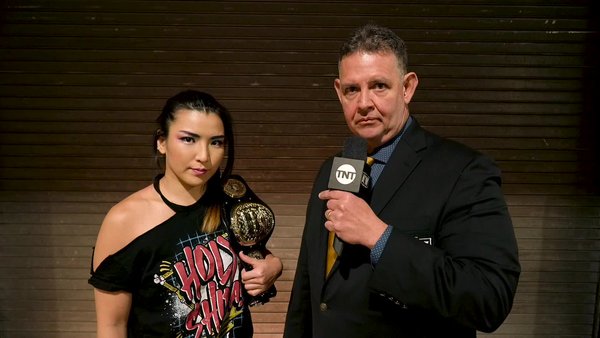
This level of detail - at which AEW has excelled to an unprecedented level elsewhere - does not apply to the Women's division. Much of the roster is green, and is as unable as AEW is unwilling to break the penultimate segment paradox: they are allocated limited time because they are limited, but they won't get any less limited with such limited time.
This stasis is halfway understandable - the immensely marketable and honed Riho and Yuka Sakazaki are locked down in Japan - but then, little attempt has been made to accentuate the positives and hide the negatives.
More damningly still, the meritocratic ideal that saw John Silver work Full Gear where Miro did not doesn't apply to the women, either. Penelope Ford worked an awesome and creative match with Hikaru Shida at Fyter Fest. In AEW, breakthrough performances are rewarded. This wasn't.
That's an indictment.
Ups...
14. Dr. Britt Baker, D.M.D.
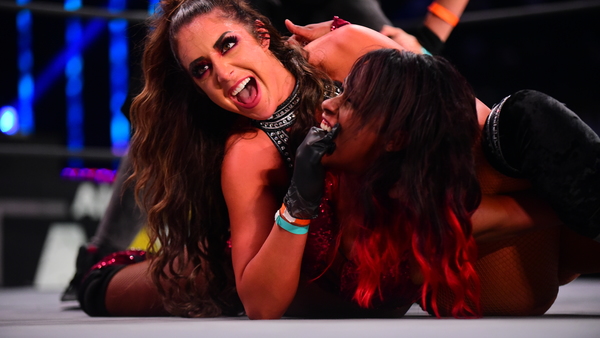
The hope amid the futility, Dr. Britt Baker has enjoyed an exceptional 2020.
She turned heel on the Jericho Cruise and proceeded to cut some of the best heat-seeker promos of the year, which is honestly outrageous, given the incredible crew of talkers in that company: Moxley, Cody, Chris Jericho, Taz, Eddie Kingston, Brandi Rhodes, Tully Blanchard, Ricky Starks. MJF tries really hard, too.
Britt radiates entitlement and insincerity to near-total perfection, and while she deserves the credit - that eye-roll.gif was so goddamn great for how OTT it was - AEW deserves a portion of it for not persisting with the barefaced marketing onslaught of 2019.
Britt has refined an act that she didn't need to, really. It was over, hilarious, and it got her TV time. The idea that she scrolled through Michael Jordan's Wiki, bored by greatness, and thinking he made his great comeback as a Washington Wizard was beautifully layered comedy.
But that's not what elite talents do; she returned from injury, dropped the broad midcard elements, and resurfaced as a legit dangerous in-ring competitor to make that inevitable title win resonate all the more.
Her match with Hikaru Shida in QT Marshall's gym was a level beyond triumph; with her nose busted, she relished the fight and condensed about two years of improvement into one super-dramatic finishing sequence.
13. MJF's Evolution To Bonafide Main Event Superstar

In 2018, MJF was such a mainstream unknown that his unannounced All In appearance was met with bafflement.
In 2019, MJF proved why he merited the spot by rattling off a deluge of piss-funny slick-tongued promo gold in which he got over as a despicable little f*cker too funny to hate, but you still hated him, and how impressive was that for a 21st century heel?
But questions remained over his in-ring ability.
That they did must have powered MJF's unbearable smugness; he answered them in supreme fashion in 2020, in which, highlighted by his stunning loss to Jon Moxley at All Out, he worked a pair of incredible bangers with Jungle Boy.
He doesn't just very, very creatively work excellent symmetry spots to get over the idea that Jungle Boy is his peer as a prodigy; he does so with an arresting fury that somebody might be as good as he is, never once betraying his heel persona with electrifying in-ring content. He could reheat Jungle Boy with a quick kiss of the ring, too, which says so much about his future Ace potential. But while he can go, and go hard - and he can draw too, looking at that All Out number - his greatest gift is his crucial ability to drop an intriguing TV hook literally every week.
The nicest thing one can write about a complete attention-seeking jackass is that he's currently working a programme with Chris Jericho - the premise of which is that he's overtaking the legend as his equal - and it is 100% convincing.
12. The Unbelievable Heft Of The Elite Saga

Following Winter Is Coming, every original member of the Elite held World Title gold.
This was the dream, and in fact the fully realised answer to the question with which a rebooted AEW began the year: for the men who changed professional wrestling to dominate it. That this development unfolded in parallel with Dynamite defeating all three hours of WWE Monday Night RAW was as poetic as it was evidence - even proof - of every breath of praise directed towards them.
But Kenny Omega, Hangman Page and the Young Bucks are the masters of details-rich, episodic storytelling. This eventual triumph arrived at a cost. The quest for redemption mutated the dynamic and created a path towards another full year of unprecedented pro wrestling storytelling.
FTR shattered a splintering unit by manipulating Hangman Page with a sinister, savvy friendship ploy: the alcohol that always disgusted his teetotal friends. The Bucks struggled between jealousy and vicarious joy at Page's World Tag Team Title triumph, pulling further at the thread. Eventually, following the events of All Out, a betrayed Omega snapped it entirely to become the Ace. But Page didn't turn heel. He's not a bad man. There was no cartoonish binary to any of this.
He is a flawed man plagued by anxiety and self-doubt - that's why he slapped in for the hot tag at the finish, he was never interested in glory, only validation - but that wasn't enough to subdue the growing megalomania within the Cleaner. He was now so desperate to overcompensate that his collector persona is separating him from the Bucks.
To arrive at these respective points in AEW's core overarching story - while dovetailing between so many intriguing developments, like Jon Moxley's attacker, Page joining the Dark Order, the Bucks being challenged by so many emerging new disciples - is a level of epic, expansive storytelling no other wrestling promotion has ever achieved. The Elite are pioneers of the business.
The creative, too, will shape the complexion of the future.
11. Cody's TNT Title Run

The design of the plate mirrored the subsequent arc: it was unfinished, unvarnished, and earned the prestige that was ultimately decorated upon it.
Cody Rhodes made a pro wrestling title because the man makes the title. Cody was the man, the constant in a sometimes uneven summer, and this run cemented his rep as an Elite-level talent.
He gave Marq Quen the best singles match of his life by encouraging him to explore the depth of his range beyond the fireworks. He coaxed an aggression and emotion from Sonny Kiss. In an all-action thriller pitting intelligence against brute strength, he got the best AEW effort yet out of Jake Hager. His handsome flexing battle with Ricky Starks earned his opponent a contract. The same thing happened following his beautifully ugly war with Eddie Kingston.
Both matches made a total mockery of the idea that Cody buries his opponents by accomplishing the precise opposite of a burial.
His selfless work in both defeat and victory created an aura around Mr. Brodie Lee that hardcore fans had always projected onto him, and, in a classic with Darby Allin at Full Gear, Cody wrapped up a legacy programme to put over AEW's big in-house project huge.
10. Bringing Back Tag Team Wrestling, And How

AEW promised to bring back the greatness of tag team wrestling. They didn't do that in 2020.
They elevated the art form to a new realm of acclaim and importance.
Though no World Tag Team Championship match headlined any AEW pay-per-view, at Revolution, All Out and Full Gear, the doubles gold was contested in the longest matches of the night, allowing the full, unprecedented scope of its storytelling to reach a new stratosphere.
Kenny Omega and Hangman Page Vs. The Young Bucks was the best match of the year and the best match in the history of the genre: a masterpiece driven by textured emotion driven by state-of-the-art exhilaration in which Omega, a genius, foreshadowed his heel turn by performing the year's greatest moment of babyface fire. He kicked out of the BTE trigger, but in doing so, cared so much more about Kota Ibushi than his own partner.
FTR Vs. the Young Bucks meanwhile was a masterpiece driven by philosophy; pitting the best cut-off guy against the best hot tag guy, the dream match lived up to its promise with a pulsating battle of curriculums in which Cash Wheeler betrayed his own to put the new school over.
On TV, meanwhile, AEW promoted countless superb tags that, if the format didn't allow for such depth, did allow for mind-melting excitement (Young Bucks Vs. Top Flight), the sort of meaty piss and vinegar AEW didn't do enough of last year (FTR Vs. The Butcher & The Blade), and a platform on which to tell chapters in long-term stories without relying on exposition nor burning through the destination (the Tag Team Gauntlet of August 27).
9. The Build To Revolution
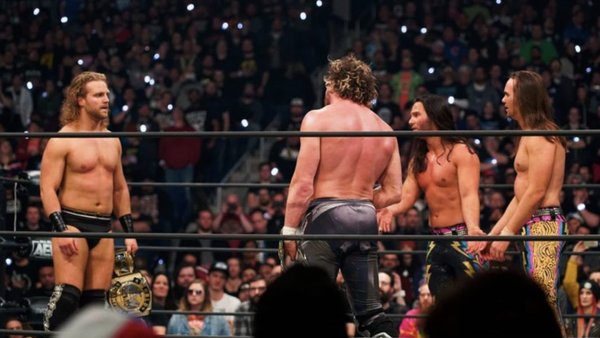
The build towards Revolution marked the very best stretch of episodic pro wrestling TV ever. A feeling of must-see euphoria swept over pro wrestling in February 2020. But that wasn't all.
Listen to the reaction that descended over Austin, Texas when MJF emerged to defeat Jungle Boy. That elusive, earnest heel heat captured and intensified the feeling of anger the Alabama fans felt when MJF lashed Cody's back in a test of his mettle. He had passed - after Wardlow lacerated his shoulder blade - but MJF in a scorcher proved himself an in-ring wizard as much as a sociopathic piece of sh*t. The layers of drama AEW built towards the most unpredictable big-time grudge feud in years were endlessly compelling.
Hangman Page and Kenny Omega evolved - much to the not-so-quiet disgust of the Young Bucks - to become the best tag team on the planet. Their own inner conflict - who really was responsible for their success? - added another wrinkle to what became a must-see saga.
Jon Moxley had to run through the Inner Circle. He did so, because the guy could pull it off, wearing an eyepatch and driving a stolen sports car - two developments that matched the aesthetic of two special shows, both of which added so much personality and pizzazz to the spectacle.
This brilliance wasn't just contained to the road to Revolution, though that was the peak.
There's nothing in pro wrestling like the big-fight feel AEW engineers ahead of its major shows through its meticulous long-term storytelling vision.The idea, and it has been articulated to incredible effect, is to ramp up and deepen the all-important sense of anticipation. You are to spend so much time wanting to see the big matches that spending the money to do so becomes a given.
The undercard unleashes constant big bangs of storytelling that, naturally, create stars. The second-annual Dynamite Diamond Battle Royal sparkled with deft and loaded storyline development. There's always an angle, a hook, a conflict - there is always a reason to watch. All TV functions to make you want to watch more adverts, if you want to be reductive and cynical about it. AEW does it to, yes, restaurant-quality standard.
The world went to sh*t almost as soon as Revolution faded to black.
AEW still delivered to shovel themselves out of it...
8. Perfecting Pandemic Wrestling

All pandemic wrestling is bittersweet. Well, virtually all of it.
Every company to varying extents has produced excellent matches in spite of the most suboptimal conditions ever faced by the industry. But AEW has pioneered and perfected the imperfect, firstly by installing talent at ringside to emulate the noise of a live crowd. That reports of AEW morale are generally very high helped get over the idea that they were enthusiastic, and moreover, AEW utilised this device to drive various angles.
But it's not just Austin Gunn, a man who deserves an honourable Up unto himself. AEW on three separate, glorious occasions conceived matches they likely wouldn't have, were it not for the pandemic.
Faced with deafening silence and depressing space, the company extracted opportunity from crisis.
The Elite defeated the Inner Circle at Stadium Stampede, in which 10 creative workers, some the most creative in the history of the business, utilised a football stadium as an epic blank canvas on which to paint a masterpiece of creativity and improbable levity.
Secondly, the Young Bucks and the Butcher and the Blade beat the sh*t out of one another where the punters would have congregated in the old world. They weren't there now, so why not send the Blade up an escalator? Why not use that space to work a wild, madcap brawl?
Thirdly, in one of the best brawls ever, the Best Friends and Santana and Ortiz worked a brutal and fabulously constructed Parking Lot fight so brilliant in how understated the actual wrestling was.
A ***** match with no fans (!), it was, possibly, the greatest flex ever by a company with much to brag about.
7. Course-Correcting Failure

AEW doesn't persist with sh*t - the Nightmare Collective were sh*t, and they were binned off - and nor do they give up on acts with potential through impatience.
There was always something to the Dark Order as a midcard act that operated sinisterly around the win/loss rankings system. A tidy marriage of framework and motive, the quasi-supernatural execution reeked. Then Mr. Brodie Lee arrived, overhauled the dynamic by embodying Vince McMahon, and it got over big when he recognised that the fury was more entertaining than the menace.
Dr. Britt Baker, D.M.D. was a transparent attempt to sweeten mainstream news outlets. Too successful to really get behind, AEW recognised that she was too far removed from aspirational and used her success to rub our pathetic, failed lives in it.
Matt Hardy's run sucked. Hokey and incongruous and well below the in-ring standard, it contrived to bore fans even when he slotted into personas tethered closer to reality. This heel reboot is already really, really good; by claiming to have created everything, he is essentially comparing himself to God. That's some heel work.
This consistent ability to get it right breeds trust in the process. This is pivotal. You are encouraged to trust AEW and receive virtually everything with blanket investment. This is almost antithetical to the WWE experience.
They aren't wrong when they say it's the alternative.
6. Booking The Best North American Babyface Since Steve Austin

Jon Moxley made grown adults feel things they hadn't felt since their formative years. He did this in 2020, for f*ck's sake. He made you believe in a hero in a world that went to hell.
Moxley made promises and kept them. He told you the finishes of his matches and he executed them in plain sight at the apex of his awesome, physical brawls, the best of which saw him blast Brodie Lee through the stage and choke out the vacant monster that emerged from the wreckage.
Jon Moxley was an invincible ass-kicker smarter than the legion of baddies who tried to take him down, but nobody ever called him "Super Mox" because he owned the living sh*t out wrestling's most challenging role. He subverted the myth of the chase with his brilliance because watching a good man hold it down was more life-affirming than watching him get there. He told you to call your grandma and he does all of this so that his mother can live comfortably. He came off as the coolest and hardest motherf*cker in the land. He was the best man.
All of this was fiction, and his character was booked on a format sheet, but it never once felt like that.
5. Getting So Many Performers Over

It's astonishing just how many performers have engaged the AEW base in 2020.
This is difficult to qualify, given that there are no live crowds of significant number to back up the online buzz and quarter hour ratings data. But beyond the top crew of main event guys, virtually all of whom are more compelling than they were in 2019 - Mox and Omega in particular - a rising wave of folk hero fan favourites and sh*t-talking heels have emerged to stack the deck top-to-bottom.
John Silver is an endearing dope of a heel who doubles as a goddamn explosive powder keg of a babyface in the ring. Dave Meltzer reported that his live reaction at Full Gear dwarfed almost everybody else's. Orange Cassidy, who ascended to a real singles position with two excellent outings against PAC and Chris Jericho, topped the ProWrestlingTees best-seller list.
Eddie Kingston sold you on a match nobody thought he was going to win by glowing with incandescent fury when Jon Moxley invoked the good name of his mother. His AEW debut with Cody was so well-received, to lead to that seminal TV moment, that #SignEddieKingston trended on Twitter at the expense of every other conversation.
That intro wasn't mark-ish hyperbole. This list hasn't even made mention of f*cking STING...
4. Kenny Omega Becomes A Star On North American TV

They said he couldn't do it. They said he was too affected, too indulgent with his epic-length main events, too keen to lose early at the expense of his own star-power.
To quote the man himself: "You fools".
He had a plan, he enacted it, and in doing so, Omega across Dynamite and Impact (!) created the most buzz of any pro wrestler in 2020. Nobody could quite articulate that hilarious expression he pulled following his Eliminator squash win over Sonny Kiss. It became very clear following the events of Winter Is Coming, after he entered yet another incredible performance of narrative depth and physicality in a match based around the swerve of a gentleman's agreement.
The weirdly prevalent idea that Omega was a bust on TV was laughable, but perhaps it wasn't. His character work was so subtle that the medium didn't meet his ambition nor recognise his greatness. Watch his World Tag Team Title win over SCU on the Jericho Cruise Dynamite, and indeed the prior episode. He requested from Kazarian a gentleman's contest. Kazarian broke it by dumping Hangman Page straight on his head, in reaction to which Omega went ballistic. How this eventually informed his heel turn is the sort of deep thought only Omega's consciousness can summon.
In a tremendous flex, Omega later created a caricature of the Cleaner persona to drive the point home for the less perceptive, whose faces he rubbed with the sh*t of his hilariously extravagant entrance.
I'm a star, are you happy now? I have three phases of music and yet more hot women with brooms!
3. It's The Small Details...

No professional wrestling company has ever rewarded an attentive audience with more small details of artistry than All Elite Wrestling. The base can get fervent, and annoying, yes. Your writer was buried on Twitter for daring to question whether it was a good idea to have Jake Roberts and his comorbidities appear on live TV mid-pandemic. For f*ck's sake.
But they've much to shout about.
Kenny Omega gently negged Hangman Page for having no "drinking buddies". Crucially, he said this in an irreverent and twee video package to promote their all-babyface match with Best Friends. But FTR watched on, sensed the divide, and opened it to a point at which it could not be reconciled - when the Elite were palling around in a match with Jurassic Express - and with this one throwaway line, the path to gold and the implosion of the Elite was laid down.
Page, manipulated, held down Nick Jackson's leg in the Tag Team Gauntlet ahead of the All Out title defence. Sick with guilt, he atoned visually by performing the exact same gesture at the PPV itself, but this time, he did so to protect his friend.
An incredible narrative layer that symbolised the complexity within the Hangman, the 'Elite' part of that company name doesn't just describe the personnel.
2. Defeating WWE RAW In 18-49 WITH Competition

This incredible victory - the December 9 Dynamite (with competition) defeated the December 14 WWE RAW in 18-49 across all three hours - was the culmination of everything. AEW promised a revolution. They promised to be a pro wrestling company ran by pro wrestlers that serves the pro wrestling fan.
And they did it. They defeated the flagship and were #1 on cable because they did the work.
They recognised WWE's bizarre persistence with the scripted promo model and put a live mic in the hands of expert promos, so many of whom sold the big fight with their own words and personalities.
They recognised WWE's regulated approach to match layouts and encouraged the roster to go ham and express themselves. There's no house show loop demanding too much of their bodies, nor is there one old man with a chinlock fetish controlling everybody like puppets.
They recognised WWE's hideous lack of continuity and immersion and didn't put some authority figure all over the show to discipline the children by making them carry out their job role.
They didn't f*ck you in the ear with mid-to-late 20th century DQ carny bullsh*t because you are intelligent and everything has to mean something.
AEW set the standard in 2020. This was reflected in the late, and improbable, paradigm shift.
1. Honourable Mentions

It's almost unfair not to pay respect to some of those individual moments, the consistent performance of talent, the creative team, and the realisation of the narrative framework.
Eddie Kingston nearly retired in the spring, he was making that little money on the indies. By the autumn, he sold a mainstream wrestling pay-per-view by getting in Jon Moxley's face and telling him, with terrifying energy, that he never got married because he spent two decades chasing World Championship glory for his proud mother.
Team Taz are an absolutely awesome heel unit with abundant main event potential. Ricky Starks needs to get strapped up by 2022 at the latest.
Tony Khan booked an incredible, low-key - and deft - angle when FTR debuted. He teased the dream match, set forth the plan to shatter the Elite, built two TV matches, the formation of a new tag team, and the formation of a new stable in one tremendous TV wrestling segment that accounted for all-important babyface psychology via Marq Quen's storyline injury - which itself informed the heft of his best singles performance.
The weirdly maligned rankings system informed the storytelling as much as emotional grudge-based conflict did, as best exemplified by the stunning layout and permutations of the pre-All Out Gauntlet tag.
Serena Deeb ruled. Sammy Guevara created a wave of memes. Chris Jericho did everything in his power to get several generations of talent over. You know those old three-disc WWE biography DVDs? Jericho did enough in 2020 alone to fill one with rampantly entertaining content. Even the unfairly maligned Jake Hager popped your t*ts off with his deadpan and carried himself as formidable threat in a handful of super-underrated tags alongside Chris Jericho.
More awesome moments will have been missed.
It was simply, somehow, that great a year under awful, awful conditions.