8 Reasons WWE Needs To Bring Back Custom PPV Stages

Dust off the trusses and pull out the projectors - things are about to get custom.

There was a time when monthly PPVs had a surefire surprise in store for fans: a new stage set. From water€“spray screens (Rumble '03) and fire-breathing dragons (NYR '07) to swinging scythes (Backlash '02) and ruddy great thrones (KOTR '01), WWE knew how to build brilliant entrance backdrops. Sure, they weren't all great. Some were forgettable (No Mercy '00), some were weird (Rumble '07), and some flew in the face of everything they stood for (One Night Stand '08). But the bespoke TitanTron surrounds and arena sets were there to do a whole lot more than look pretty. Unique staging brought concrete character to PPV events in the biggest way possible. Gimmicks they might have been, but, by its nature, WWE survives on just such gimmicks, relying on event theming to drive storylines, hype Sunday night brawls and get fans on board. Where are we now? WWE has ditched the logistical nightmare of one-off event sets in favour of the big-screen, technicolour behemoth that is the universally-used HD-era entrance. Gone are the signature setups of special events and the ingenious invention of bold designs for every PPV, in favour of sky-high visuals and enough pixels to overpower Adam Sandler €“ and that's a darn shame. In an era of middling mid-card matches and perplexing title pushes, WWE needs some serious Sunday night sparkle €“ and custom stages could just be the answer. Here's why...


8. Surprise!

Love it or hate it, the pre-show format has banished that "big reveal" feel from the opening of a PPV €“ and part of that is because the stage set design is already known to everyone. Now, warm-up matches and crowd-pleasers are as much a part of big live events as anything else, but an entire, broadcast show that runs straight into the event with little but a TV graphic to tell you that the PPV has started is not the way to run a monthly mega-event. Bring back bespoke stages €“ but don't chuck the pre-show. Instead, have the pre-show use only part of the stage. Light up just a couple of the screens and leave the rest in darkness. Sure, you'll still see the stage, but you'll get a kick when the pyro blows and the full set stirs into life at the start of the PPV. Make the pre-show feel like a house show and let the atmosphere build. Throw in an awesome one-off set that'll get fans going and you've already laid the foundation for better entertainment €“ even if the card leaves much to be desired.

7. Stronger Event Theming

If WWE insists on turning match formats into PPV events (TLC; Elimination Chamber; Hell In A Cell; Money In The Bank; etc.), it ought at least to retain the stunning sets that made them stand out. Nowadays, the most you're likely to get is a nod to the Cell or the Chamber with a few trusses bolted onto the standard stage. Gone are the days where superstars walked in under a giant PC replica (Cyber Sunday '07) or Chamber events saw massive mock-ups plastered across the entrance. Why does this matter? Well, when big events are no longer likely to carry special matches unless they're in the name, WWE needs to do something to illustrate why feature bouts justify an entire evening to themselves. What's more, when those same events deliver less-than-inspiring entertainment (here's looking at you, Chamber '15), it helps if there's something stronger than Michael Cole commentary and shiny graphics to remind fans that they are, indeed, watching the supposed pinnacle of 'sports entertainment'. Fatal 4 Way is a case in point: the 2010 PPV ran like a never-ending episode of RAW and saw Sheamus pick up Cena's WWE Championship. It was somewhere between poor and terrible. But the addition of a big number 4 to the stage made it memorable, and that almost saved it. Almost.

6. Less Hype, More Substance

Once upon a time, PPVs carried real provenance. There was less need to repeatedly and brazenly hype an upcoming event because the moniker and meaning of the event itself were so entrenched €“ in no small part thanks to the promise of a properly cool entrance set. No Way Out. Armageddon. No Mercy. All tended to have memorable stages that played to the core of what each event was about €“ be it massive padlocks, flaming platforms or crashed cars. In 2016, they're all the same. Seriously: with everything but Wrestlemania utilising an identical design, is there such a thing as a PPV of substance any more? OK, so match-specific main events remain €“ but they're about the only thing that gives one PPV more meaning than another. It used to be that from its name alone you knew what the tone of a Sunday night event €“ and, with it, the storylines and matches €“ would be. Stages and arena set-ups played a huge part in that.

5. Variety

Simply put, WWE needs some spice in its Sunday night life. With identical stages for every show there's one less thing to keep fans interested and one more reason to ask which event you're watching and why you're supposed to still be interested in the latest love-triangle-title-chase-confusion. OK, so splashing the cash on monstrous stage sets might not be the cheapest way to bring back some verve and vigour to WWE's showreel, but the re-introduction of unique decor could, at the very least, deliver something different to look at once a month. With WWE Network's main draw being the broadcast of PPV events at present €“ with weekly shows going out on satellite and other streaming services €“ the lack of any concrete differentiation month-on-month can lead to a serious case of Network-induced boredom. Slap together some special edition entrances and, wham, variety is back on the cards. For the first two minutes, at least. Better still, it would make compiling a highlight reel that much easier: as it stands, telling one PPV from another is an unenviable task.

4. In-Match Interaction

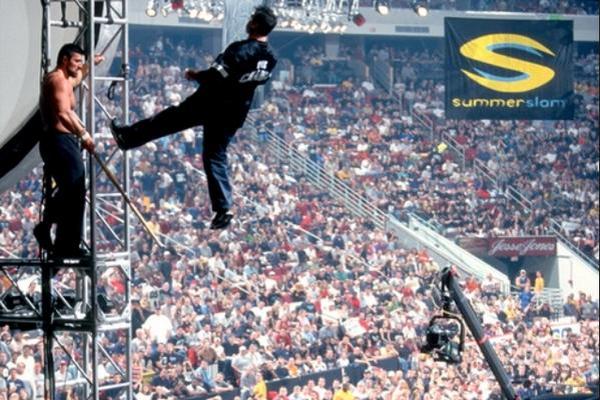
A belly-to-belly through glass. Shane O'Mac leaping (multiple times) from the gantry. Slams through spotlights. Spears through the stage. Buried alive pits. The best stages were ones superstars could use as playgrounds. Sure, set interaction isn't dead, but there's a whole lot less to play with nowadays €“ not least because scratching Vince's LED walls would be a big no-no. Whilst the PG-era put paid to backstage hardcore battles, there's no reason not to resurrect custom sets for out-of-ring experiences that supply big pops, the likes of which WWE would pay anything to hear again. Often you could see the spot coming a mile off €“ and that made it great. Knowing there was a handily-placed piece of glass or dangerously-located lighting rig left you wondering who'd be the wrestler to make it go ka-boom, and that's something the sport desperately needs: intrigue.

3. Paying Homage To Heritage

Sure, Wrestlemania still gets whopping great gantries, super-sized screens, and ramps so long that Cena needs a Montain Dew break halfway down, but it's hardly the only annual event worthy of distinction. On a calendar packed with tenuously-themed PPVs, now more than ever WWE needs to celebrate its contingent of age-old events and use them to carry the baton of brilliant brawling. How best to do that? Return to custom set designs. SummerSlam is owed more than the same old stage. The Rumble needs something radical. Survivor Series means so much more than six-man matches and month-long promos. If 'Mania warrants such whopping stadium set-pieces, why don't the old guard deserve awesome arena get-ups? Even if it was only the big four that got the bespoke background boost, it would be better for the Company than working historic events into the never-changing monthly cycle of same-old screens.

2. Giving Kids (And Adults) A Reason To Doodle

From back-of-a-napkin scribbles to AutoCad mockups, inspiring fans to sketch out arena sets and stages is a big part of what makes PPVs special. The originality, creativity and ingenuity inspire fans young and old to get involved in a way no turn, swerve or sell ever could. Sure, there's no way for WWE to monetise it (though, if they could...), but not knowing what the next PPV stage will look like gives viewers every reason to draw up their dream entrances as if they were Vince's head of design. Why is this good? Because it sparks imagination €“ and that's precisely what entertainment should do. Just look at how popular the Create An Arena option has been in the 2K gaming franchise. It's a symbol of the thirst for novelty and innovation in WWE, something that's been missing since the introduction of the latest stage iteration.

1. Distinguish PPVs From Standard Shows

This one's the biggie. WWE's transition to the universal stage design might have saved the company money and delivered a more cohesive feel across Smackdown and RAW, but it also thrust a hefty nail into the coffin of content distinction. In an era where the RAW show following a PPV is almost guaranteed to carry main event rematches and, often, better performances than on the Sunday night, WWE needs to think hard about how to make PPVs feel special again. Custom staging isn't the panacea to its problems €“ but it's a fine start. What better way to instantly introduce some magic than by building a behemoth of an entrance? For one thing, you'd know immediately that you weren't watching RAW or Smackdown. You'd also feel justified in staying up to see something that didn't feel just like every other show that comes out of the Connecticut Company's creative department €“ because it would have character. It would be unique. Stages might seem like a small part of the PPV experience, but they're the backdrop to every Sunday night moment. They set the tone for what happens, before, during and after. Without variation, stagnation is almost inevitable. #BringBackBespoke

 
Posted On: 
Contributor
Contributor

Happy-snapping worldly wordsmith. In between snapping street shots, tapping out stellar prose and having more hair-brained ideas than a barber with a bachelor's in business, you'll find him fumbling with the latest fitness fads and dreaming of a debut in F1 (he's a late bloomer, OK?).