8 Wrestlers Who Did Better Things In Retirement
From A-Train to Ace Trainer.
It's well-established that many wrestlers take the Rick Astley approach to retirement, steadfastly refusing to ever give the business up, let the pops down, or say goodbye for good, no matter the desperate plea of their aching, decaying bodies. Darren Aronofsky even made a film about the phenomena. You may have heard of it: it's called The Fountain (he made another, less subtextual flick on the same subject, called The Wrestler).
Simply put, nothing can match the thrill of performing, the camaraderies of the locker room, and - perhaps most importantly - the financial clout of the paycheque than traveling town to town, slamming onto mats night after night. Superannuated stars may settle into a semi-retirement with a regular day job, but the pull of spot shows and fanfests will always draw them right back in.
Fact is, very few go on to accomplish great things after leaving the wrestling business behind. Realistically, what could ever top being cheered on by thousands of adoring fans? Even The Rock, who now makes easy money as Hollywood's number 1 action man, still considers WWE his home.
Arguably, he's an obvious exception. But there are a few others.
8. Brian Glover

In pro wrestling terms, Brian Glover is a name only resonant these days to British grans with hazy memories of tuning in to ITV's World of Sport every Saturday afternoon. As 'Leon Arras, the Man from Paris' - a moniker given to him by a desperate promoter after a French import failed to turn up - Glover would leave viewers in stitches with his antics, in particular, shouting "ask 'im, ref!" in a gruff Barnsley accent which belied his supposed French origins.
It was Glover's exposure as Britain's toughest Tyke which led to his casting in 1967's class-and-kestrel struggle Kes, set in his South Yorkshire hometown. Despite having no prior formal acting experience, Glover excelled as the overbearing PE teacher Mr. Sugden, and soon his unique characteristics as a rough Yorkshireman were in demand. Though he remained active in the ring, notably sharing an uproarious contest with Les Kellett in 1970, 'Arras' gradually faded into the background as Glover's acting career took over. He'd go on to star in a range of TV and film roles, most notably a small part in Alien 3.
Despite being often typecast, Glover nevertheless enjoyed a diverse acting resumé; he was Bottom in BBC's adaptation of A Midsummer's Night's Dream, and Mr. Rottweiler in BBC's slapstick sit-com Bottom.
7. Kurrgan

As the Truth Commission's interrogator Kurrgan, seven foot tall Robert Maillet towered over the WWE roster during his brief Attitude era run - but he could never reach the top.
Kurrgan's literal upside was obvious, but attempts to push him as face-squeezing monster in the mode of Giant Gonzalez or The Great Khali once Jackyl's stable disbanded amounted to nothing. In the ring, he was just as good - which is to say, just as bad - as either Harvey Wippleman's eight-foot sasquatch or the Punjabi Playboy, but the 1998 emergence of Kane precluded the usual programme with The Undertaker, and an inevitably sh*te match. The usual monster to light relief depreciation was accelerated in Maillet's case, and fairly swiftly he was prancing about in tie-dye shirts and striped pantaloons.
Maillet couldn't cut it in the ring, but there was no denying the spectacle of his physiognomy. Hollywood agreed, and in 2006 his considerable frame was cast in Zack Snyder's Spartan romp 300. There was more life to come in the Über-immortal's silver screen career; in 2009, Maillet bagged a part in Sherlock Holmes, before notably going on to star in Pacific Rim and Deadpool 2. The oddity had became a commodity.
6. Chris Nowinski

It's somewhat ironic that, for a man who rose to wrestling prominence through a show called Tough Enough, it was brains, not brawn, that proved Christopher Nowinski's greatest asset. The Illinoisan earned a WWE contract having finished third in the reality show, and the company soon honed in on the rare fact he was a grappler with a Harvard degree.
As a modern day cross between The Genius and The Varsity Club, Nowinski made a moderate impact in the promotion. He's probably best remembered for being cast as a conscientious objector to the Iraq war, the inexplicable heel opposite the jingoistic, soldier supporting Scott Steiner. An Ivy League education was no match for Steinernomics, and Nowinski and his La Résistance crew found themselves pulped in the name of patriotism.
Booksmarts were all well and good, but it turned out there are some things you just can't teach - in particular, how to avoid injury. Nowinski's short WWE tenure ended in 2003, after he'd suffered post-concussion symptoms for over a year. Following his retirement, and due to his experience, Nowinski decided to devote his intelligence to sports-related head injuries, founding the Sports Legacy Institute (later renamed Concussion Legacy Foundation), and writing a book: Head Games: Football's Concussion Crisis.
The Harvard grad's dedication to studying and understanding CTE has since massively contributed to the recognition, prevention and treatment of brain injuries from sport - an accomplishment far worthier than his Tough Enough bronze medal and two year WWE sting.
5. Gorilla Monsoon

Name your five favourite Gorilla Monsoon matches. Go on: we'll wait.
It's not that easy, is it? Maybe the one against Muhammad Ali, perhaps? Beyond that, even the most ardent aficionado of WWE's pre-Golden Era would struggle to list more than two Monsoon matches they'd voluntarily watch for pleasure.
That's not to say Gorilla wasn't a draw in his day. As a heel, the gargantuan, grizzled New Yorker sold out arenas across the north east opposite Bruno Sammartino in the '60s, and was a similarly attractive prospect paired with Superstar Billy Graham as a fan favourite. Monsoon was massively popular in his home territory, but it was nothing compared to the worldwide adoration he'd earn in retirement.
In 1980, Monsoon put his career on the line against Ken Patera, and the stipulation stuck in defeat, as he was transitioned to an announcing role. The mic suited Gorilla's massive hands much as a banana does a... well, an actual gorilla. As the voice of WWE during the company's global expansion, Monsoon provided the soundtrack of childhoods the world over, his partnerships with Jesse Ventura and Bobby Heenan becoming the announcing template always strived for, but never matched.
His backstage legacy endures to this day also; the spot just behind the curtain directing traffic is affectionately referred to as the 'Gorilla Position'.
4. Matt Bloom

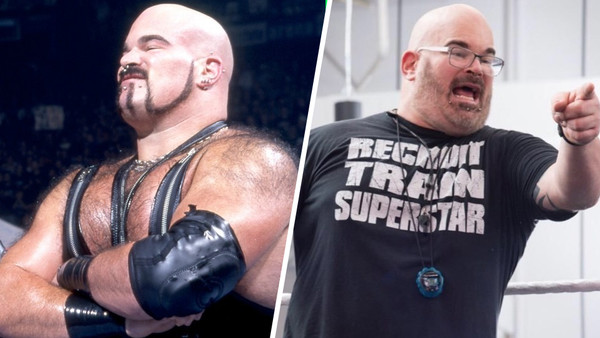
If you were going to pick one man from the Attitude era to impart his knowledge to the next generation of promising superstars, you probably wouldn't have plumped for Albert. The A-Train, whilst competent, was neither the period's most popular nor proficient grappler, even if he did enjoy moderate success under and largely thanks to the tutelage of the eye-catching Trish Stratus.
Though Bloom unquestionably seasoned his work during a late career break in Japan, you'd never have known it from the way WWE repackaged him as the reductive Lord Tensai on his return to the company in 2012. Two years later, having made the natural decline into the dancing big guy gimmick, Bloom called time on his in-ring work, and settled into a comfortable teaching position in the Performance Center.
When NXT Head Trainer Bill DeMott resigned following allegations about misconduct, Bloom was suddenly given a field promotion, his interim role swapped for the dean's office. It's not disrespectful to say he's accomplished more in his six years overseeing the training school than he ever did in his career. Under Bloom, Winter Park's field of buds have been able to do so, free from fear, as the brand has developed first into an indie finishing school and then a mainstream product competing for ratings supremacy every Wednesday night. Obviously this hasn't all been Albert's work, but he's had a pretty sizeable hand in the transformation.
3. Hiroshi Hase

Former Olympian Hiroshi Hase isn't spoken about in quite the same terms as his NJPW and AJPW contemporaries, probably because of his selfless propensity to put over the stars of the era at the expense of his own prominence. His most famous moment in the ring came when he caused The Great Muta to bleed all over it, creating the legendary 'Muta Scale', by which all future acts of wrestling phlebotomy would be measured.
A blood-letting background didn't necessarily make Hase an ideal candidate for politics (though some would cynically argue otherwise), but his prior life as a classics tutor perhaps did. In 1995, Hase followed mentor Antonio Inoki's footsteps in becoming the second wrestler elected to a the National Diet, and five years on he was voted into the House of Representatives. His political competence would eventually see him appointed in a cabinet role, given the portfolio at the Ministry for Education, Culture, Sports, Science and Technology.
In 2015, he became a champion of Japan's LGBT community ahead of the Tokyo Olympics, following the open discrimination seen in Sochi's Winter version the year prior. Just as Hase always put himself on the line for the betterment of others in the ring, so too did he in government.
2. Jesse Ventura

Like his regular commentary partner Gorilla Monsoon, Jesse Ventura's rise to mainstream prominence coincided with WWF's national exposure years after he'd hung up his feather boa.
In the ring, The Body had enjoyed relative success in his home state of Minnesota, capturing the tag team championships in Verne Gagne's AWA, before making the move to Stamford as part of Vince McMahon's mid-'80s expansion. Plans for a high-profile run opposite the industry's biggest star Hulk Hogan were scuppered when blood clots - allegedly caused by exposure to Agent Orange during the Vietnam War (the chemical, not Hogan) - were found on Ventura's lungs. His wrestling career effectively ended, but missing the Hogan gravy train didn't prevent him becoming a household name.
Though Ventura was never the most compelling worker, he was one of the business's most compelling talkers, and it was entirely natural that he was repositioned into an announcing role. As WWE's expansion gathered pace, a much wider audience became accustomed to The Body's bristling charisma, to the point Hollywood came calling. A starring role in 1987's Predator led to a massive fallout between Ventura and Vince McMahon, but by this point he was above the law. Years later, he'd be making them, elected Governor of Minnesota in 1999. No other American wrestler has ever held such high office.
1. DDP

Diamond Dallas Page is a three-time former WCW World Champion and WWE Hall of Famer who briefly reigned as one of the industry's top babyfaces, headlining a string of PPVs opposite legitimate legends of the business (and Dennis Rodman). There's no question he did a lot of great things in his active career, the likes of which most journeyman superstars can only dream of.
However massively popular though DDP was in his heyday (his brief, stalkery run in WWE notwithstanding), it's been his second life as a DVD fitness guru, basically a wrestling equivalent of Beverley Callard, that has seen his stock rise from legend status to godhood. Not only has Page's accessible DDP Yoga programme improved the health of countless people, but his intervention and mentorship may just have saved the lives of two of wrestling's biggest lost souls, Jake Roberts and Scott Hall.
Roberts was a tragic news headline waiting to happen until DDP stepped in on behalf of his buddy. Though there have been hiccups along the way, under Page's tutelage, Jake has went from a hopeless case to a WWE Hall of Famer and a regular, winning presence on AEW Dynamite. That alone is worth far more than any amount of championships.