8 Wrestling Careers That Ended In One Match

These guys were gone faster than you could blink.
A career in professional wrestling doesn't appear to be the most stable job on the market - it's hazardous, often reliant on backstage politics, and usually requires peak physical condition. Of all the performers who have stepped in the ring on big stages, very few of them have had formal, quiet retirements. They tend to be more abrupt departures than anything else, especially as a talent rarely leaves on his own terms. That's if a wrestler even survives his career, wrestling's often known for tragic, untimely deaths due to the intense nature of the profession. Some careers have lasted years, just to end one night when no one was expecting it, while others have ended the moment the very moment they stepped in the ring. If the departure of CM Punk has taught wrestling fans anything, it's that they can never know or predict in the full story in wrestling, there will always be shocking exits made for as long as wrestling exists, whether it's voluntary or not. In examination of wrestling careers and how they often end, here's compiled a list of careers that ended in one swift match, for one reason or another. Whether the wrestler did something drastically wrong in that match, whether it made management regret hiring them in the first place, or if it's the the rare occurrence of death in the ring, there's every angle available. Here's eight wrestling careers that suddenly ended in one match.

8. Braden Walker

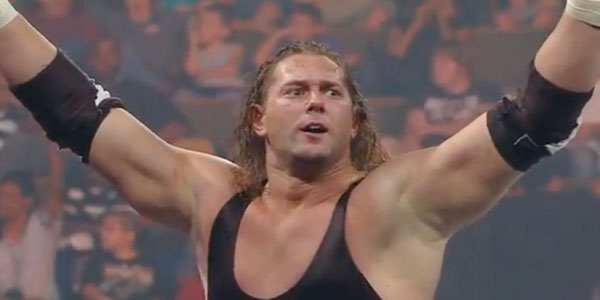
While Braden Walker's career in ECW didn't end until his second match in the promotion, all it really took was one outing for the former TNA star, before he was let go for obvious reasons. While he was in TNA, Chris Harris was an athletic, charismatic and agile individual who teamed with James Storm to form America's Most Wanted. After his departure from TNA in January, 2008 for unknown reasons, Harris signed a developmental contract with the two weeks later. He debuted in a segment with Teddy Long, soon being pitted against Armando Estrada. The match showed that Chris Harris had massively let him self go, with the pre-scripted segment and awful line 'I'm Braden Walker, and I'm gunna knock your brains out', has since become infamous. Braden Walker was slow, stodgy and awfully marketed in his run, he'd go on to work one more match with James Curtis, but after his very first appearance in the WWE, the writing was already on the wall. In one match, Chris Harris had gone from a previously rising star with endless potential, to a slow, washed-up loser.

7. Muhammed Hussan

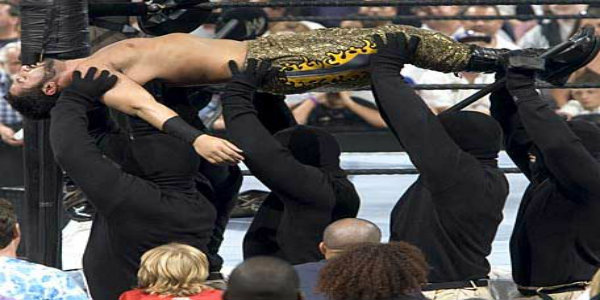
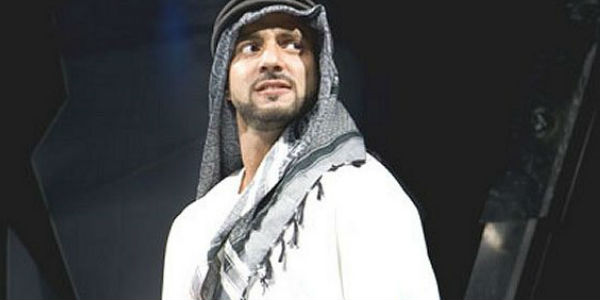
Mark Copani, more well-known as his WWE character Muhammed Hussan, was a victim of coincidence, media pressure and bad timing. Creative gave him a gimmick of an Arab who exploited his nationality to complain about his position, seeking to further cash in on the political mood of the time and national heat, as WWE would do in the past with similar characters like The Sheik. However, WWE would accidentally pull the trigger on an angle at the worst possible time. On July 4th, 2005, Daivari would face the Undertaker in a losing effort, but Hussan then came out and prayed on the ramp, after which, several men dressed in black shirts, ski-masks and camoflage pants would beat the Undertaker with piano wire and clubs. Just three days later, the London bombings happened, which immediately doomed Hussan's career to go nowhere due to the ensuing media scandal. Hussan would be kept off TV, lastly appearing at the Great American Bash, when he was buried by the Undertaker and never seen again. Copani soon retired, his career ruined because WWE needed a fall guy to blame for their sensitive angle which was clearly a bad idea in the first place.

6. Buff Bagwell

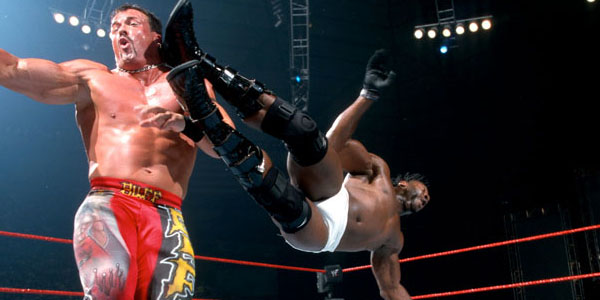
After the closure of WCW, the WWF tried to buyout a number of the still existing contracts from the company for a much lesser price, most didn't accept and chose to sit at home still earning good money, whilst doing nothing. Buff Bagwell was one of the few who agreed to the buyout, who would then appear in a WCW Championship match on Raw on July, 2nd against Booker T. The match was nothing spectacular, fairly average, but it wasn't allowed to play out properly, as Kurt Angle and Steve Austin would assault Booker T just a few minutes in. After this match, Buff Bagwell would be released after just one televised appearance in the WWF. It's alleged that WWF management claimed there were complaints about his attitude, and he had an altercation with Shane Helms. It's also said that he faked an injury at the subsequent Smackdown taping, after taking a power bomb from the APA. Bagwell himself clearly states that he has no idea why he was fired from the WWF, to this very date. Either way, no matter what the truth is, Bagwell's WWF career started and ended in the same match, though he was never destined to go anywhere.

5. Darren Dorzdov

Darren Dorzdov, better known by the ringname of Puke or a temporary Legion of Doom member called Droz was a worker in the WWF 98-99. Dorzdov's career was just starting in the WWF, but ultimately it was cut absurdly short by a crippling in-ring injury. In a Smackdown taping in October, D'Lo Brown went to execute his signature running powerbomb, but he found it hard to grip Droz due to a baggy shirt, while Droz failed to jump properly, which would have helped D'Lo. This resulted in Droz being dumped on his head, leading to two fractured disks, rendering Droz a quadriplegic. drozparalyzed_display_image Drozdov was only the young age of thirty when the career ending injury happened, though it's often claimed that Droz has never blamed D'Lo for the misfortune. Regardless, it's a still huge shame that Darren Dorzdov's career ended, before it had ever really started.

4. Sid Vicious
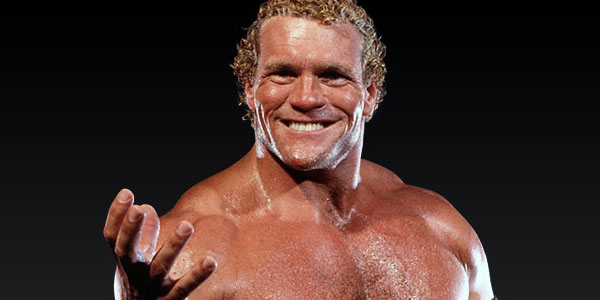
After having been written off TV for most of 2000, Sid Vicious was written into a four-way feud for the WCW World Heavyweight Championship culminating at a match at Sin. Before the match, WCW management approached Sid and told him that he needed to broaden his move-set, asking him to incorporate more aerial attacks and maneuvers into his routine, even though Sid was clearly against this idea. During the pay-per-view match, Sid botched a leap from the second turnbuckle in an attempted big boot causing Sid to brake his left leg in half, snapping both the tibia and fibia, with at least one segment of bone exposed through the skin. This was in fact so graphic, that certain TV stations refused to air it the next night, although many did. Most would agree that its unnecessary for wrestlers of Sid's size to dive, fly and perform aerial attacks, clearly WCW management thought differently, essentially ending his in-ring career.

3. Rick Rude

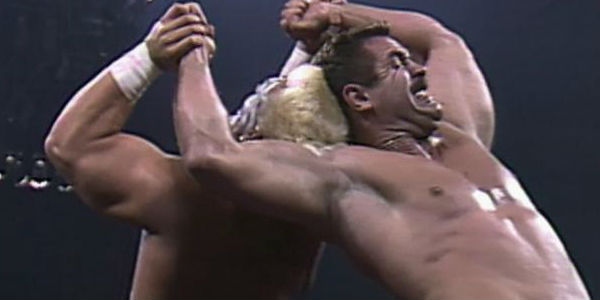
Rick Rude was at the very pinnacle of his career before it ended, having won his first NWA World Heavyweight Championship in 1993, going on to feud for the WCW International World Heavyweight Championship throughout 1994. However, all it would take is one unfortunate injury which was no one's fault to effectively end the 35-year-old star's career, then and there. Rude was on a tour of Japan with other WCW stars, with Rude vs Sting being pushed as a main event at many venues. On May 1st, Sting performed a suicide dive onto Rude, but as Rude caught Sting he fell backwards, landing on a part of an uneven, raised platform which caused him to severely damage both his neck and back, causing him to retire on the spot. The botched spot is effectively neither man's fault, as both Rude's catching position and Sting's attempt at a dive were both mistakes, given the circumstances. Rude would go on to appear in ECW, WWF and WCW programming as a managerial figure, until his untimely drug related death in 1999.

2. Mitsuharu Misawa

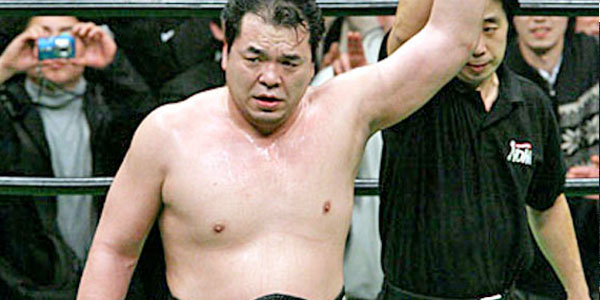
For those unaware of Japanese wrestling, in a nutshell it can be brutal, exhausting and damaging. Mitsuharu Misawa was a legend in Japanese wrestling, having dominated AJPW for over two decades, before going to form and found his own wrestling promotion, Pro Wrestling Noah. Having wrestled in the taxing puroreso Japanese style for multiple decades, Mitsuharu was tired of wrestling by the late 2000's, but found himself unable to retire in fear that his promotion might collapse without his own presence in the ring. In a match for GHC Tag-Team Championship, June, 2009, Mitsuharu lost consciousness after receiving a back-to-belly suplex from Akitoshi Saito. Misawa was then rushed to a hospital, but died at 10pm, that night. It's speculated that he died from a spinal cord injury that led to cardiac arrest, but his family invoked a Japanese law in which the cause of death wasn't to be publicly announced. Those with a thorough understanding of Japanese wrestling have commentated that Misawa's death could be attributed to sheer exhaustion because of the toll on his body, that professional wrestling had taken. Mitsuharu Misawa was a legend in Japanese wrestling, but fans had no time to say goodbye as both his life and career ended unexpectedly before a shocked crowd.

1. Owen Hart

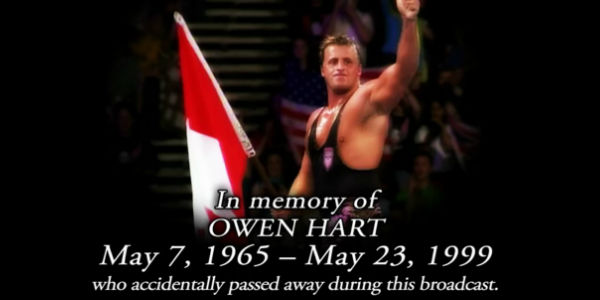
No story of a career ending in one match is more infamous than the untimely passing away of Owen Hart. Hart was scheduled to face The Godfather for the Intercontinental Championship in his Blue Blazer gimmick, but he tragically died during his ring entrance. The entrance itself relied on a lowering mechanism, as Owen Hart would slowly be lowered into the ring from the rafters, much like Sting's entrances during his crow gimmick in WCW. A cable disconnected from the safety vest, causing Owen to fall 70 ft, as he fell on one of the ring's turnbuckles. Owen Hart was a beloved competitor in the WWF whether face or heel, and his death was a tragic loss to the wrestling industry, fans and friends alike. The Hart family would understandably sue the WWF over the incident, with a settlement being reached with a payment of $18 million dollars.

Contributor
Contributor

Sam is an experienced Film, Gaming and Wrestling writer, critic and journalist who was written for a vast number of different entertainment websites. Follow him on twitter at @Sams_Reel_Views.