9 Ups & 4 Downs From WWE WrestleMania III
The Biggest. The Baddest. The Best?

Accepting defeat when it came to WrestleMania 2's over-thought enterprise, Vince McMahon steered into a personal defeat by chasing the biggest professional victory of his career to date the following year.
93,173 (or, as has often been mooted, nearer 78,000) fans invested in his grand vision and filled one stadium in one town with one card to create a night that three the prior year couldn't remotely rival.
WrestleMania III was a pivot point for the industry in much the same way the inaugural version had been two years earlier. Newer fans were still climbing aboard after the 'Rock N Wrestling' explosion, but these ones came and stayed almost entirely for the wrestling. The pagentary was supplied not by celebrities selling their latest wares, but the wrestling. WWE presented a match on this show that was, without compare at the time, their best ever example of pro wrestling on pay-per-view.
The iconic main event was notoriously low on the stuff, but hundreds of past, present and future WWE stars cited that match as the intoxicating moment they knew they wanted to run Vince McMahon's ropes for a living.
Two of the greatest workers of a generation inspired wrestling's future, and one of them barely even took a bump on their biggest night. WrestleMania I may have birthed a dream, but WrestleMania III birthed the dreamers.
(Playing catch-up? WrestleMania I & 2's Ups & Downs are here and here, respectively)
Downs...
4. Sublime To Ridiculous
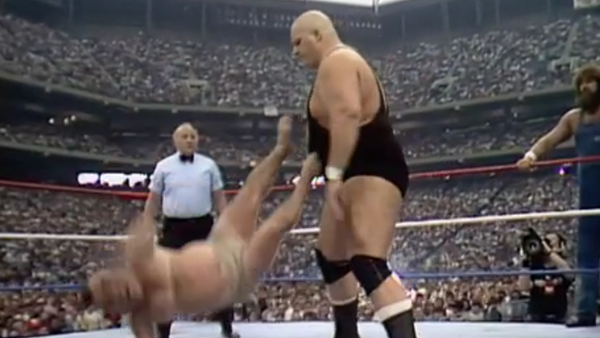
There's a surprisingly rich history of wrestlers going from bust to boom and back again between WrestleManias, but King Kong Bundy's fall from grace was especially damning considering the scale of the Detroit crowd.
A year earlier, he'd taken on the industry's mainstream and cultural giant with much of the world watching. 12 months on, and with what literally looked like half of the universe in attendance, he took on men less than half 'The Hulkster's size.
Bundy the bully was as well cast as Hillbilly Jim was in the role of their protector, but Haiti Kid, Little Beaver, Little Tokyo and Lord Littlebrook's banter spots could only go so far before your sympathy is actually with Bobby Heenan's dilapidated monster.
He's not grunt and growl on the 'Grandest Stage' again for another eight years.
3. Pretenders To The Throne

Harley Race's 'King' gimmick looked to many ardent observers as a Vince McMahon rib - sign the hardest f*cker going and deck him in a cape and crown, what a worker - but it did at least provide the former NWA great with a bit of renewed panache at the wrong end of his legendary run.
For the third time in as many WrestleManias, Junkyard Dog was again wildly over to a point, but his match deflated the balloon-scale pop his entrance and exit received. A 'Loser Must Bow' match he lost didn't exactly inspire those that had lost interest in him as the match was in progress.
Crawling headbutts and fake monarchs are all fun and games on television tapings, but the bullsh*t and bluster looked even smaller time in front of such a huge crowd.
2. Filling And Killing Time
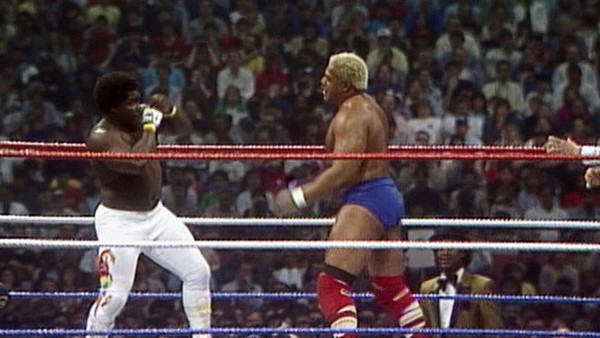
It's important not to misunderstand the dual purpose of pay-per-views in this particular era, especially in contrast to today.
All the matches had value to a point because the stars almost never fought each other on television. Audiences were used to Butch Reed and Koko B Ware knocking off goobers an hour at a time on Saturdays, but butting heads with each other on a Sunday was different gravy.
That's not to say it was always particularly good. Novelties wore off fast after the bell, but the supercard formula at least kept these middling efforts short. Something needed to go between the excellent Tag Team and Intercontinental Title clashes, just as it did to cool audiences down before the main event...
1. This Sh*t Again?
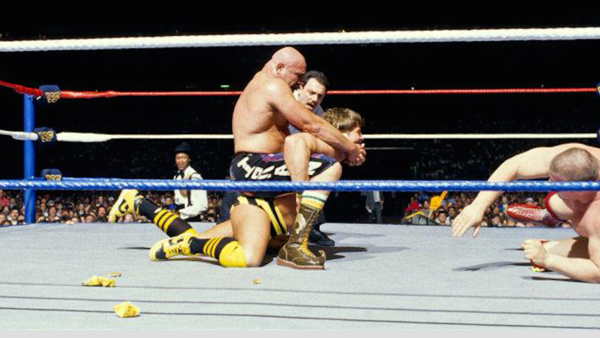
The Iron Sheik/Nikolai Volkoff pairing had been split apart for WrestleMania 2 but were back with a vengeance a year later to give the substantially-more-exciting Killer Bees a humbling before ultra-patriot Jim Duggan made a popular save.
Anti-USA rhetoric dates horribly for the most part, but only as bad as the lumbering offence from the heels. Sheik and Volkoff could have made great bases for the Bees' dynamic tandem offence, but didn't look particularly bothered about that as they stole the disqualification victory thanks to 'Hacksaw's aforementioned intervention.
In all fairness, Shiek looked pretty ripped here - no wonder it was Jim Brunzell taking the Camel Clutch instead of his partner.
Ups...
9. Hot Start
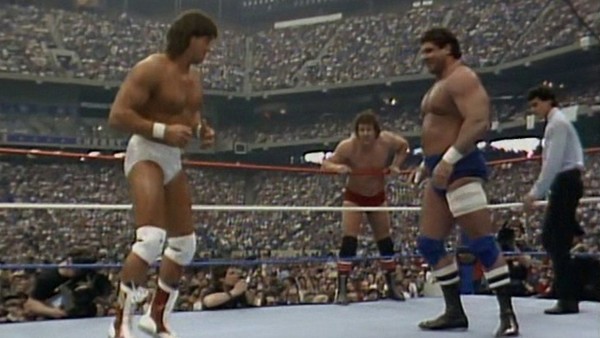
The Can-Am Connection's red-hot chemistry was effortlessly replicated Strike Force after Tom Zenk fell afoul of Vince McMahon, but their lone WrestleMania appearance produced the type of far-from-ordinary opener that highlighted exactly why The Chairman wanted a couple of all-smiling flyers in his arsenal.
WrestleMania I and 2 stalwarts Bob Orton Jr and Magnificent Muraco are amiably cast as the elder statesmen both Zenk and partner Rick Martel are too hyped to stand still for.
93,173 (or thereabouts) popped their socks off for the high spots and high fives as the babyface pair kicked the night off in uncharacteristic-for-the-era style.
8. Bigger, Badder, B*stards

Hercules was humanised by a loss to Ricky Steamboat during his 1986 WrestleMania debut, but a Bobby Heenan-based cleanup had turned him back into a monster in time for his battle with babyface mirror image Billy Jack Haynes.
The brutes battered the b*llocks out of each other for the seven minutes they were afforded before Hercules took his chain to the head of Haynes when he realised exactly how powerful his opponent was.
Perception really is everything in wrestling - both men here were cut to shreds in a way even Hulk Hogan could only dream of. That they only had a smidgin of his star aura ultimately held them back from ever taking his spot.
7. Dream Over
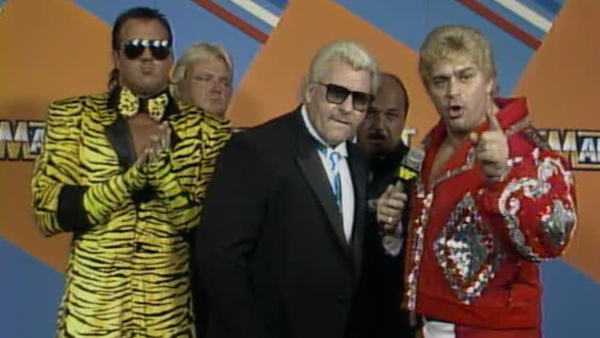
Brutus Beefcake had had his long locks inadvertently chopped by an aggravated Adrian Adonis weeks earlier (more on that later), but his wings were clipped entirely in an angle that would change his life and career forever.
Dino Bravo had wormed his way in alongside Greg Valentine and Johnny Valiant to such a degree that the 'Canadian Strongman' was presented as a vital cog in the Dream Team machine without even tagging into the match.
Their makeshift victory over The Rougeau Brothers was tainted by the group's relegation of the future 'Barber' to bit-part player, but Beefcake's babyface turn was yet to be cemented by the abandonment. It took a staggeringly enjoyable post-match angle after the next bout to usher that in...
6. Hair Today, Gone Tomorrow

According to Bruce Prichard, Vince McMahon doesn't particularly care for Hair Vs Hair matches, but this is especially confusing considering how well one of the best ever examples of it drew, and what emerged from its white hot aftermath.
Roddy Piper's faux-retirement added genuine emotion to a heartfelt victory, but Brutus Beefcake's first case of "Cuttin' and Struttin'" gave the moment a uniquely comic touch that gave the fans a second wind for seeing expert heel Adonis humiliated.
Roddy's WWE farewell would last just over two years, but the 'Adorable' one had sadly passed away before Piper even had chance to pop back.
5. Family Affair
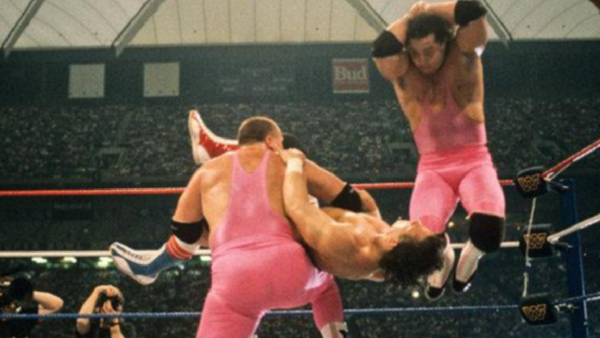
Finally given a stage worthy of their future-proof singles and doubles outings over the prior year, The Hart Foundation and The British Bulldogs kept it in the family alongside Danny Davis and Tito Santana respectively for a six-man tag that preserved their title clashes for the follow-up house shows.
Ex-corrupt referee Davis had helped the Harts screw the Bulldogs out of the belts just weeks earlier after Dynamite Kid's back fell to pieces before they could drop them properly, and this WrestleMania match didn't offer the babyfaces any redemption as the sly former official nicked off with the cheap pinfall victory.
Long forgotten thanks to the technical masterclass later on the card, this blinding battle made the best of Bret Hart and Dynamite Kid's exceptional in-ring gifts. At a spry 8:52 it was still the third longest match on the show - a gift itself in the bloated WWE Network era.
4. The Greatest

It's a favourite take of wrestlers and insiders but it remains true - Andre The Giant and Hulk Hogan sold the show but Randy Savage and Ricky Steamboat stole it.
'The Dragon' was less complimentary of this luxurious mat classic in later years in comparison to his battles with Ric Flair. As he saw it, his instict-led classics with the 'Nature Boy' were a true reflection of talent compared to the heavily-scripted showpiece Randy Savage had assembled for them to learn ahead of time.
This underserves how supremely talented Savage was. He wasn't just plotting a course, he was predicting the emotional ebbs and flows of one of wrestling's biggest ever crowds - and every prediction came true.
An epic in an era without them, the match transcended the entire organisation - only when Hulk Hogan left for good in 1993 would the company embrace this aesthetic as the standard all performers should work towards.
3. Rock & Wrestling

Alice Cooper's arms may have been mocked by perma-tanned ex-wrestler Jesse Ventura, but his megastar aura matched that of Jake Roberts and The Honky Tonk Man in front of the Detroit locals - a rarity for the wrestling celebrity.
The physical chemistry between the two was dynamite even if it was hard to picture the demure and devious 'Snake' rocking out at one of Cooper's concerts. Roberts and Honky dished out hit after hit even if they both had to know they couldn't be Number One that night.
As a literal contrast to the Honky Tonk Man's knockoff Elvis aesthetic, the 'Godfather Of Shock Rock' was ideally placed to second Roberts in his babyface bow. The heat for Honky was off a different chart altogether - he was the perfect sh*thouse to steal the Intercontinental Championship from Ricky Steamboat when Vince McMahon required an unexpected Plan B.
2. Nothing Bigger
Hyperbole is simply hype in professional wrestling - always oversell, always over-promise and, ideally, always over-deliver.
Hulk Hogan and Andre The Giant - in spite of their awkward, clunky brawl - achieved all of the above.
The legendary clash is defined beautifully by its bookends. 30+ years on and what feels like 30,000+ views later, it's hard to keep one's jaw from dropping at the scintillating staredown. Likewise, Hogan's victorious powerslam comes the closest to actually proving one of his daftest lies true.
The move didn't kill Andre because of course it f*cking didn't, Terry, but as far as the awesome audience were concerned, the biggest Giant in the world had just been slain.
1. Changing The Game

WWE may have inflated the attendance figure and presented the "first time ever" main event with a wink and a nudge, but WrestleMania III provided conclusive proof that the work will always be more important than the shoot in pro wrestling anyway.
Ignoring the hard data, the fact remains that a f*cking load of people packed out the Silverdome for what they considered the biggest money match in all of wrestling. They were given what they were promised and then some, not least in the form of the iconic Intercontinental Title clash.
This was polished and purified Sports Entertainment conclusively proving itself as a draw and proving Vince McMahon's vision spot on. The Chairman would have persisted anyway, but having this in his back pocket for the rest of the decade opened even more doors and minds to his bizarre and brilliant one-ring circus.