How AEW Got A Five Star Match With NO Fans
In which crisis also means opportunity.

You try not to chase the thought, because it's depressing and it diminishes what little remains to enjoy in an unrecognisable world, but virtually everything about pro wrestling post-March 2020 is bittersweet, even (especially) the triumphs of this no-fans era.
Of course, something like Mr. Brodie Lee's ascent has been immensely rewarding to witness - but how much better would it be, if a red-hot, 4,500-strong Dynamite crowd pissed him off by chanting for John Silver?
Roman Reigns should be casting a knowing but uncaring look at the fans chanting for him now where they crucified him back then. #SignEddieKingston was a really nice and earned thing to have happened, but that incredible, gutsy performance demanded booming chants of "Please come back!"
Jon Moxley should be making buildings shake. FTR should be registering lowkey disgust at the 'This is awesome!" chants that would have met their matches alongside the Young Bucks. Sasha Banks should have been unable to suppress her glee at the support receiving her slow-burn babyface turn.
And if it's not bittersweet, it's plain bad. RETRIBUTION. Fake Doinks. Mandated entrance poses to nobody. And if it's not plain bad, or brilliant, wrestling just exists as this glum echo of what it should be and what it once was. Average feels crushingly pointless now.
CONT'D...(1 of 6)

WWE assessed its environment, resolutely failed to play around with it effectively in the abominable form of its mercifully abandoned "cinematic" genre, and then asked itself how it could feel normal again. The company arrived at the answer via its ThunderDome concept - the exact same show, except the fans are virtual - which, very weird uncanny valley vibe not withstanding, isn't nearly as bad as expected.
New Japan Pro Wrestling has only just recovered from a bizarre summer of dreadful booking, and the cursed images of Double Champion EVIL, to deliver two damn good nights of the G1 Climax tournament. But so much of NJPW's action - the incredulous, awestruck roar when the hero finds something in an empty tank, the sickened yet delighted gasp for the most squelching forearm blows - depends on sound. Most of it is very good, virtually all of it is strange.
IMPACT Wrestling and now ROH have promoted empty arena wrestling to at least modest success, and the outdoor socially distanced indie shows have their charm.
But AEW has adjusted to this new world better than any other promotion because it has openly acknowledged the new circumstances and used them to shape its creative direction, match layouts, and, in the case of Stadium Stampede, match genres. AEW was the first company to emulate a crowd by planting fans at ringside, and this wasn't just to emulate the old atmosphere. MJF and Shawn Spears placed bets on the action to create a fun narrative hook and to protect their image as serious heels. The Dark undercard crew provided the trenches spirit in full voice. Big Swole squared up to Lance Archer and Mr. Brodie Lee so that she emerged from ringside with a sense of agency. Several storylines were developed via this new arrangement - brawls tumbling over to ringside, the Colt Cabana recruitment attempt - and the noise and enthusiasm, particularly that made by unsung hero Austin Gunn, summoned a festival atmosphere, if not a traditional one.
CONT'D...(2 of 6)

AEW realised very quickly that things weren't the same and immediately abandoned Blood & Guts, gauged the tone, and pivoted into a new, heightened quasi-canon. Wrestling didn't feel like wrestling anymore, in the traditional sense, and so AEW attempted to function as a real escape via the Stadium Stampede attraction that headlined Double Or Nothing. Pitting the Elite against the Inner Circle, it was a masterpiece of levity. AEW utilised the eerie space that had become synonymous with wrestling and had Hangman Page, on a horse, chase Sammy Guevara across all 100 yards of it. Matt Jackson suplexed Guevara across the same length in a wonderfully wry nod at the editing process. Chris Jericho smashed a mascot in the face with the Judas Effect. It was a silly and vital time that was also a fantastic wrestling match; Hangman Page and Jake Hager worked a western bar fight with insane athleticism; Matt flattened Jericho with a moonsault off the field goal; Kenny Omega, beyond that incredible finish, went weapons-heavy apesh*t in his sequence with Santana and Ortiz.
The Street Fight that built towards it was a fabulous time, too. The four men who worked it surveyed their surroundings and used them to create something awesome. There's a cherry picker over there; let's do a moonsault off it. There's a golf cart; let's do a slapstick gag all the funnier for how absurdly drawn-out it is. There's a traffic cone; let's pop that on my head, and I'll do a f*cking witch's cackle because I'm the irrepressible jackass you need right now.
The Falls Count Anywhere match between the Butcher and the Blade and the Young Bucks - itself built via the planted crowd - was an amazing New World match, too. It started in the Daily's Place kitchen, and sprawled to the ring by way of a production truck and the empty concessions stand in a pulsating, deliriously entertaining brawl that, again, did not remind the audience once of how much better it would be, were fans in attendance. It was incredibly resourceful; if fans were in attendance, we'd never have been treated to the sight of the Bucks superkicking the Blade and sending him up an escalator.
CONT'D...(3 of 6)

All of this was much-needed respite all the better for the extent to which AEW removed us from the old, unrecoverable normal. But that creativity and tone could only sustain AEW for so long. Much of the fun that swept through the promotion detracted from what was an uneven All Out build that felt off in tone. The defiant Double Or Nothing celebrated the first, cruel glimpse of freedom. When it became apparent that we remain quite f*cked, the disproportionate amount of comedy wasn't quite as infectious.
Last week, AEW got serious with the Parking Lot Brawl between the Best Friends and Santana and Ortiz, using the comedy at which it excels not to distract but to accentuate at the finish.
Immediately, the tone was set. The two teams, recognising that the main event doesn't come easy and that the storyline demanded it, beat the ever-living sh*t out of one another under a hailstorm of closed, stiff fists.
It was a savage and incredibly committed fight, but the wrestling - and there was just enough in it to not compromise the tone - was as exceptional as it was seamless. Trent countered an early attempt at a power move with incredible agility, fusing the modern state-of-the-art style with heart-stopping death match suspense. In a fantastically inspired tandem high spot, Ortiz flattened Chuck Taylor before Santana splashed him from one non-gimmicked car hood to another. Most if not all of the spots were not gimmicked, which is contra to how the best wrestling should work - but goddamn did it work as a spectacle.
CONT'D...(4 of 6)
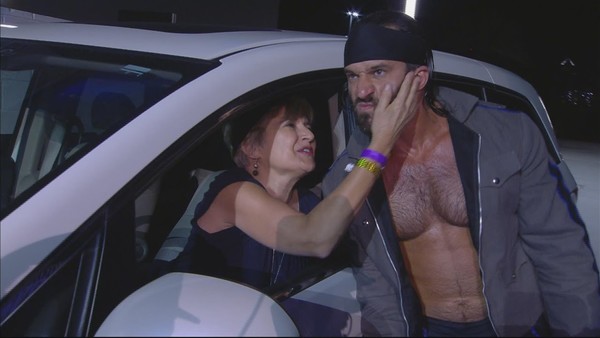
Virtually every plunder brawl asks pressing questions of the audience - what is a compressed sawdust table doing under a ring that is more painful to bump on? - that we simply ignore to increase our enjoyment of them. The genius of the Parking Lot Brawl is that almost every weapon used was germane to an environment AEW recognised as a means of working within the new world.
These four men, in totally deranged spots elegantly constructed to not once pause to set them up, crashed into sh*t one would expect to crash into a parking lot fight - hoods, bonnets, windshields - creating an immersive and bloodthirsty atmosphere. Electric, violent, intoxicating, dramatic: this was, in its minimal use of spectacular wrestling and punishing brutality, as restrained as it was gratuitous.
Of course, that audience was not present. Here, the intimacy enhanced the match because that audience, wincing and gasping - not popping - sold the blood feud blow-off as if it weren't a performance.
Santana pitched the idea to Tony Khan, who is receptive to the ideas of his workers because pro wrestlers are inherently creative people. Santana was astute enough to recognise that Sue, Trent's mom, had instantly established herself as a beloved cult figure by driving "Greggy" to his big title match. Like any great heel, his immediate thought was: "I can get a sh*tload of heat here". And so he pitched wrecking Sue's van, which would lead to the fight and the iconic wholesomeness of that happy ending.
CONT'D...(5 of 6)

Something like this was already in the works just after lockdown; Khan, aware that a deeper reservoir of creativity was required to lift the gloomy no-fans setting, had the idea to promote a Parking Lot Brawl between the Best Friends and the Lucha Bros. It didn't happen - neither Fénix nor Pentagon were available - and it was shelved until AEW's collaborative culture enabled it to happen in the end.
It was felt during lockdown that no match could reach true classic status because every classic match, whether blood-soaked U.S. melodrama or the high-end of puro's master craftsmanship, had one elusive thing in common: the roar of a crowd. Khan had the idea to promote a match that the pop might even diminish, and Santana plotted a tremendous story to arrive at it.
When Sue flipped the bird to the heels, in a now-seminal exclamation mark, the commentary team could only piss themselves laughing as the show faded to black. AEW had achieved something very improbable. They've a knack for doing that.
WWE looked at the looming, empty space and tried to obscure or no-sell it. AEW utilised that glaring, depressing space as a resource, an artist's canvas, with which to deliver four incredible spectacles that would never have happened in the old world.
AEW extracted opportunity from crisis to cement itself as the best and most creative promotion on the planet.