How Good Was 'Stone Cold' Steve Austin Actually?
In-Ring Ability
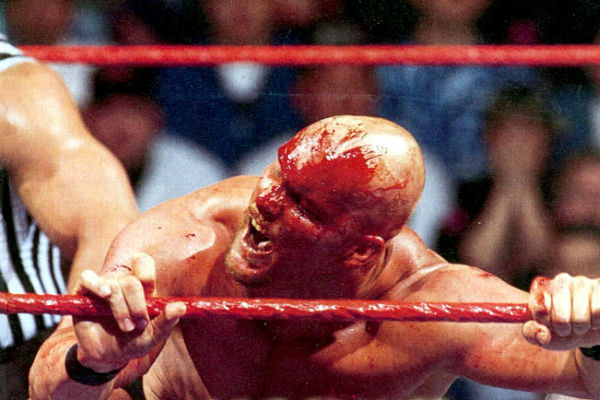
Steve Austin’s in-ring legacy is divided between two chapters: pre- and post-neck injury.
Pre-neck injury, Austin was a dazzling technical wrestler who knew his way around a massive bump. He was always very well-rounded - his performance in the 1992 WarGames match at WCW WrestleWar was a red-hot display of his brawling prowess - but he was super-fit and beyond motivated. Moreover, he knew the audience he was wrestling in front of. WCW fans actively loved pro wrestling. Austin located the exact intersection between sophisticated craft and unvarnished scrap. It was fancy, his work, but not too fancy. He could work a labyrinthine chess match with Ricky Steamboat that also felt like a real, hard-hitting fight. There was a strategic purpose to everything Austin did, an immersive cause-and-effect. He never wrestled a great match for the transparent purpose of doing so.
In late 1996 and the first half of 1997, he reached his perfect form between the ropes. His ‘Stone Cold’ character was far more likely to aggressively and directly kick your ass than draw you into a tactical mistake, but against Bret Hart, he could do both. The motor on early WWF ‘Stone Cold’ was outrageous.
Austin was unreal at selling, too. He was note-perfect at WrestleMania 13. He sold his battered leg for almost 20 minutes, but, to tell the story of your new babyface badass who never gives up, Austin never stopped moving. It remains the most dynamic, lengthy display of selling in wrestling history. The crowd were never not convinced that Austin was in a state of abject agony, but the indefatiguable Austin literally never bored them nor prevented them from believing he could fight his way back in. He was hurt, pissed off and vengeful. His performance was blissfully anti-methodical.
Austin’s physical prime was cut short when, at SummerSlam 1997, he broke his neck as an Owen Hart seated piledriver went awry. This actually allowed Austin to showcase his character, and by the time was as healthy as he was ever going to be again - i.e., not very - his primitive take on arena-wide shortcut brawls endeared him to a new young adult male audience that didn’t much care for thoughtful layers of drama. The lack of true movement was actually a feature, not a bug; Austin doing more bumps might have detracted from his ultra-credible hard bastard persona.
Even then, from 1998-onwards, Austin found the “intestinal fortitude” to go all-out, when the occasion demanded it, in lung-bursting spectacles against the Rock and Kurt Angle. Austin was limited, understandably. Certain pay-per-view main events, many against the Undertaker, were lifeless and repetitive. But they were rarely not over, which is the most important aspect of any match. When the Attitude Era caught ablaze, Austin was confined to the Greatest Hits - but what a repertoire. His frenzied stomps, the “f*ck you” hand gesture, resuming the attack with even more intensity: Austin got a lot - the most, you could argue - out of the least.
There is one noticeable flaw to Steve Austin’s in-ring work - and, since it’s the primary weapon he wielded in his twilight years as a megastar brawler, it’s less than ideal. Steve Austin was not amazing at the worked punch, and he threw roughly four million of them in the faces of Mr. McMahon, The Rock, and Triple H during WWE’s Attitude Era.
Austin’s technique was a little bit weird, frankly. He didn’t appear to blast his knuckles directly into his opponent’s jaw, ramming his forearm forward with rapid, metronomic, Memphis force. He’d sort of flick his wrist from side to side, grazing their cheeks with the middle phalanx. His driving footwork was near-perfect, but scrutinise the actual strike, and you’ll understand why Jeff Jarrett once described it as phony.
But how much does this matter? The fans went crazy for and very much believed in Austin’s punches, regardless. But if Bobby Eaton and Jerry Lawler are a 10, Austin might be a 6 at best.
He was a 10 or close to it at everything else.
Austin was generally and most often incredible, but if there’s one more flaw to his game, it’s that his paranoia and desperation to hold onto the top spot sometimes informed selfish, standoffish matches. He was guilty of giving selected opponents very little in the ring. The Three Stages of Hell match at No Way Out 2001 was fabulous, but his work opposite Triple H in 1999 was counterproductive. If a great wrestler can carry a broomstick - wrestling parlance for their inability to have a bad match - Austin doesn’t quite meet that criteria. Very few wrestlers got a thing out of Attitude Era Undertaker; Austin was no different. The Rock and Triple H displayed far better chemistry with Chris Jericho.
There’s more than one category Bret omits when he critiques a wrestler, and the first is box office drawing power…