That Time The Undertaker Brought A WWE Superstar BACK FROM THE DEAD In Japan
Or how a 'Deadman' brought a 'White Angel' back to life...
October 1997 was a different time.
21 years and one day on from the first time they shared a screen together, The Undertaker, Kane, Shawn Michaels and Triple H will do so again at WWE's bizarre Australian banter card Super Show-down. A go-home Raw main event segment was dedicated not to babyface and heel also-rans The Shield and The Dogs Of War but to the four men that first came together at the climax of the legendary Badd Blood: In Your House main event.
Not that Shawn knew much about it back then. He was lying bloodied on the mat as Kane - we were allowed to presume it was Kane thanks to confirmatory screams from Vince McMahon and some exceptional storytelling that got us there in the first place - came back from the presumed dead to cost his brother ultimate vindication against a sh*thouse D-Generation-X and kickstart a character's career that somehow persists to present day.
Maybe October 1997 wasn't a different time after all. 'The Big Red Machine' wasn't even the only corpse exhumed that month...
CONT'D...

Kane's elevation from a burned out house to a sold out one completed a character resurrection for The Undertaker that had begun in earnest over a year earlier.
In 1996, the deranged Mankind beat the purple gloves off of the New Generation monster-slayer and took his longtime associate Paul Bearer in the process. Bearer turning on The Undertaker felt like a father abandoning his son - something that foreshadowed Paul's actual relationship with 'The Big Red Machine' by the time the story ran out of shock twists. Undertaker was humanised by the relatable loss, and his edgy reinvention late in the year fed into his revitalised quest to regain the WWE Championship in 1997.
His refreshed status looked good to greedy Uncle Paul but Undertaker's refusal to return to his side resulted in the 'KANE'S ALIVE!" secret - and all it's ugly innards - being shared with the world. The payoff needed to be more than just a one night attack - it was the end of 'The Deadman's latest chapter.
Undertaker subsequently disappeared in the immediate aftermath of the Hell In A Cell classic. He could, back then. The company had less than three hours of television a week to produce and even a barren roster could manage without his looming presence once in a while. Shawn Michaels and Triple H had Bret Hart to bully, whilst Kane's rampage required big brother not to be watching in order to help him get over as the new supernatural entity in the organisation.
Yet still, his fire and fury couldn't compete with what his older sibling was up to in the Far East.
CONT'D...
Time off was rarely an option to Vince McMahon's "independent contractors" during the darkest days for his empire (or...anytime, come to think of it), but The Undertaker was occasionally given rest periods to simultaneously heal up old injuries and heat up old rivalries. Keeping the character fresh also allowed for the modicum of reinvention that inched the character along as his WWE tenure increased.
In 1994, he supposedly levitated into the rafters until SummerSlam after Yokozuna and his gaggle of heel chums chucked him in a casket, yet was back working for the group as early as May on a broadly unsuccessful 'Japanmania' tour. "Broadly" because it didn't sell half as well as WWE were expecting, but not completely disastrous because it opened the door for a prodigious talent to come the other way.
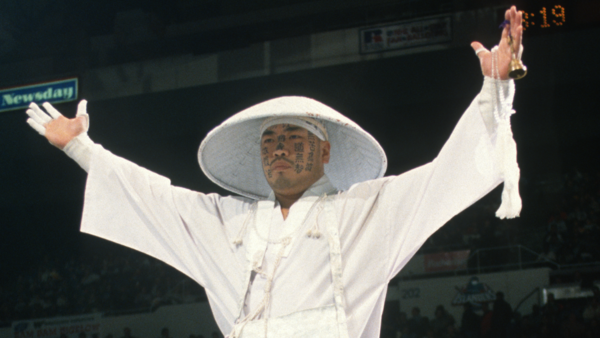
Jinsei Shinzaki was just 28 years old when he worked singles matches against Doink The Clown, The 1-2-3 Kid, Tatanka and The Undertaker himself over four nights in 1994, but his efforts obviously made a huge impression on the right people within the organisation. By the end of the year, he was receiving the full vignette roll-out from Vince McMahon. The rebranded 'White Angel' Hakushi was coming to America, right in time for a darker-than-ever Undertaker's own re-emergence...
CONT'D...

Alas, a seemingly natural feud between the opposing forces never materialised.
Hakushi engaged in eye- and boy-poppers alike with Bret Hart and The 1-2-3 Kid, but the stink of 'foreign menace' lingered too long on the 'White Angel' to ever find time to tackle the 'Lord Of Darkness'. Worse was to come for the athletic star when Vince McMahon's reverse midas touch at the time sucked the heat out of his crowd-pleasing offence by creating a happy-to-be-here babyface dork alliance with Barry Horowitz.
Seeing more writing on the wall than all the scripture tattooed on his chest, Shinzaki bid Hakushi and WWE farewell in early 1996 to find further fortune in his homeland.
It didn't go (storyline) well. Though spiritual home Michinoku Pro helped him hone his craft as it had years earlier, his one date for New Japan Pro Wrestling ended in disaster. A match against The Great Muta at Battle Formation 1996 was so one-sided that the sub-Hakushi persona he portrayed was pronounced dead. Evil had permanently defeated good, with no supernatural power strong enough to bring it back to life.
Enter The Undertaker.
CONT'D...
Just days removed from his gruelling clash with Shawn Michaels, 'The Demon Of Death Valley' was back in Japan for a contest that has to be seen to be believed. The Undertaker took on his former WWE colleague Shinzaki, but not before bringing him back to life after mortuary attendants wheel his corpse to the ring.
Supposedly caught compromised to a permanent end after the Muta loss, Jinzaki - specifically as the Hakushi-esque version himself that wrestled for NJPW - was left in the ring by the assistants. The ghoulish and other-worldly presence of The Undertaker astonishingly returned him to life, with the mud-and-blood-stained Hakushi selling the experience as if he was literally learning to use his arms and legs all over again whilst attempting to yet again do battle with death.
Ordinarily considered a superlative performer for his in-ring work alone, this was character-driven stuff on another level from anything he'd had the chance to do for Vince McMahon and again highlighted the size of the open goal missed when he did wrestle for the biggest organisation in North America.
October 1997 was a different time. This sort of silliness wasn't hard to keep hidden from fans, and thus didn't damage the legacy of Kane or The Undertaker one iota. Unlike, say, coming back to perform quasi-comedy matches with fellow old-timers Triple H and Shawn Michaels in 2018 for a small fortune. Regrettably, it's hard to imagine this Undertaker inspiring life in a deceased soul when he seems so tragically unwilling to inspire it in himself.