The Day WCW Nitro Died
It's 20 years since WWE purchased WCW, but Nitro had long died before Vince McMahon put it down.
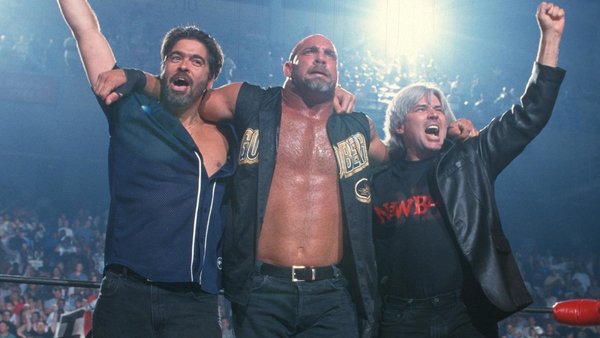
21 years.
Over two decades have passed since WCW's doors closed in March 2001 just months removed from a catastrophic calendar year and mere days before WWE's most celebrated WrestleMania ever. The body wasn't cold, the funeral was nonexistent and the wake ended up being the best night out anybody ever had.
It's been a minute. And yet, because modern wrestling feeds and feasts on anniversaries, retrospectives and the like, WCW endures as something of a perpetually reanimated corpse. Monday Nitro especially. Why is this?
In short, it's capitalism. It's always capitalism.
A billion dollar deal with NBC for WWE's archives recently spoke to the success of the Network as a seven-year project, and the likes of the New World Order and Eric Bischoff going into the WWE Hall Of Fame keeps the Monday Night Wars conversations simmering between many that weren't even alive to have the original ones.
But - to paraphrase the Big Boss Man reading a eulogy of a different kind - the old b*stard is dead, and it ain't coming back. And sadly, Monday Nitro passed long before Shane McMahon pretended he wasn't putting a bullet in it in Panama City.
We're 21 years on from that night. But that night was nearly two on from the show's real demise.
CONT'D...

The closing moments of the last ever Monday Nitro saw it halved on screen with a live edition of Raw simulcasting across TNT and USA Network.
This was one of the few audacious flexes Vince McMahon actually deserved, though who knows what any of us did in a past life to suffer Shane McMahon on the other half of the divide. You know all this, though. WWE love bringing it up, even though there was once a time they wouldn't even mine their own history with such fondness.
Imagine tuning into an edition of Superstars or Wrestling Challenge to watch Hulk Hogan and Randy Savage in March 1991 and listening the commentators or wrestlers themselves talk about Ivan Koloff and Pedro Morales battling over the WWWF Championship. The comparative timeframe is identical. The difference is how little wrestling used to lean so heavily on its past. And the prism of nostalgia can be powerful, regardless of what actually took place.
It's so prevalent that some of the Wrestling Twittertariat have become confused into thinking that this classes as "#storytelling", which itself has been chewed up and sarcastically spat back out by opposing voices. It's not storytelling, because - and this almost shouldn't need saying but evidently does - a story isn't being told. An image may be revisited, a moment rebadged or a memory relived. But it's not a story. Not unless it builds on the old, creating something new.
This was something Vince Russo clearly felt when he took the creative reins of the struggling Atlanta outfit in 1999. Time for new. New wrestlers, new stories, and a new WCW. This was good.
His version of WCW Nitro...was not.
CONT'D...

Feels worth clearing something up before we get back into how such a massive mess was made.
Vince Russo didn't kill WCW, and far be it for this article to be another assertion of that for him to vanity search and rip apart. 2004's "Death Of WCW" by Bryan Alvarez and RD Reynolds pinned plenty on him, and Eric Bischoff and many others. Just about every one of the named parties predictably refuted much of the book's content as missing the wider issues at play, and maybe they had a point. Though detailed, Alvarez and Reynolds luxuriated perhaps a little too liberally on some of the truly terrible storylines and angles that permeated Nitro and Thunder in the years leading up to WCW's demise.
As a division of a Turner enterprise that was simultaneously crumbling and evolving beyond something anybody - Ted Turner included - could realistically keep a hold of, World Championship Wrestling was always going to struggle to maintain its position as long as it continued to lose money.
And lose money it did in 2000. Sh*tloads of it.
A Variety piece on the planned 2001 Fusient Media company buyout notes it was around $60,000,000, with various other sources offering figures around $10,000,000 either side of that. This year - this disastrous, money-haemorrhaging sh*thouse of a year - was dominated and defined by Vince Russo's vision of Nitro. He was in and out of the company over the 12 month period, was at various points the on screen authority figure, the real life head of creative and even briefly the WCW World Heavyweight Champion.
It was the sort of chaos that invites ironic analysis in the post-script. Wrestling Twitter's version of bad movie night, 2000 Nitro doesn't blink when you're trying to stare it out, but when you do you miss something. It's batsh*t, cash-pilfering television.
And I sweaaa to gawd bro, you won't believe it but this is a shoot bro, but the night that birthed this era was also the night that killed WCW's flagship. March 23rd 2001 was the end. October 18th 1999 was the point of no return.
CONT'D...

The job of Vince Russo as WCW's new creative head honcho was to show us that things had changed at the top, not tell us at the top of the f*cking show.
But that's what happened on October 18th 1999.
Viewers were told on camera by Tony Schiavone and Bobby Heenan earlier in the broadcast that the company was under a new creative direction as if that - in kayfabe - warranted explanation. There'd already been a clue of this in the opener when Bret Hart walked out during a match between Juventud Guerrera and Evan Karragias to cut a promo because "somebody in the back" told him he couldn't have any time for an interview.
That's yer universe rules established and then destroyed within the first six minutes of the show, then. At least it ended with the promise of a World Championship match that night. Which, as it turned out ended up going on in the middle of the show and finished cheaply thanks to a poorly-executed Lex Luger run-in.
It was just after Schiavone and Heenan's reveal of Russo's involvement that they promoted a "New York Evening Gown" match too. This was all suddenly following form, but at least there was...sigh...a sales pitch to stick around. Or was there? Soon enough, Madusa was cutting a promo saying she refused to compete, which, based on the precedent set by Hart's interruption, would get her a title shot, right?
Lol. Nope, she was just forced to compete anyway.
Women got a raw deal on this show because of course they did, but a Nitro Girls fan vote triggered the most egregious deathblow - Buff Bagwell.
No, 'The Stuff' didn't help put a nail in WCW's coffin (this time), but he was involved in the calamitous segment that did.
CONT'D...

Appearing for yet another interview that "wasn't on the format", Bagwell cut an enthusiastic promo about being "the chosen one" by his "new bosses", noting that success in wrestling was "all in the stroke". Strangely though, he looked thoroughly disinterested when he emerged for his match against La Parka later in the broadcast.
As the announcers constantly made mention of him not looking his typical self, Buff cut a frustrated figure throughout the whole match, mocking all his own taunts and completely exposing the rhythm required to actually have a pretend fight in the first place.
The finish was criminal pro wrestling negligence. Presenting himself for La Parka to kick him in the head, Buff mocked the process and yet sold the boot all the same. Absorbed the finish, but popped straight up afterwards. Asked Russo, on the announcer headset, if he did a good "job". It became clear that management had told him he wasn't their top guy after all, and that he was due to lose to the Mexican star. His display was thus entirely in protest, and completely contradicted the fundamental rules one has to accept about professional wrestling as a whole.
Then, in case you were concerned that enough tropes hadn't been ticked off, Jeff Jarrett jumped from the World Wrestling Federation and smashed him in the head with a guitar.
CONT'D...

It can't be understated how much of a disaster this whole scene was, even if one can be generous about the shock factor of 'Double J' arriving 24 hours after working his infamous No Mercy Intercontinental Championship match.
Russo was always obsessed with reality equalling ratings, but he so often leaned on the "this is real...those other segments are the fake ones" mentality that it undermined the attempts at supposed sincerity. Was the balsa wood guitar real? Bagwell sold it like it was, even though it looked faker than most of La Parka's offence.
This was an objectively poor show without this bullsh*t anyway. Show-long angles featuring Sid deploying Lawyers to stop Goldberg, the drunken Outsiders p*ssing about for no purpose in particular, and Ric and David Flair not knowing their elbows from their a*seholes doubled down on the cr*p product fans had already abandoned in droves. The aforementioned Hart/Sting title stuff was 50/50ed by the end of then night by virtue of allies Goldberg and Lex Luger doing battle in the main event. People walked backstage in between segments. F*ck me did people walk a lot.
So too did yet more fans. This thing was doomed, bro.
CONT'D...

Is this Nitro worth your time, even for a bit of hate-watching, in 2021?
Perhaps. If you only watch one from the eternally boring 1999, make it this one. Foreshadowing how awful the three hour Raws would become, the long drawn out matches and rematches make for dire times when the characters aren't over.
Vince Russo addressed this problem for all of one week in how quickly this show moved, but it was unwatchable for entirely different reasons almost immediately afterwards.
WCW lost viewers and AOL/TimeWarner bosses lost patience, but this Nitro resulted in the company's core audience - the one that has proved so vital to WWE in the streaming age - losing faith. Russo wasn't the fix, the fix for the fix wasn't the fix, and the promise of a fresh start couldn't fix what was deemed too broken after shambolic telecasts like this one.
Cry for the death of WCW 20 years on from its passing if you must, but take care to remember the reasons it happened. Or for that matter, watch them on Peacock - Vince McMahon's already been paid for it, because capitalism - not McMahon, nor Russo, nor even Jeff Jarrett - will sadly always be king.
Watch Next
Quiz: Can You Name These WCW Mid Card Wrestlers?
