The Disturbing Truth Behind The Fiend
"Heal"? More like, "Hurt!"

‘WWE buries the Fiend character during second match,’ reads like a down-voted SquaredCircle comment, but that’s what happened.
At Hell In A Cell, WWE infamously portrayed the Fiend as an invincible killer who lost, more or less, or was at least incapacitated by a regular old wrestling finishing move. He endured several weapon shots, too, but so too do at least two ‘Superstars’ on every other pay-per-view. The Fiend no-sold much of Seth’s onslaught, but did lay on his back, for what seemed like an eternity, in a scene drawn out by a toxic din.
It was astonishing, in that you could almost feel the character slip away from the clutches of hope, and for reference, Humberto Carrillo brought more of an offensive fight to Rollins on this week’s RAW. This horror movie layout jarred with the psychology of pro wrestling to the point of irreconcilable farce. It wasn’t a gun that rendered the Fiend unable to defend himself; it was the same Curb Stomp Braun Strowman had bantered off at Clash of Champions, the same chair shots that Attitude Era fans—the only fans, far fewer in number, that make up WWE’s base—can’t take seriously as a match-ender, much less a life-ender.
Imagine Michael Myers selling a suplex from Laurie Strode, and honestly, you’re not that far away.
WWE failed the Fiend during that match—and minutes before.
CONT'D...(1 of 5)
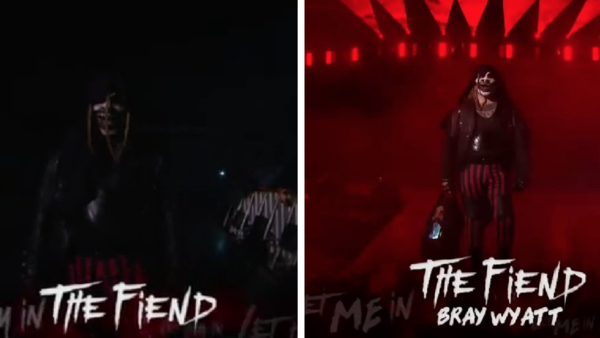
The graphic ’The Fiend Bray Wyatt’ appeared when the character made his entrance. This is in contrast to simply ‘The Fiend’, which ran over the screen at SummerSlam. Somewhere between August and October, Vince McMahon decided to conflate the two entities. Joseph repeatedly insisted that ‘the Fiend Bray Wyatt’ was carrying a mallet, or whatever dumb sh*t he was doing, and not simply ‘The Fiend’.
You could almost hear Vince screaming in Joseph’s ear. “He’s the Fiend Bray Wyatt! Our idiotic Universe must be made aware that it’s Bray Wyatt in there!”
*Narrator*
It wasn’t Bray Wyatt in there. The Fiend is—or was—the manifestation of Wyatt’s disassociated personality. He was a tulpa, thought into existence, driven by Wyatt’s guilt, fury and self-loathing at wasting his awesome potential. That’s one interpretation, and that was the joy of the character: it yielded several, and these interpretations converged to create the one non-toxic discourse surrounding WWE.
And until Vince Vinced it, the character was awesome. There was a real Lynchian quality to the horror, an unsettling contrast between lightness and innocence and the darkness that will always undermine everything. The Muscle Man Dance was as funny as the Fiend’s SummerSlam debut was really quite horrifying. The Fiend, for a time, felt like the ideal, only-in-sports entertainment creation—the perfect way to combat the rising ride of professional wrestling.
And then Vince Vinced it.
CONT'D...(2 of 5)

As reported by Fightful’s Sean Ross Sapp, at Hell In A Cell, Vince’s “vision” played out to his exact specification. Of course it did.
A less controversial but equally grim development occurred on the SmackDown after Hell In A Cell—after WWE had refused, through presumed embarrassment, to acknowledge the farce on RAW. The Fiend interfered in the match between Seth Rollins and Roman Reigns by breaking through the ring canvas and dragging Rollins to symbolic hell. Rollins promptly escaped from hell within 12 seconds. So what happened here? How did he escape? Did the Fiend simply taunt Rollins, as part of an ongoing crusade of torment? Does the Fiend, like the eponymous ‘IT’ from Stephen King’s novel, need fear to inform his power? Or did Vince just think Hell, have him do some Kane sh*t!, conflating Wyatt with the generic ’Supernatural character’ trope?
Because that’s what that angle was. This was the same goofy, antiquated sh*t Kane used to do, and it’s what the Fiend is doing now, because it’s Vince’s show, and Vince is bereft of imagination. The scene looked hokey. The Fiend looked like a generic Boogeyman—the exact opposite of what was promised in those stupendously creative Firefly Fun House vignettes.
The failure of the Fiend character brought into focus WWE’s absolute refusal or ability to commit to anything remotely in the vicinity of ‘conclusive’, or ‘purposeful’, or ‘not a total waste of bastard time’. If a supernaturally-powered character can’t win his second match, what point is there in expecting any performer to progress—especially since those who do, do so through resistance (Kofi Kingston) or happenstance (Becky Lynch)?
The reaction has created a black hole around the company. It has existed for several years, but the events of Hell In A Cell ripped it open further. Why get behind Humberto Carrillo’s push? He’s outrageously talented, but that doesn’t matter. Also, he’s a power ranger.
After being genuinely unsettled by the Fiend at SummerSlam, the WWE fandom is now scared for the Fiend. The Fiend is illustrative of everything. If WWE fans can’t believe in the Fiend, what can they believe in? The Fiend is emblematic of the malaise, the nihilistic pointlessness that courses through everything: he is the grotesque, fixed-grin Face of WWE.
CONT'D...(3 of 5)

Shortly after the Hell In A Cell debacle, an unrelated event unfolded: Eric Bischoff was removed from his position as Executive Director of SmackDown. Again, this served as a reminder that Vince is going to Vince: Eric, per the musings of those who know Vince best (Jim Ross), Wrestling Observer sources and Fox insiders, was “hired to be fired”. He was a fall guy with which to shield himself from blame. The narrative had gently changed. Paul Heyman’s fingerprints are on RAW! The show has improved! Buddy Murphy is getting a push!
And now, the narrative has changed again, as it all too often does: Vince never went away, did he?
The disturbing truth behind the Fiend is that the Fiend has proven, almost conclusively, that WWE is bankrupt as a creative entity. It's been this way for years, but everybody is waking up to it. People like to use the capitalism argument when it comes to WWE, so look at the latest SmackDown rating. How can a million people be wrong?
The character cannot work, even if Vince grasped it. The Fiend is over-powered, but he isn't permitted to showcase that power. And if he was, that power can only manifest as schlock that renders suspension of disbelief impossible in the context of professional wrestling. To have stood any chance of this working, WWE should have treated the Fiend like Brock Lesnar immediately: as a destructive force only a well-built babyface, in the form of his life ahead of WrestleMania, could compete against. Instead, he was 50/50'd in his second match.
WWE at this point would have Cthulhu look shocked when Shorty G stole one from him.
CONT'D...(4 of 5)

"They call him the ‘Great Old One'. You know, I was talking to Cthulhu earlier today, and they told me that they want to open a monstrously craven portal within the WWE Universe.”
“Cthulhu, a skyscraper-sized dragon-octopus hybrid, having trouble building momentum over Drew Gulak.”
The Fiend can’t sell. He has supernatural powers. Selling anything undermines his aura as a monster and achieves a weird, tragicomic effect. There might be a way to adapt the character into a fictional universe resembling pro wrestling, but in hindsight, perhaps the least creative wrestling company wasn’t the best place to do it.
The Fiend character was dreamt up by a deeply creative and motivated individual with agency and the time to perfect it. The vignettes that got it over were produced outside of WWE’s umbrella. The process took a considerable amount of time. The whole thing was ruined, aggregating SummerSlam and Hell In A Cell, in under 10 minutes within the cursed WWE ring. There is a systemic failure rotting WWE from within, and it’s literally got horns on its head.
In the end, ‘Abandon all hope ye who exits here’ was a meta in-joke too far.