The Disturbing Truth Behind The Worst Month Of Vince McMahon’s Life
The Chairman has a November to remember...
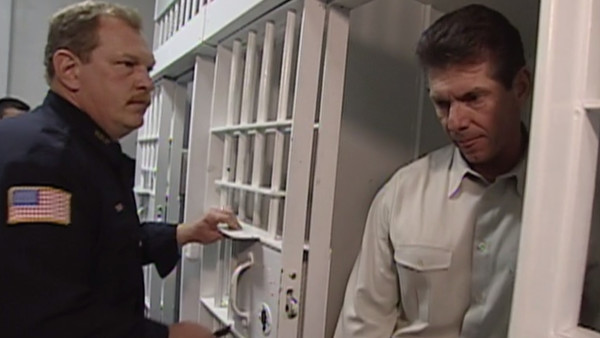
Vince McMahon, as evidenced by his gradual and enforced decline as an on-screen performer, hasn't really had an awful lot to sweat about over the last decade. As of 2019, ratings aren't ideal, talent morale isn't what it could be and dweebs like your writer are smashing their heads into screens trying to make sense of his product, but Chairman LMao himself has guffawed his way into the biggest television deals of his insane life and an XFL reboot in 2020 that already somehow looks set to knock all the punchlines into a cocked hat.
The glow of fortune can be fickle, but it's shone brighter than ever on McMahon since he escaped his last scandal largely unscathed. In 2007, the ramifications of the Chris Benoit double-murder suicide were such that he had to make wholesale changes to his output, or at least look like he had. A move from TV-14 to PG serviced lucrative merchandising and sponsorship deals, whilst a broadly functional Wellness Policy (instead of an entirely impotent) helped talent as a secondary function. The primary one? In McMahon's own words - "public relations".
He'd been forced to get much better at that after Owen Hart fell tragically to his death during Over The Edge 1999, five years after his company approached a commercial and creative nadir following scandals and charges strong enough to send him to jail. In July 1994, he was legally and publically exonerated, but over a catastrophic period between October and November 1993, he was months and multiple lifetimes away from the safety of the following summer, or the infinite security of the present day.
CONT'D...

On November 19th 1993, Vince McMahon (or, Titan Sports, then the parent company of WWE to allow for him to fart out mad concepts such as the World Bodybuilding Federation years earlier) was indicted by the federal government on charges of conspiracy to distribute steroids and illegal possession of steroids with intent to distribute them.
Despite McMahon and the organisation's protestations, the allegations weren't wildly flung by governmental forces looking to bring him down for their own amusement. Former ringside medic Dr George Zahorian's 1991 steroid distribution conviction had opened several new avenues of investigation, and several of them led to the front door of Titan Tower. Zahorian's actions were, according to the case against WWE, not just his own, but ones shared by McMahon, Hulk Hogan and others in and around the industry during the doctor's stint with the group in the 1980s.
This was no temporary Twitter cancellation or misguided WrestleMania Battle Royal labelling snafu. Sponsors had already deserted the company during the Zahorian case years earlier as drug and sex scandals engulfed the organisation, but the penalties that came with any guilty verdicts stood to potentially sink WWE outright. At worst, Titan could have had their headquarters seized and been crippled financially by legal fees and fines. All while McMahon himself would have been forced to run what remained of the organisation from inside a prison cell for up to eight years.
Agreeing to go to trial in 1994, he plead Not Guilty to all the charges on November 23rd, one day before a Survivor Series pay-per-view already in total crisis. And not, astonishingly, just because of the intense legal scrutiny. Not around steroids, anyway.
CONT'D...

The 1993 feud between Bret Hart and Jerry Lawler had been a shining light in an often-dim and dull summer. Hulk Hogan's June departure (more on that later) had left the company with less fuel than the broken down Lex Express that had sat in a parking garage after Luger's failed attempt to dethrone Yokozuna at August's SummerSlam. A tepid tribute act to 'The Hulkster' despite his talents, the 'Made In The USA' gimmick wasn't taking in an era where fans were still broadly responsive to whatever they were given.
Underneath a main event that felt far too attached to what had worked before, Hart and Lawler were bringing something brand new to the upper midcard. The 'Hitman' had won the inaugural King Of The Ring pay-per-view in an effort to keep him at the top level without the actual title, whilst Lawler's presence on television at all was still brand new to younger fans and older Memphis-savvy audience members that never imagined it possible.
Lambasting, Bret, Owen, Bruce and Keith Hart along with the rest of the seemingly endless siblings, Lawler saved his sharpest barbs for the parents, Stu and Helen. Positioned by WWE as patriarchal figures of pro wrestling rather than just their own family, it was as if 'The King' had gone for the industry's genuine monarchs. A blistering series went unsettled in a fabulous extended segment at SummerSlam 1993 leading to a planned Survivor Series payoff in which the four maligned brothers would kick the f*cking sh*t out of 'The King' and three mysterious "knights".
The company hadn't been the best at setting a stage when nothing was commercially clicking, but this, at long last, was something fans were desperate to sink their teeth into.
("Jaws" theme intensifies...)
CONT'D...

A go-home angle that featured Jerry Lawler decking Owen Hart to distract Bret in his WWE Championship match against Yokozuna was already in the can when 'The King' got his own knock from the police just a week or so before Vince McMahon himself.
The Survivor Series co-main eventer was charged with one count of second-degree rape (statutory, not forced), three counts of second-degree sodomy, and one count of harassing a witness. Big f*cking charges, big f*cking words, and big f*cking problems for both Lawler and the frazzled Chairman.
A incredibly complex case best left for another article altogether, the charges were dropped the victim amidst some controversy around the legitimacy of the claims, but it would be six months before 'The King' could be anywhere near the company's output again. A half-year of story was flushed and hushed by the scandal as WWE scrambled to slot a villain in Lawler's place. McMahon - as he would multiple times over the years - turned to a controversy-riddled Shawn Michaels.
'HBK' had been suspended and stripped of his Intercontinental Title months earlier for failing a steroid test. It's a failure he disputed then and still does to this day, but the cloud of suspicion hung over his head, not least with performance-enhancing-drugs being such a hot-button subject in light of McMahon's other pressing problems. Taking the punishment on the chin, Michaels was brought back the week before the show to shoot a tacked-on angle where he crudely bantered off the Harts, before assuming the role in the match itself with masked knights he barely even attempted to force chemistry with.
A money payoff never materialised, the elimination match a reflection of all of Vince McMahon's problems in a microcosm. He surely must have felt the squeeze of these outside forces at the time, but much internal strife was adding to the pile - some from two megastars he'd been batting back for years.
CONT'D...

On October 18th 1993, Randy Savage went absolutely f*cking mental about Hulk Hogan during an episode of Monday Night Raw, and it was brilliant.
It was part of a brief campaign from the Macho Man against his former friend that also included a lengthy takedown on the short-lived Radio WWF show hosted by Jim Ross at the time. Fleshing out the astounding diatribe, he dished some very, very dirty dirt on Hogan, severing their ties as well as confirming what most already knew - things between 'The Hulkster' and the company were at their lowest ebb.
Reported by the Wrestling Observer at the time, Dave Meltzer noted that Savage called Hogan "the worst prima donna I've ever met in my life" and said his ego is so out of control that 'Hulk Hogan' had consumed the real Terry Bollea. Amongst other damaging remarks, he commented that he'd advised Hogan not to lie about taking steroids on "The Arsenio Hall Show" in 1991 (before he eventually did), and even accused Hogan and then-wife Linda of directly contributing to the breakdown of his marriage with Miss Elizabeth with some behind-his-back meddling when they were still together.
Using a live Raw commentary spot was a rare case of platforming from the ultra-professional Savage, but the lack of any of his rage being cut at the time as well as the radio rant implied that McMahon was more than happy to potentially sabotage his former golden goose, not least as Mr Nanny struggled to finally get Hulk's cinematic career off the ground at national box office.
The shoot fizzled by virtue of Hogan's surprisingly passive non-response to it all, suggesting that if McMahon or Macho were after a bite or the negative publicity, they'd even failed at that.
Nothing was going right, no matter how wrong some of the spiky remarks sounded on the saccharine shows. The greatest wrestling promoter in industry history couldn't book a shoot between two sworn enemies, let alone an effective worked one between storyline foes...
CONT'D...

Small change in comparison to some of the above tales of darkness and debauchery, the product suffered under the strains of these external challenges.
In an effort to keep Lex Luger hot before a second challenge at Yokozuna the following WrestleMania, WWE sought to get Finnish heel Ludvig Borga over as an equally devastating foreign menace. They gifted him Tatanka's near-two year undefeated streak in November, writing the Native American out of the Survivor Series in the process. Borga subsequently drew poorly with Luger in December and was injured in January, before the company could even get a pay-per-view payday out of the Tatanka rematch.
Survivor Series didn't need McMahon's state trial distractions, the Hart/Lawler disaster or any more matches getting robbed of serviceable midcarders in this manner. A catastrophic contest featuring Bam Bam Bigelow's heels getting bantered to death by Men On A Mission and The Bushwhackers dressed in Doink masks was one of the most embarrassing spectacles in company history. It's a vision of a product entirely off the rails. The clown was a f*ckabout face rather than a heel, and he wasn't even part of the match because the original man behind the paint (and the only one who might have gotten babyface Doink over) Matt Bourne had just been fired.
In a tragicomic end to 1993, Bobby Heenan exited Raw and WWE altogether at the hands of longtime rival Gorilla Monsoon. It was a beautiful send-off between the two real life best friends, but occured because WCW had given 'The Brain' the proverbial financial offer he couldn't refuse. The crumbling company had lost another cornerstone and The Chairman couldn't even really do much about it.
Maybe this, rather than any of the individual incidents, was what stung the most for McMahon. To look at him now is to see an unflappable, untouchable tycoon immune to everything, let alone the minor disturbances we all might enjoy heightening. Power beyond the amount any normal human would really need.
For one torturous tenure in his incomparable existence, he was completely, entirely powerless.