The Disturbing Truth Behind WWE’s New Monopoly
MASSEDUCATION.

“I thought I was good. You know? I really thought I was good. And then I got in the ring with Eddie Guerrero. And I was like, ‘Holy crap, am I bad.’ That was the big step up in competition, that was the big test. But it gave me that attainable goal.”
CM Punk, Best In The World DVD [2012].
A sequel of sorts to Michael Hamflett’s excellent piece, here, we deep dive into the implications of WWE’s “global localisation” directive on the wrestling art form.
As broken by WrestleTalk earlier this week, WWE has renegotiated the performer contracts of NXT UK talent—though that suggests a bargaining we’re quite sure did not take place—and they are now precluded from working anywhere else beyond PROGRESS, ICW, OTT, wXw, Fight Club Pro, and Attack! Pro Wrestling.
WWE presents sports entertainment, not pro wrestling. To WWE, sports entertainment is better than pro wrestling because sports entertainment squashed pro wrestling in the 1980s. It’s not pro wrestling to them, hence why they refuse to accept the terminology; it’s wrasslin’, a smug bastardisation with dry, niche, corny connotations. In the wake of this news, the rising Phoenix of pro wrestling may turn to the ash from whence it came.
History supports this cynicism.
CONT'D...(1 of 5)

Goldberg became a WWE-style sports entertainer babyface in 2003, to the complete detriment of his destructive WCW aura. He had to sell. When CM Punk delivered a piledriver to John Cena in their famed RAW match of February 2013, it was celebrated as an act of transgression as much as a potential match-ender. That is because the move, like so many others, is banned. Imagine if he decided to dust off the Pepsi Plunge. You can’t: nobody has Punk’s balls any more, and even he didn’t have the balls to ascend that turnbuckle.
Daniel Bryan, a performer unique in WWE’s context, ran through a John Cena-like sequence in his babyface pomp, one that relied on the temporary amnesia of his opponents. He did this in every match. The mass-produced WWE model encourages this sort of homogenisation. Bryan, incidentally, is credited with tearing up WWE’s recruitment policy.
But did WWE learn to love the Independent circuit, and its lucrative diversity—or learn to tolerate it?
Those aforementioned examples were all drawn from WWE’s pre-NXT history. A return to the values of professional wrestling spearheaded by a man who grew up on and did not resent it, Triple H’s TakeOver represented something of a paradigm shift. No longer was size or dreaded popularity a barrier to success; if you were good, NXT made good on you. Generating an unprecedented level of critical acclaim and hardcore fan engagement, NXT was and is as outstanding as it is refreshing.
But.
CONT'D...(2 of 5)

To enjoy a Johnny Gargano match in 2018, you sort of have to enjoy a Shawn Michaels match, too: though exactly the sort of pulsating, twisting, affair NXT fans lap up, you couldn’t not see the puppet strings hovering over the heads of Gargano and Aleister Black in Los Angeles. The story-driven build reflected in the match, melodrama at times supplanted realism. At various points, both the never-say-die Gargano and martial arts practitioner Black disengaged from combat blows to instead exchange words.
This TakeOver was suffixed ‘WarGames II’; at times, they might as well have stuck ‘The Resurrection of Shawn Michaels’ on it. Shawn was an outstanding performer, obviously, and clearly, millions of fans enjoyed his theatrical style. But this sort of very apparent NXT production is another form of WWE control. Look at certain new main roster acts, like AOP, and you can infer what is taught and what is learned—and, by extension, how much of what we see on NXT is production flex, and what is creative freedom. A more entertaining spin on it—but control, nonetheless. Even if that one match was amazing in itself, the principle behind its layout remains troubling for the wider picture.
Should WWE achieve this new strategy, and become successful in luring away the very best practitioners in Japan and elsewhere, hysterical as this may read, you won’t see Minoru Suzuki drill anybody’s skull with a cradle piledriver. You won’t see Tomohiro Ishii bust anybody’s brains. Kazuchika Okada isn’t an enduring, safe pair of hands known intimately to WWE for decades. He’ll have to retire his Tombstone. It’s not as if Okada, and what a grim, sad-but-true notion this is, is Kane.
Kenny Omega doesn’t appear to be WWE-bound anytime soon, but then, many wrote that about WALTER prior to this week. It doesn’t matter that the Cleaner has performed his uranage signature safely every time he has delivered it; his opponents land a bit too close to their heads for WWE’s liking.
It will have to be modified.
CONT'D...(3 of 5)

Everything is modified in accordance with WWE’s practises, either through arrogant control or sponsor-friendly safety guidelines. We might soon apply that maxim to all of professional wrestling, at least until the next Phoenix movement —which, reminder, the last one took over a decade and half to fully gestate.
And, when it did, it terrified WWE into this response. They will have far more money and reach to thwart the next movement, if in fact one materialises.
This is the worst-case scenario—but not unthinkable. Per the latest Wrestling Observer, upon reaching agreements with ICW and PROGRESS, WWE inserted clauses that will allow them, unchallenged, to purchase both companies and shut them down to avoid any competition. These agreements are not mutually beneficial, nor are they beneficial to the talent, nor the health of the art.
They are beneficial only to WWE. If the parallels between now and 2001 are not clear, they should be.
We’re not just talking moves. Moves are almost incidental to the best in-ring stories. But the broad way in which WWE tells stories is as rigid as many of those—like Baron Corbin—tasked with the pen.
Zack Sabre, Jr. flourishes on the worldwide circuit because his submission-based approach is a sort of anti-theatre aimed at the purists. He doesn’t strive to entertain, but to hurt—but is so good at it that entertainment is a byproduct. He doesn’t tell S T O R I E S.
Does Tomohiro Ishii, if he goes to WWE, take not stiff forearm shot after stiff forearm shot to convey his unyielding fighting spirit, or does he, like they all do in the end, get put into a rest hold by Baron “F*cking” Corbin? Omega has redefined pro wrestling with unreal feats of stamina and athleticism over several, seminal 40 minute plus matches. He won’t redefine sports entertainment.
Nobody ever does.
CONT'D...(4 of 5)
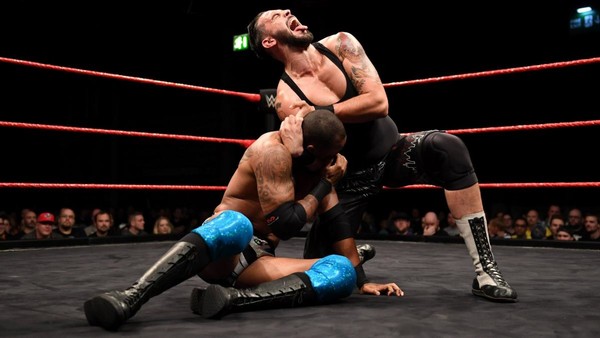
In WWE, babyfaces sell, and sell, and sell—to such an extent that the desperation has come to undermine what was once a lucrative pitch. It’s sort of anti-premium. Just look at the absolute state of torture porn protagonist Finn Bálor: in a grim metaphor for all of this, he exists now as a neutered, literal fall guy.
AJ Styles and Samoa Joe resumed their old TNA rivalry in a WWE ring over the summer. The first two matches were stiff and engaging, but far less lively. Maybe it’s an age thing—or maybe they’d have performed like this had WWE signed them a decade prior.
Ronda Rousey sold for Alexa Bliss, for minutes on end, at Hell In A Cell. Ronda Rousey. Stretches of that match were absurd. Irreconcilable. But that’s just the way WWE does things. It’s all an echo of Hulk Hogan, of John Cena, something the mass-produced and very successful model will not deviate from. Why put the hard work in, when there is easy money on the table?
It’s all deeply, disturbingly ironic. With the global localisation policy, WWE does not want to cater for region-specific tastes. They just want to maintain their stranglehold over the world, and continue to shape it in its own image.
History supports this cynicism—but what of the present day?
NXT UK is, in a word, indistinct. Though it bears the same name, it hasn’t yet resonated as the passion project of Orlando. It resonates as, and very much is, a cynical, hastily cobbled together wrestling brand with no real selling point. There’s no ICW-level camp or ultra violence, no state-of-the-art PROGRESS technicality. It is WWE wrestling, only in Great Britain. What’s troubling is that the crowd receives the uneven, basic and formulaic undercard action with all the enthusiasm of the spoiled Full Sail faithful—and yet, the UK crowd hasn’t been spoiled over the course of six years. The TV show is this new, yet oddly familiar beast. Wrestlers make their entrances without acknowledging the pulse of the crowd. Eyes fixed on the ring, they play only to the hard camera once inside of it. They barely interact with the fans in the crowd, nor do anything beyond their signature pose for the benefit of those at home. It’s not in the WWE playbook.
The main events are cracking—but then, those who perform in them honed their craft, for years, across the globe. On this evidence, NXT Germany will be WWE wrestling, only in Germany. WWE Japan will be WWE wrestling, only in Japan. Ask yourself this: what was the impetus behind NXT UK in the first instance? There’s nothing benevolent about any of this, nor, you have to forecast, anything beneficial.
That quote, at the top of the piece, saw the Second City Saint cut his own version of the old “Iron sharpens iron” proverb. Would Punk become the performer he did, had Eddie not pushed him to his absolute limit and demanded he exceeded it? Now that NXT UK performers (and any prospective NXT Germany performers etc.) are contractually unable to wrestle the experienced, immensely talented hands of NJPW and ROH, and wrestle instead the same old faces, many of them as inexperienced, how can we expect them to truly develop?
If the WWE Universe expands, the art of pro wrestling shrinks. It has happened before, and if there is one constant in this year of utter chaos, it is that WWE always goes back to that they know.