The Problem With Edge That No One Wants To Talk About
Edge will likely face Roman Reigns at WrestleMania 37. A great story? Sure. Good business? Ehh...

For those successfully worked by it, Edge's Royal Rumble 2021 win was an invigorating slice of catharsis in an era largely devoid of such releases.
And how could you not be worked by it? The story was magic.
Out of the blue, a 46-year-old Adam Copeland made the most emotional Rumble comeback ever one year prior. The pop was thunderous. Almost a decade after being told he risked paralysis if he continued wrestling, Edge was back, live and in the flesh, raising hairs and spiking heart rates. A tremendous feud informed by 15 years of history followed, wavering only during WrestleMania 36's overambitious Last Man Standing slog, lasting until Backlash's 'Greatest Wrestling Match Ever.'
It wasn't the greatest wrestling match ever, but it was a great wrestling match. Edge and Randy Orton earned their plaudits for miraculously surviving WWE's absurd marketing of the heavily-produced bout.
Disaster struck within that slick epic Edge's dream return turned to a nightmare in the form of a torn triceps. Ruled out for the rest of the year, reports of a slow, troublesome recovery followed, raising questions of if he'd even be back for WrestleMania 37, let alone the Rumble.
But he was back for the Rumble. He overcame, endured, survived, and won, doing so following a perfectly-placed, anxiety-inducing RKO. You knew Orton would return to the match after his worked injury, but it didn't matter: the execution hit every note.
12 months after doing the impossible, Edge had done the highly improbable. It's not often a real-life tale as gripping as this falls in WWE's lap and the promotion, to its credit, stuck the landing.
Edge now heads to 'Mania 37. A shot at Roman Reigns' Universal Title presumably awaits in April. It's a near-perfect clash between a damaged, sympathetic veteran who has overcome unassailable odds ahead of a glorious last stand, and a ruthless, domineering brute of a heel, cold-blooded and cruel enough to snuff the fairytale out to maximum effect.
The biggest star of this era between a big star from a previous era.
Is it really, though?
Let's think about that word for a minute. Star.
CONT'd...

If "classic" and "buried" are the two most misused words in modern wrestling discussions, "star" is up there with it.
It has become a nebulous term thrown at any wrestler positioned in or around main events and major title scenes.
Drew McIntyre is a star, we're told, because he has thrived as WWE Champion on Raw under the most trying circumstances (he has), delivering weekly excellence in dystopian video conference stadium that eats lesser performers up (he has). Randy Orton is a star because he's a 14-time World Champion. Big E is a star because he's finally on the singles run fans always wanted, unhindered by The New Day's tag division trappings. Winning the Royal Rumble made Bianca Belair a star in one night. Karrion Kross must be a star: just look at him!
Throw any word around too often and it starts losing its meaning. "Star," like "classic" and "buried", is treated with such flippancy that the definition (within the context of wrestling) has become muddied.
McIntyre is tremendous, and deserves every drop of critical acclaim that comes his way, but Raw lost 19.2% of its audience in 2020 (far higher than the cable average of 8%) and he spent around eight of those 12 months on top.
Orton has lots of shiny titles and accolades but stopped being a genuine draw in 2008.
Big E is in the exact same spot he occupied seven years ago: Intercontinental Champion.
As talented as they are, Belair and Kross' pushes began five minutes ago. They haven't had a chance to drive business yet.
That's what a wrestling star is: somebody who pushes business in the right direction. None of the above can say that at the moment. Perhaps they'll be able to in the future, but not now. Arguing that this doesn't matter because "the brand is the draw" doesn't stack up either: the brand, WWE, has lost around 50% of its audience in five years.
As far as Roman Reigns and Edge go, there's enough evidence to call one of them a star in 2021. The other? Absolutely not.
CONT'd...

Roman Reign is currently driving WWE's business in a positive direction
Roman Reigns, therefore, is a star relative to this era.
The Tribal Chief returned to WWE on 23 August 2020, turned heel, and became Universal Champion seven days later. This sparked an immediate upturn in interest. Here's what SmackDown's average viewership was prior to Reigns' coronation:-
June 2020: 2.074 million
July 2020: 1.881 million
August 2020: 2.077 million
Things have since improved:-
September 2020: 2.151 million
October 2020: 2.186 million*
November 2020: 2.226 million
December 2020: 2.168 million**
January 2021: 2.216 million
In graph form:-
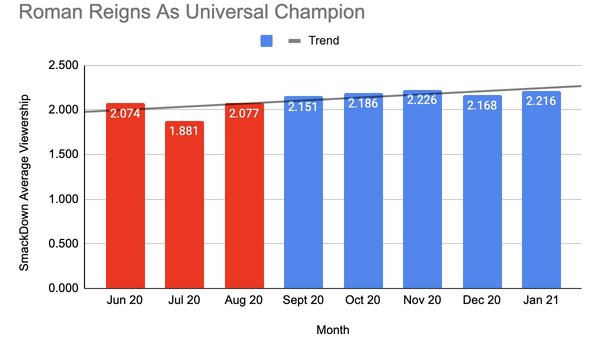
Clearly, the numbers are up on the whole. They're still down on last year, but WWE has at least stopped the SmackDown rot, with an increase of around 6.7% from September to January.
SmackDown is considered a much-improved show across the board over the past six months. Reigns can't claim sole credit for the upturn, but he should claim the lion's share as the man on top. He's also the only full-timer capable of breaking non-wrestler Bad Bunny's stranglehold on the merch charts. For this era, Roman Reigns is a star, driving numbers in a similar manner to Sasha Banks and Bayley for much of 2020.
Edge, depressingly, is not.
CONT'd...
* excludes an artificially low rating when SmackDown was moved to FS1 on 23 October
** excludes an artificially low rating when SmackDown was moved to FS1 on 18 December and an artificially high rating due to a strong NFL lead-in on 25 December

Though Edge's Royal Rumble 2021 victory was generally well-received by those watching, people weren't interested in the follow-up.
Marketed largely around Edge's celebration, the 1 February episode of Raw hit an average viewership of 1.892 million across its three hours. This was actually up on the previous week, but only by 72,000, which falls well within the Nielsen system's accepted 10% margin for error. These numbers compare poorly to the 2020 Rumble fallout show, which drew 2.402 million viewers and a 0.76 P18-49 rating.
WWE got next to no post-PPV rub following a show that closed on Edge's grand triumph, as was the case with McIntyre in 2020. Additionally, Raw lost 500,000 viewers from the previous year.
Edge then appeared on NXT two nights later, announcing it on Twitter the day before. This was a disaster. NXT plummeted by 110,000 viewers to 610,000, with the demo plunging from 0.21 to 0.15. The quarter-hour featuring The Rated R Superstar got smoked by Kip Sabian and Penelope Ford's wedding on AEW Dynamite, outdone 868,000 vs. 618,000.
Two nights later, with the intrigue of Edge's WrestleMania 37 decision the supposed selling point, SmackDown suffered a minor decline from 2.304 million viewers to 2.257 million.
On all three shows, the supposed "buzz" of Edge's win yielded negative results - and the following week's Raw was down even further.
Subjectively, anyone can receive Edge as a star. He is a big name with a glittering kayfabe past and his comeback run is a great story with plenty of fresh feuds and matches ahead.
But numbers don't lie, and they tell us, objectively, that Edge isn't currently pushing business in the right direction.
In February 2021, Edge is not a star.
CONT'd...
In Edge's defence, this is a largely star-less era. People like to argue this commonly-made point when they shouldn't, as the list of wrestlers one can point to and credibly say that they drive the business forward, using data as evidence, is minuscule. For the past six months, we have Roman Reigns, Bayley, and Sasha Banks. Bray Wyatt's 'Fiend' character has at least been a reliable merch-shifter since debuting, but doesn't necessarily compel people to tune in to Raw.
And that's about it.
Stars of previous eras reliably provide short-term ratings boosts, as was last seen when Raw Legends Night. The great hope when bringing the likes of Ric Flair, Hulk Hogan, and others in is that people who don't watch every week will see something they like and come back the following Monday, but they never do. Legends Night pulled 361,000 extra viewers on 4 January but Raw had lost almost all of them by the next show.
Edge ties into this problem. He's 47 years old now, and yes, it's a great comeback story, but he's the oldest person to ever take the Rumble after novelty winner Vince McMahon, and WWE still felt he was the best option to help Reigns and McIntyre lead the company through its most important part of the year. So far, he hasn't succeeded in attracting extra eyeballs. The data tells us that people beyond WWE's hardcore viewership are no more interested in him than anything else on Raw, SmackDown, or NXT.
CONT'd...

Again, this is a good story. It's a Hollywood yarn about an affable protagonist who has overcome real-life adversity to get back to this stage and is immensely rewarding for anyone who has ever invested in his career. Adam Copeland seems like an earnest, hard-working, and dedicated guy. It's hard not to root for him.
On a creative level, it's fine. On a business level? It isn't moving the needle. This is the problem with Edge that no one wants to admit.
We like The Rated R Superstar because of everything he was before his sudden retirement, everything he still is, and everything he went through between these two periods. With that level of investment, it's hard to look at the cold, hard numbers and accept the objective failure staring back, but it's right there. This isn't doing what it's supposed to: spark interest on the road to WrestleMania 37.
Perhaps it'll heat up before the pay-per-view. There are still two months to go and Edge naming the title he'll challenge for after Elimination Chamber 2021 (21 February) will guarantee more interactions with Reigns, a proven ratings draw. By that point, the Rumble winner will be paired up with the male wrestler doing more to drive business than anyone else. If Roman's continued ratings drive accelerates, great: it was worth it after all.
Until then, this story is no more attractive to the average consumer than anything else happening in WWE today.