The Real Reason We Never Saw Steve Austin And Jeff Jarrett Wrestle
That’s B U Double R, ha ha, I E…

Steve Austin and Jeff Jarrett debuted within just three years of one another.
Jarrett debuted in 1986, working for his father’s Continental Wrestling Association at 18 years of age. He was born into the business, and benefitted from that nepotism immediately: he didn’t stare at the lights in his first match, nor get smashed into the learning curve as a jobbing greenhorn: he took an enhancement talent to a ten-minute draw, as a referee, in a match driven by an actual storyline. That enhancement talent was named Tony Falk—a figure of fun in the ring, a referee and a wrestler, and a man about whom nobody has said a bad word. As the senior man, he of course steered Jarrett through this baptism of fire.
Austin, meanwhile, debuted in 1989. He wasn’t born into the business; he was drawn into it through the alluring pull of the Von Erichs lighting up the Dallas Sportatorium. There, he was also victorious in his debut against Frogman LeBlanc. Tony Falk officiated that match and guided Austin through it.
Jarrett and Austin were also linked by their early promise as newcomers; Austin, prodigious, won the Wrestling Observer Newsletter award for Rookie of the Year in 1990. Jarrett in 1992 secured Feud of the Year for his work in a rave-reviewed USWA feud in which he and Jerry Lawler waged war with the Moondogs.
Their paths were bound to cross in the ring at some point or another; just three years separated them, they came up in the same states, and those paths converged amid the World Wrestling Federation’s relentless expansion. As preternatural talents destined to make it to the big time, there were but two promotions that could be designated as such: the WWF and World Championship Wrestling.
They never did.
CONT'D...(1 of 5)

Part of that story stems from the very discrepancy between Austin and Jarrett’s breaks. Jarrett was the promoter’s kid. He was looked after. Austin in contrast alleges that he wasn’t taken care of by Jerry Jarrett. The man named as the best rookie in the game so quickly after his debut wasn’t perceived as such by his old USWA promoter. To Jarrett, Austin was "mediocre," green, didn’t connect with crowds, and benefitted mostly from a simpatico relationship with Vince McMahon. Speaking to Hannibal TV, Jarrett said "They would’ve never been who they were, if they hadn’t been together and against each other. Wouldn’t work under any other circumstance."
Any other circumstance?
This is quite easily countered: the sheer personality Austin displayed in the early ’90s proved that he was, inherently, a star: WCW just didn’t, couldn’t, or wouldn’t recognise what they had in him. Austin’s mere four-month ECW ’95 run is remembered to this day as a revolutionary cult classic. Austin got over everywhere but Memphis. Jarrett said this in a 2018 shoot interview, and these words, arguably, were stated from a defensive position.
The relentless pace at which wrestling ages may not have been lost on Jarrett; because so many wrestling fans know so much more about Austin than Jarrett, Jarrett is known in shorthand as “That guy who paid Stone Cold in potatoes”. Few modern fans are aware of Jerry Jarrett’s seminal, influential legacy as a booking great.
And while Jarrett didn’t literally pay Austin in vegetables, he paid him so poorly that Austin had to subsist on a diet of boiled potatoes. Austin was so incredulous at the size of his pay cheque that, apocryphally, Jarrett witnessed him staring at it backstage. “Keep on staring at it, boy: it ain’t going to make it no bigger!”
This ruthlessness informed Austin’s resentment of—and refusal to work—his son.
CONT'D...(2 of 5)

Austin and Jarrett avoided each other, inadvertently, as their stars rose.
Austin drew critical acclaim for his eye-catching work in the Hollywood Blondes tag team. Alongside Brian Pillman, Austin popularised the impersonation skit and showed bags of the personality that would revolutionise the industry. In singles competition, he worked a blistering series of matches with Ricky Steamboat. He was a tremendous all-rounder years before he reinvented the wheel of episodic wrestling television. Around the same time, Jarrett tasted mainstream success in the WWF as the country singing Double J character, famed for a superb match with Shawn Michaels that, for years, stood as an all-timer before the onset of this quality boom. His strong promo work carried a fondly remembered feud with his Roadie. If not "great," Jarrett was memorable: 'With My Baby Tonight' still pops into the heads of wrestling fans some quarter of a century later.
Austin and Jarrett eventually crossed those paths in 1997; Austin and Jarrett effectively entered and exited the WWF in parallel the year prior. By 1997, Austin had made a mockery of Jerry Jarrett’s ability to scout talent. An hilarious, sinister, totally believable badass, he was the best sports entertainer, and arguably pro wrestler, on the planet. Jarrett attempted to draw inspiration from his persona and the wider shoot season that was the year of 1997 to less than successful effect - creatively and politically.
Austin's ECW shoot promos were incendiary, entertaining and cathartic, and they were justified, most importantly. He was a superstar, and only he recognised that. Shawn Michaels and Bret Hart traded lurid, ultra-compelling barbs at one another. Jarrett came off as whiny and boring - Vince McMahon certainly felt as much at the commentary table - and this new means of getting oneself over in a reality-tinged world did not get him over.
CONT'D...(3 of 5)
He didn't get over with the crowd nor the "boys"; infamously, by claiming Austin 3:16 was "blasphemous", he buried any chance he had of working a major programme with the major star. According to Vince Russo, blogging on InsidePulse, Austin's "bald head was boiled red". He was "freakin' furious". Austin, according to Russo, chewed Jarrett's ass out backstage.
Austin took much, hilarious pleasure in reminding Jarrett him of his displeasure.
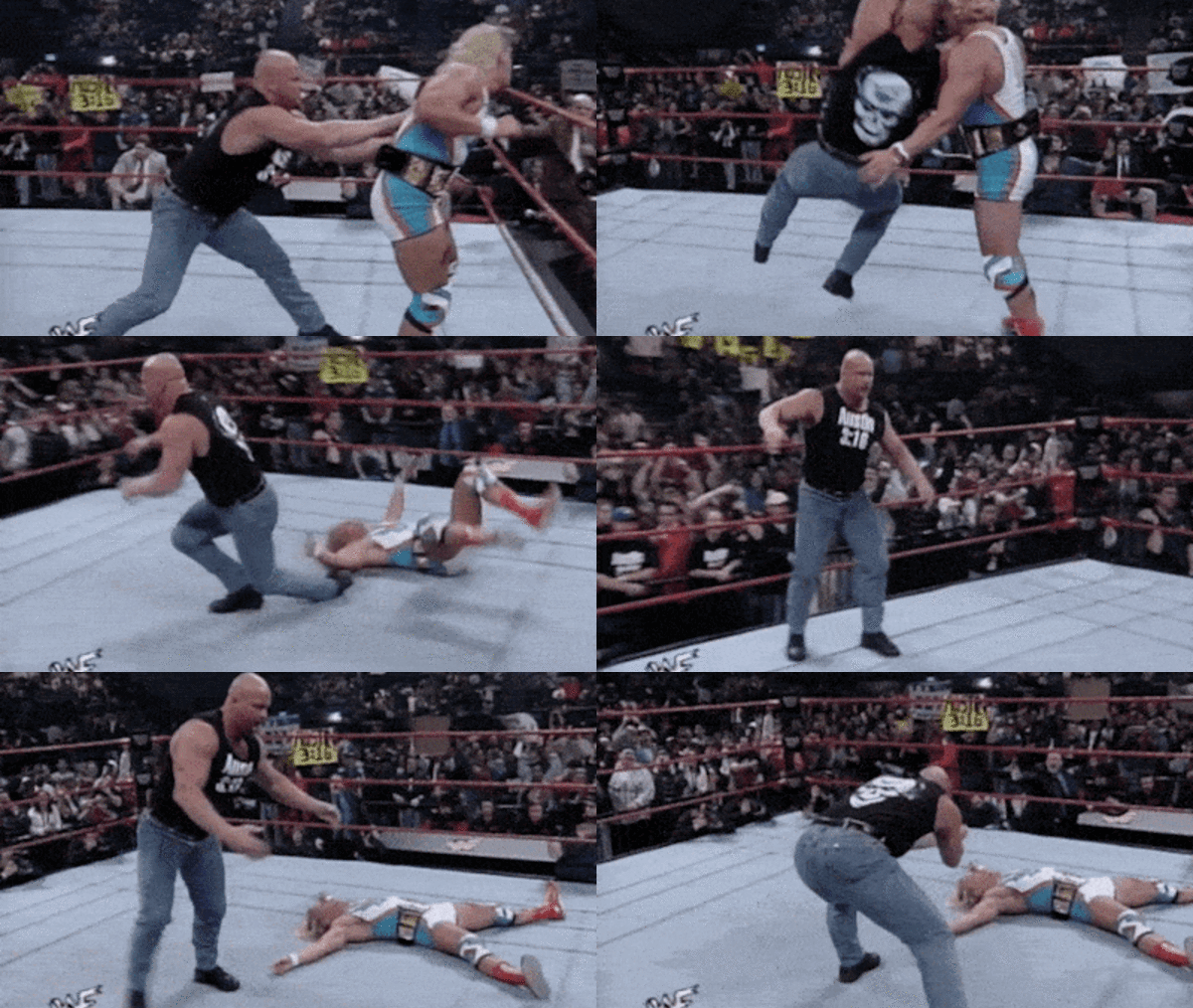
Months later, with Austin on a tear, he took out "everyone of the WWF Superstars" that had targeted him on a rampage ahead of the 1998 Royal Rumble. When it was Jarrett's turn, Austin smashed him, and ripped the piss out of his trademark strut before lashing him with the double bird. This was telling, but nobody told Vince Russo - even though, swerve, he knew better - who saw far more main event potential in Jeff than Austin did. He also reckoned Buff Bagwell was more charismatic than the Rock, but that's an article for another day.
Russo pitched Jarrett as an opponent for Austin in 1998, as Jarrett got over under his misogynist, guitar-smashing gimmick. Austin was apoplectic - Russo knew nothing of continuity, but Austin sure as sh*t did - and vetoed the idea immediately. Austin didn't even fancy paying Jarrett a poetic receipt by stiffing him with potatoes on a one-shot B-level pay-per-view.
This wasn't purely spiteful, much as it seemed that way.
CONT'D...(4 of 5)

Austin had incredible instincts to preserve his star power. He knew Marc Mero wasn't a major player, nor could he elevate him to that level. He knew Triple H wasn't ready in the summer of 1999, whereas he knew Rock was at the onset of that year. He knew to avoid the politicking power of Hulk Hogan. His 2001 heel turn was disastrous enough for his career; the Rattlesnake knew well enough to keep himself away from the monstrous nostalgia flex of those 24-inch pythons. He was proved right, in the end: Jarrett was a paper headliner in WCW, in which he failed quite dismally to arrest the decline.
This may all read as a character assassination of Jarrett, but that wasn't the intention. The man was a superb midcard talent, one of the best of a loaded 1990s scene: his slapnuts schtick was priceless, his work of a high in-ring standard, his way of timing the despicable deed so expert that it provoked the guiltiest of pops. He was good, but he was never great - and that's why Austin refused to work him in a major, Attitude Era programme.
In fact, beyond a dark match and a pair of Royal Rumbles, he never worked him at all.
There is a neat parallel between the careers of Steve Austin and Jeff Jarrett, but a greater irony: "Don't piss me off" earned as much money as Jarrett missed out on.