THIS Was WWE's Most Creative Year Ever
In which creativity is not necessarily an amazing thing...

Creativity is not necessarily a good thing, it should be immediately pointed out. To underscore this, even Vince Russo's fiercest detractors never said he wasn't creative.
The Attitude Era is held aloft as the bastion of creativity, a time period in which megastars made themselves under Vince Russo's fit of form transgression and their own quick and often vile wits. Per WWE's retelling of it, the WWF simply had to move away from the New Generation's passé, star-devoid camp to survive, and having cast an eye to wider society - "Seinfeld and King Of The Hill," not ECW nor WCW of course - they did precisely that.
The WWF built on the transformative 1997, and its mind-blowing controversy, to situate its antagonist Vince McMahon against emerging superstar Steve Austin in a phenomenally successful, all-time classic rivalry. Between the 1995 and 1997, however, lay 1996.
The contrast between the über-goofy 1995 and 1996 is shocking, but this is sometimes obscured by the shared red, white and azure blue aesthetic. 1996 was a thoroughly bizarre, brilliant and b*llocks year in which a desperate and receptive Vince McMahon threw a f*ck-tonne of sh*t at the wall of Titan Towers - and some of it was earnestly deserving of the famous "such good" prefix.
CONT'D...(1 of 5)

The WWF went ballistic with match type experimentation. Very few of these new genres were successful, or repeated, but the volume of invention underscores the sheer extent of the Fed's starving, transparent ambition. 1997 was a superior year, in terms of match quality and intricate, gripping episodic storytelling, but 1996 saw the WWF flex its creative muscles and windmill punch its way through the cobwebs of what had come before. Irrespective of whether or not those blows connected, there was an enemy to fight; the rising WCW, which had compounded the WWF's disastrous post-Hulk Hogan malaise by weaponising him against them.
Great wrestling promotions now struggle to create new match concepts - the upcoming Casino Ladder match at AEW Double Or Nothing promises to be exceptional, but it's a mere Royal Rumble/Money In The Bank hybrid. The WWF in 1996 either innovated - or brought to Vince Jr.'s WWF for the first time - no less than eight "new" match concepts across its 12 pay-per-view events. Some were horrendous; the 'Crybaby' match between Razor Ramon and 123 Kid at In Your House: Rage In The Cage was well-worked, because of course it was, but the post-match scene in which Razor "diapered" the Kid appealed solely to Vince McMahon when the WWF sorely needed to appeal to a wider audience. Some weren't innovations at all, but rather incredibly desperate attempts to sex up your garden variety no disqualification match (Final Curtain, Armageddon Rules).
But others, like the Boiler Room and Hollywood Backlot Brawls, saw the WWF literally expand the scope of its physical action and experiment with pre-taped proto-cinematic form and adult-specific content, respectively.
CONT'D...(2 of 5)
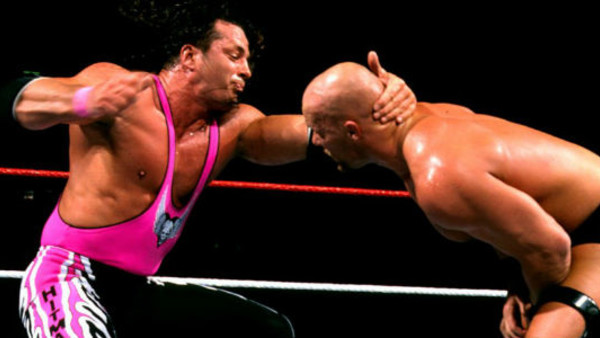
One got over, at least - the Buried Alive concept, one that basically made a casket match slightly more dynamic, made it through to and beyond the Attitude Era as a respectable draw. The Caribbean Strap Match, a great, snug, fight that harkened back to the best of the WWWF, almost, indirectly propelled Steve Austin to megastardom. His performance in it was so good that it convinced Vince McMahon to crown him King of the Ring, which while overstated in its importance - a push and its success isn't that dependent on that or the Royal Rumble win or what have you - he made millions and millions by successfully marketing Austin's off-the-cuff "Austin 3:16" gag.
The old glory aesthetic remained in place, but the WWF was painting from every hue of the colour wheel in 1996 before it settled for the blood red darkness of that which followed.
The WWF also expanded and matured the scope of its storytelling from the goofy, kiss-footing fare of the '95. The notorious Brian Pillman incident - in which he ostensibly shot Steve Austin at the climax of a jaw-dropping home invasion angle - felt like it belonged and fast-forwarded to a dystopian future, not the family-friendly WWF.
That was an infamous lightning rod moment, but the thunder of transformation rumbled ominously for Bret 'Hitman' Hart as the WWF approached an epoch of sorts in which it asked, even unconsciously, its maturing audience to look introspectively. Was Bret Hart still their hero? Or was the clearly reprehensible but compelling Steve Austin better, or more interesting?
CONT'D...(3 of 5)

Though to the adolescent fans that stayed beyond the fad, the WWF was a form of entertainment shaped definitely by the do-gooding of Hulk Hogan, really, how much did morality matter so long after he'd left?
It was as if Vince was live surveying his remaining fans in a bid to attract more of them, but the events of Survivor Series doubled as exceptional professional wrestling stunning in its fusion of brawling and technicality and thoroughly convincing in its worked animosity. Every pro wrestling fan believes their era was best, or was booked for them, but the attitudinal shift shared by the WWF and the kids it hooked during the Hulkamania years really was a journey taken together.
Austin wasn't the only darker character tethered to a harsh reality Vince was always insistent on shielding his audience from. Mankind, unlike the crudely drawn monsters of the usual Undertaker formula, was a tortured soul achingly human in his lamentable state - sympathetic, almost, were it not for his brutality, the manifestation of which was tremendously artful and violent. Mick Foley, between the Boiler Room Brawl and the seminal main event of In Your House: Mind Games, literally and stylistically diversified the WWF's in-ring output. He innovated the crazed, arena-wide violence that would become the hallmark of the Attitude Era's bigger, broader - and dumber - fun.
Of course, the WWF took a further two years to get hot for a reason: much of its output was shockingly bad.
CONT'D...(4 of 5)

The WWF, not knowing the direction to the future - only that it needed to sprint beyond its past - ran the full gamut, from inspiration to desperation, from seminal to embarrassing. In the very same month the WWF promoted one of the greatest and most atypical matches in its history, the company debuted the fake Razor Ramon and Diesel in an embarrassing, spiteful self-own. In the same year that Steve Austin challenged our very perception of aspiration, he shared the same 'Free For All' SummerSlam pre-show with TL Hopper, the wrestling plumber, who in a skit removed what was either a bar of chocolate or a piece of sh*t from the bottom of a swimming pool. It was 1996, and thus pretty hard to tell.
The shifting complexion of the roster symbolised the strange, competing forces at work. The Ultimate Warrior represented McMahon's ingrained desire to yield to a successful past, where the development of Austin showed him the future. Austin reality-infused approach clashed wildly too with the pig farmers, cowboys, and 1970s heartthrobs (!) was "fixin'" to get through. The Bushwhackers were still a thing in 1996, for f*ck's sake, as was the perfect intensity of Sid - both sweating, towering form of karma for Shawn Michaels and forward-thinking update on the mould of WWF Champion.
Ironically, it was Vince Russo - remembered in retrospect for his undisciplined, scatterbrained approach - who gathered together these wild, experimental, contradictory impulses under a singular aesthetic vision of lurid, sexed-up car crash TV.
The WWF of 1996 was so fitfully creative and philosophically incoherent that Vince Russo had to make sense of it.