Why 1997 Was The Greatest Year In Wrestling History
Because 1997 was about far more than just the Montreal Screwjob.

Ask wrestling fans of different ages and of different tastes, and you'll get a whole variety of answers on just what the greatest year in pro wrestling history is.
Truth be told, there are so many great years in the history of the wrestling business. Even if some of the more recent ones may have felt like a true slog to be a wrestling fan, there's always plenty of brilliance to be revisited with a trip down memory lane. Or hell, some people may even make the bold claim that 2020 has been a standout year for the industry due to how AEW has established itself as a genuine player in the market.
For the purpose of this article, it's 1997 that's being held up on a pedestal and proclaimed the greatest year in wrestling.
1997 was a perfect storm in so many ways, not least with how WCW and WWF both put out some of their best ever programming. The ratings war had yet to hit the peak numbers seen in 1998 and '99, but quality-wise, '97 saw WWF having to up its game to compete with the dominance of World Championship Wrestling - and for fans, that led to an iconic year for the business.
It's a subjective matter, of course, but here's the argument for why 1997 was the best year in the history of professional wrestling.
10. The Rise Of The Real People's Champ

Before The Rock took the moniker on as his own, WCW had organically grown their own People's Champion in the form of Diamond Dallas Page.
From a manager and sometimes commentator, DDP famously only began his formal in-ring wrestling training at the age of 35. To his immense credit, Page would go on to make himself one of main attractions of WCW during the company's most popular years - with him becoming a three-time World Heavyweight Champion along the way.
For DDP, his star really began to seriously shine in 1997.
That year started off hot for the Master of the Diamond Cutter, with Page being one of the few to turn down an approach from the New World Order. Not just that, but, in a memorable segment, DDP would drop both Kevin Nash and Scott Hall with Diamond Cutters in the ultimate F-U at January '97's Souled Out PPV.
In that one moment, Page suddenly become a major babyface on the rise - and DDP's ascension was really kicked into another gear when he began feuding with the nWo's 'Macho Man' Randy Savage.
Page and Savage would exchange wins in a lengthy rivalry through 1997 - a rivalry that won the PWI Feud of the Year - and this would even lead to DDP butting heads with nWo leader 'Hollywood' Hogan.
It would take DDP until 1999 to win WCW's biggest prize, but 1997 was the most important, impressive year of Page's career.
9. ECW Makes It To PPV
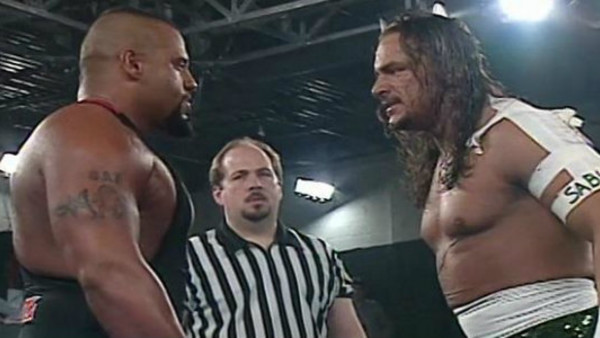
Having spent the past three years establishing itself as a part of syndicated TV and beyond, 1997 saw Extreme Championship Wrestling finally get the opportunity to take the next step up the ladder. That step, of course, being to take the company's extreme antics to pay-per-view.
WWF and WCW had long established themselves as the dominant promotions in the industry, but many had hopes that Paul Heyman's ECW could become a legitimate third player in this burgeoning wrestling war. While we know that ECW would never quite manage to hit the heights of those other two companies before ultimately stumbling to a formal close in April 2001, 1997 was a year full of optimism for those with a penchant for E-Cee-Dub.
With buzz building and building and building, ECW landed itself on PPV for the first time in April '97 with its Barely Legal event. Culminating with Terry Funk winning the ECW Championship from Raven, the PPV was largely viewed as a success, with names like Rob Van Dam, Lance Storm, Taz, Sabu, Shane Douglas, The Sandman, and the Dudley Boys some of the standout attractions on the card that night.
The Hardcore Heaven and November to Remember shows would follow for ECW by the time that 1997 came to a close, and the company's PPV buys continued to rise on a steady curve over the next several years. For those who'd stuck with ECW since its early days, '97 was where the momentum jumped to an entirely new level for the Philly promotion.
8. The Streak Begins
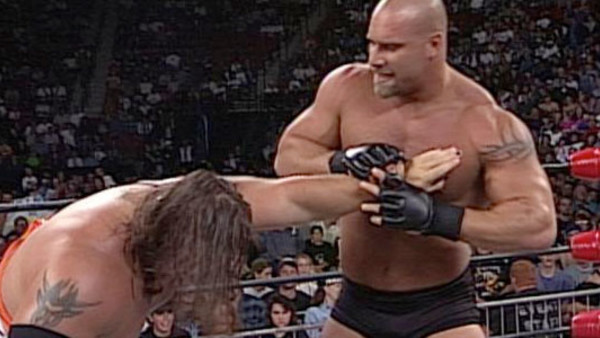
Bill Goldberg has his fair share of detractors, but there's no arguing the impact that Da Man had on the wrestling industry for a couple of years.
In a WCW that was often lambasted for not creating its own stars, Goldberg was one of the few exceptions to this. And not just a star, but the former Atlanta Falcon become a true megastar of the industry. He may not have been the best wrestler in the world, he may not have been the best talker in the world, yet few people in WCW's history ever connected with the audience as well as Bill.
Of course, WCW did all that they could to hide Goldberg's weaknesses, and Ted Turner's promotion was smart enough to go all-in on the intense powerhouse as soon as they realised they'd stumbled across lightning in a bottle.
Adding further historical significance to 1997, this was the year when an unknown, generic, bald-headed wrestler first turned up on WCW TV. As watching eyes presumed this no-name was merely there to do the J.O.B. to Hugh Morrus, the script was flipped and Bill Goldberg got off to a winning start.
The rise of this future Hall of Famer was a swift one, with him picking up the United States Title and World Heavyweight Championship before his iconic streak came to a halt at 173-0 - and all of this began on a September '97 episode of Nitro.
7. WWF's Shift In Attitude
Backed into a corner by the goings-on in rival company WCW, Vince McMahon and his World Wrestling Federation had no other choice but to start throwing things at the wall and seeing what would stick in 1997. In doing that, WWF ended up embarking on a shift of attitude and allowing a slew of talents to step up to the plate and make themselves main event stars.
WWF may have been losing the ratings war, but '97 saw McMahon's company start to get white-hot. Letting the shackles off Steve Austin obviously proved to be a masterstroke - with the Texas Rattlesnake going on to become the hottest star of the hottest period in the history of the business - and just behind Austin was an upstart named Rocky Maivia.
Austin's ascension up the card began ahead of Rocky, but Maivia made himself a must-watch performer once he joined the Nation of Domination. With charisma oozing from the screen, The Rock was the encapsulation of what has forever been referred to as the 'it factor'.
Away from these two legendary rivals, D-Generation X formed and pushed the envelope to levels rarely seen in terms of what they would be able to get away with in their promos and with their general behaviour.
Looking back, 1997 earmarked Steve Austin, The Rock, Triple H, Kane, and even Mick Foley as the stars who would lead the WWF forward alongside The Undertaker over the next several years.
6. The NWO Had Yet To Become Too Swollen

The New World Order eventually became a bloated monster that was largely a parody of itself, but in 1997 the nWo hadn't quite eaten itself just yet.
To be fair, the '97 incarnation of the nWo wasn't the absolute best iteration of the stable, yet it was a line-up that still had value, that still felt special, and that was infinitely better than what would follow for the nWo letters in the subsequent years.
By this point in time, the nWo still had 'Hollywood' Hogan, Kevin Nash, Scott Hall, Ted DiBiase, nWo Sting, and Syxx amongst its ranks, and those six names were joined by Vincent, Elizabeth, Eric Bischoff, Buff Bagwell, Michael Wallstreet, Scott Norton, Randy Savage, Konnan, Curt Hennig, and Rick Rude as 1996 ran through to '97.
Granted, you could argue that only Bischoff, Savage, Hennig, and likely Konnan added anything to the nWo act out of those additional names, but this version of the New World Order was still far more enjoyable than what would follow with nWo Hollywood, nWo Wolfpac, nWo Elite, nWo B Team, and the disastrous nWo 2000.
There are so many reasons to throw shade at the nWo when reflecting back on their overall influence on the wrestling business, but the faction was still a major draw in 1997.
5. That... That's Gotta Be Kane!

Is it the greatest debut in pro wrestling history? If not, it's most certainly in the conversation.
The arrival of Kane was huge when it happened back at October 1997's Badd Blood PPV. For years, the Undertaker was the unstoppable, otherworldly monster who would always stand tall against whatever threat reared up. But with the arrival of Kane, that dynamic was flipped on its head.
After Paul Bearer had spent months teasing the impending arrival of the Phenom's presumed-dead brother, the wrestling world was shocked to see the Big Red Machine turn up at Badd Blood, rip the Hell in a Cell door off, and leave his big brother laying.
Not only was the presentation of Kane instantly attention-grabbing, but his arrival added a whole new layer of character depth to The Undertaker by giving him a sibling who was even more destructive and demented than he was. All of a sudden, 'Taker was vulnerable - and it made for fascinating TV over the ensuing months and even years.
As alluded to, Badd Blood also introduced wrestling audiences to the concept of the Hell in a Cell match. In fact, some still retain to this day that the original HIAC offering of Shawn Michael vs. Undertaker is the greatest match ever served up within the confines of the cell structure.
4. The Crow Stalks The Rafters

Having spent large parts of 1996 wrestling with his own identity and distancing himself from his so-called friends, it was on the 21 October 1996 edition of WCW Nitro that wrestling fans first saw Sting don his legendary black and white Crow-inspired look.
For the Stinger, 1997 was likely his hottest ever year. And to make this all the more brilliant, it was a year where Sting barely uttered a word. Throughout '97, this multiple-time World Champion kept himself to the rafters and the shadows, only making fleeting in-ring appearances as he maintained a watchful eye over the antics of the nWo.
After an entire year of build, Sting finally got his hands on 'Hollywood' Hogan at Starrcade '97. The build was phenomenal, the hype was real, and the significance of Sting toppling Hogan and the nWo to take back the World Heavyweight Championship for WCW was massive.
Sure, that Starrcade match itself was a dud once the bell rang, but that didn't take away from the huge reaction to Sting standing tall as that PPV went off the air. It was more than just Starrcade that made 1997 special for Sting, though, and the year-long arc of this WCW staple in '97 was something that had never been seen before in the wrestling world - with a vibrant, neon-adorned screaming babyface turned into a brooding, judgemental mute.
3. The Duality Of Bret Hart

For Bret Hart, 1997 may have ended with him being screwed by the company he'd given the past 13 years of his career to, but '97 was also a banner year for the Excellence of Execution.
Having been an uber babyface act since breaking out into the singles ranks in 1991, Hart represented a new sort of good guy. He didn't have the physique of predecessors like Hulk Hogan and Ultimate Warrior, but Bret instead had a connection to the audience that was undeniable. Relying on hard work and clinical in-ring technicality, and with a cool as f**k demeanour to everything he did, the Hitman ticked a whole lot of the right boxes for a wide variety of demographics.
In 1997 though, things began to change.
Whiter than white good guys were now passé, and rampant fans instead wanted to cheer for edgy, aggressive characters who had traits more synonymous with the classic heels of yesteryear.
The overall reaction to Bret's good guy act had started to wane in 1996, but '97 saw Hart masterfully use this to create something truly different. Snapping in the aftermath of WrestleMania 13, the Calgary icon spent the rest of the year lambasting American wrestling audiences, while simultaneously being embraced as an all-conquering hero in Canada, across Europe, and beyond.
1997 will sadly be forever associated with the Montreal Screwjob, but that year was brilliant from Hart as a character, as a promo, and, of course, between the ropes.
2. Controversy Creates Cash In Montreal

Love it or hate it, the Montreal Screwjob created a whole lot of controversy that got the whole wrestling world and beyond talking about it.
Some may rightly label the incident a black eye on the wrestling business, but other will point to how the events of November 9, 1997 ultimately ended up being a great thing for the industry. If it wasn't for the very real events of the 1997 Survivor Series, who knows if we would've ever got the Mr. McMahon character. And if he we had never got the Mr. McMahon character, would 'Stone Cold' Steve Austin had gotten over to the level that he did? Maybe Austin would've, but nobody knows for sure.
For Bret Hart fans, the Survivor Series '97 still sticks in the throat, yet the greater significance of that night cannot be overlooked.
Not only did the Screwjob start Mr. McMahon on the path to becoming the industry's best heel, it also gave uber-prick Shawn Michaels more material to work with in the aftermath of that November PPV. The Heartbreak Kid embraced the hate that was directed towards him after Montreal, with him using this very real situation to get himself some truly nuclear heat - which then played a part in fans wanting to pay to see someone like Steve Austin kick the crap out of the Showstopper.
1. Mr. McMahon Is Born

While the wrestling business was changing in 1997, so too was the on-screen presentation of Vince McMahon.
Having been forever kayfabe known to just be one of the then-WWF's numerous commentators and interviewers, the mask began to slip as it became common knowledge that Vincent Kennedy McMahon was actually the real owner of the World Wrestling Federation.
That reveal was one thing, but it was a whole other ball game to see McMahon start to slowly become a key part of wrestling storylines. Beginning with Bret Hart, the character of Vince began to grow a backbone and would stand up to the wrestlers of the day. And what had started with Hart, and even Shawn Michaels, was completely escalated to a whole other level as 'Stone Cold' Steve Austin's ascension to the top of the card gathered momentum.
McMahon vs. Austin was the biggest part of WWF programming through 1998 and 1999, and it was a rivalry that rumbled on even in the years after that. But it was in 1997 where the start of this ratings-grabbing feud first began, with fans getting to see the transition of Vince McMahon, Commentator... to Mr. McMahon, WWF Chairman.
Austin would go on to become the star of the burgeoning Attitude Era, but Stone Cold couldn't have done that without having the absolute perfect foil to play off in that Mr. McMahon character.