Why Mark Henry Was NEARLY WWE's Biggest Ever Flop
The World's Most Enduring Man.

Mark Henry triggered something within Vince McMahon back in 1996.
While he failed to make the Olympic weightlifting podium, few disputed his ‘World’s Strongest Man’ billing; Henry was a legitimate strong man with a powerlifting record that glowed gold. A genuine beast in both physique and stature, McMahon knew that, if this aura was transferable to the squared circle, he had a major star on his hands.
It was not.
Injury robbed Henry of his dreams in Atlanta. It was a telling omen for the first chapter of his pro wrestling career, though this was no hard luck story; Henry was both unlucky and entirely unsuited to his new profession, which he was convinced to transition into to the tune of a guaranteed multi-million 10-year contract. It was eye-watering, especially considering that a contract similar in scope, Bret Hart’s, inexorably changed the course of company history as a result of its apparently unsustainable nature.
In very short order, McMahon’s eyes watered also; reports of Henry’s in-ring development were drastically bad. Comically bad. Dr. Tom Prichard’s training credentials are not to be disputed; the man was chiefly responsible for the development of both Kurt Angle and The Rock. But then, they were naturals. Henry was antithetical to them; lumbering, uncoordinated and dangerous, his struggles were literally painstaking.
Even under the expert tutelage of Dr. Tom, Henry floundered, infamously collapsing under his own weight in an early, routine rope-running drill. His ankle shattered, necessitating a four-man carry-job in the dusty climes of the Stamford warehouse - though you suspect, even in the state-of-the-art Performance Center facility, Henry would have struggled. He was that incompatible with his new profession.
McMahon actively and visibly resented Henry, his buyer’s remorse manifesting as perhaps the most rancid burial ever from a company defined by its toxicity. Tied to a deal blindingly stupid in retrospect, McMahon embarked on a one-man smear campaign in an attempt to bully Henry out of the company. Henry was positioned as a sex addict harbouring a slew of fringe fetishes ranging from humiliating to disgusting. Octogenarians; transvestites; siblings: the love net cast by ‘Sexual Chocolate’ was not above plunging to what was framed as the lowest depths. CONT'D...
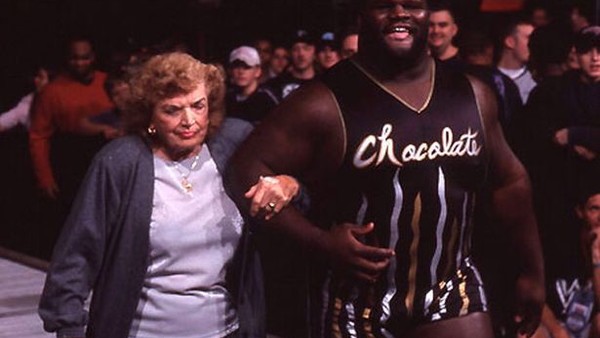
Henry, to his credit, got over as an affable Lothario, improving in the character department. His in-ring work remained abysmal, even by pre-Radicalz Attitude Era undercard standards, necessitating a return to developmental four years into his professional career.
He emerged from an Ohio Valley Wrestling stint designed to humiliate him yet further in yet another racially-charged portrayal, swapping the Nation of Domination for ‘Thuggin’ And Buggin’ Enterprises”. This repetitive career arc made emblematic his continued struggles. Henry, it seemed, was doomed to repeat his failures in an expensive and tedious Möbius strip - a curse reinforced when he suffered another major injury in the developmental arena, tearing his quadriceps muscle during a 2004 OVW practise session, the likes of which, as a nominal eight-year pro, he should have long since graduated from.
McMahon sought to maximise his investment upon Henry’s return to the WWE arena, positioning him as the Undertaker’s Monster Of The Week in a WrestleMania 22 casket match. This, by some distance, was Henry’s best WWE match. While his opponent was no coincidence, the stipulation, infamously naff, leveraged the argument in his favour. He had arrived into the elusive realm of the respectable. More so than the success of the match itself, Henry deserves credit for emerging from it with a degree of credibility intact. If ever there were a talent irreparably stigmatised, it was - or should have been - Mark Henry.
So respectable was the match that Henry even generated sympathy upon suffering his next major injury. He split his patella tendon completely in two on the July 16, 2006 Saturday Night’s Main Event, in what was, near enough, his 10-year anniversary with the company - a tenure extended by virtue of the shrinking pool of wrestling talent, post-Monday Night War.
Over 10 years, several wrestling lifetimes, Henry contested precisely one memorable singles match and embarked on precisely one memorable character run. Had WWE anything in the way of viable competition facing it, Henry, surely, would have ranked as the single greatest and most expensive flop in the history of the industry.
Henry, however, achieved elusive consistency upon his next comeback, indirectly benefitting from John Laurinaitis’ disastrous mismanagement of the company’s in-house developmental system. Having quietly enhanced his reputation as a limited but imposing and believable freak show attraction as ECW Heavyweight Champion, Henry, with so few of his successors ready for the main event (or at least deemed ready for the main event), was given the World Heavyweight Championship in 2011. CONT'D...

To some, this booking decision illustrated the sheer extent to which WWE had fallen. Though no longer interchangeable with the WWE Title, the Big Gold Belt nonetheless represented the pinnacle. That it was bestowed upon Mark Henry, an historical dud both dangerous and dismal, indicted the company’s creative philosophy and the execution of it.
To others, the Hall Of Pain run maximised Henry’s value and, in turn, rewarded WWE fans with entertainment value. The gruff, intense, sh*t-talking Henry was the best iteration of the character, a remorseless beast taking his bad luck out on and storyline injuring those who dared oppose him and innocent bystanders alike. At its best - an inconceivably dynamic Clash of the Titans opposite the Big Show at Vengeance 2011 sparks to mind - you could legitimately buy into Mark Henry as the force of nature McMahon had in his mind, all those years ago.
The uplifting Hall of Pain run slowing to a crawl, Henry was a sporadic presence on WWE TV in his latter years - though a superb, absorbing bout with CM Punk on the post-WrestleMania XXVIII RAW indicated that Henry did not necessarily need the all-in mega-push to frame himself as something truly dangerous.
The famous fake retirement RAW angle, ahead of Money In The Bank 2013, emphatically symbolised Henry’s true ascension to the realm of the genuine worker. It was as objectively good an angle you will ever see in the wildly subjective world of professional wrestling, in which Henry consummately veered from the amiable and humble to the destructive and psychopathic - his career in wonderful microcosm.
With real tears in his eyes, the fans rained down chants “Thank you, Henry!” Henry, wasting nothing, wore an intentionally naff salmon suit to put the bit over the edge, in a tacit acknowledgement of his limitations. He was never the best in the ring, he seemed to suggest - even now, he didn’t even look the part. Affectionate chants of ‘Sexual Chocolate!’ boomed around the arena. He had them in his proverbial palm.
And then: he levelled John Cena with the World’s Strongest Slam in a contender for wrestling’s greatest ever ruse. Wrestling is one big ruse. That angle was such a monumental achievement.
News broke this week of Henry’s real, unceremonious retirement (he was never going to follow the fake one, astutely so).
What is Henry’s legacy?
Not the best - at all - when the numbers are crunched, Henry’s highs dwarf the lows, perhaps because he was never as profoundly overexposed as those he shared such epic tenure with. Even those who never generally “got it” - as the faint praise in this article suggests - absolutely cannot begrudge him that.
Ultimately, somehow, his legacy isn’t that of a flop. For that, Henry deserves credit as herculean as his strength.