Wrestling IS Performance Art: Deal With It
Thank me, f*ck me, bye.

“I’d like to watch Midsommar, but the mere existence of Scary Movie means I won’t get scared.”
That would be a literally absurd leap of logic for a horror movie fan to make—so why do certain pro wrestling fans? These fans—galvanised by the old guard on Twitter to such a sad extent that they borrow their language—have surfaced to aggressively thwart the discourse that professional wrestling is a “performance art”. These guys literally cosplay as Jim Cornette when bemoaning so-called ‘cosplay’ wrestlers. The hypocrisy is profoundly irritating.
Motherf*cker, it’s not art! It’s wrestling! Wrestlers should look like they could kill a guy in a real fight! Wrestling ain’t flips and goofy gimmicks—it’s a tough-looking good guy beating up a weasel of a heel!
This is obviously a residual feeling from how wrestling used to operate. The WWWF was considered cartoonish, as was Memphis, in comparison to the badass grit and advanced technique of Jim Crockett Promotions. But virtually every territory adhered strictly to kayfabe—the idea that wrestling must be presented as a legitimate enterprise in order to extract money from the marks who wished to believe in it. That’s how the money used to be made. And that’s what it was about. There was no honour to it, and if there was, the honourable went out of business. Multiple times.
Some members or supporters of the old guard reckon this new, niche generation is “scorching the earth” for their successors, who can never hope to be taken seriously in the wake of guys who touch c*cks with their hands, when those hands aren’t wedged firmly in their pockets.
This is hysterical, verifiable bullsh*t.
CONT'D...(1 of 5)

Joey Ryan invented the ‘Penisplex’ in 2015. In that same year, Jay White was an emerging Young Lion in the NJPW dojo system unrecognisable from his current ‘Switchblade’ guise. MJF, meanwhile, was wrestling as ‘Pete Lightning’ and ‘Maxwell Jacob Feinstein’ in his debut year. Both men are now flourishing as true old school heels with an ability to control entire crowds into a state of unanimous hatred.
The debate is all a big, tiresome omni-work. The old school podcasters moan about it to drive clicks, because reminiscing over halcyon days in the mid-south coliseum doesn’t—and that’s sad, subjectively, but no less true. Their snitch-tagging acolytes want the recognition of a retweet. Their opponents in these online rivalries hope to get over as rebels.
The irony is that, viewed through the optics of 2019, something like Arn Anderson’s ‘80s selling looks comical. Mr. Perfect took ridiculous, rotating bumps. Broad slapstick used to get over as a comedic device—even if nobody ever punched somebody’s shadow in “a real fight”—to pop a more earnest, easier crowd. Back then: now, hyper-irony pops a more jaded public on a fringe people are under no obligation to acknowledge.
Wrestling in 2019 is diverse, and what’s wrong with that? Isn’t a rigid imposition of form precisely why WWE draws so much criticism? Freedom of creative expression can manifest as anything because that’s what it f*cking is.
Wrestling always was a performance art because it was never a fight. It was by definition a performance. Acknowledging this didn’t “kill the business” at SuperBrawl VI in 1996. The business exploded two years later. In 2019, the concept of traditional wrestling performance is toyed with, subverted, parodied, and this is crucial, perfected.
And yes, Arn Anderson does look like he’d cream Joey Janela in a real fight, but Minoru Suzuki would knock f*ck out of Arn Anderson, and you can watch him in 2019.
CONT'D...(2 of 5)
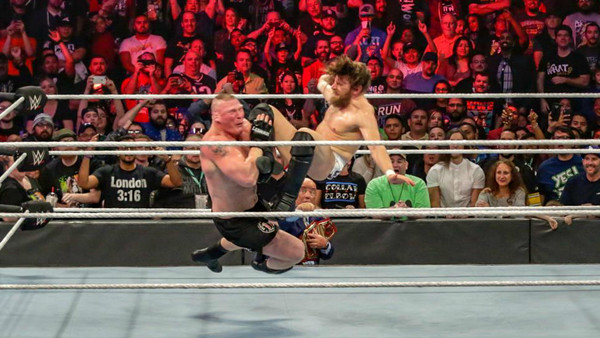
You can watch Jon Moxley chew guys’ faces off in punishing, brutal matches. You can watch Charlotte Flair straight up beat the piss out of her opponents in some of the most physical WWE matches ever held. You can watch Zack Sabre, Jr.—who rarely bumps, much less on his head and neck—manipulate limbs into positions of certain agony. You can watch Daniel Bryan scrape the faces off his opponents in matches that intersect the dual remit of safety and credibility.
You can watch Kenny Omega pull off a V-Trigger and worry, momentarily, that he just inflicted brain damage on his opponents. You can watch Hiroshi Tanahashi work matches so intricate and believable that, every time, his dragon screw makes you believe that he might just win—win a match, not continue to enter a genius “performance”. It obviously is a performance, but it never feels like that in the moment.
And, yes, you can also watch Orange Cassidy pull off one of the best suicide dives in the game, with his hands in his pockets, and perceive it as either an affront to or a new, flexing mode of psychology.
You can watch all of this without it compromising itself.
The counterargument isn’t without merit—a guy like Arn, who was awesome for his time, didn’t mangle his back so that some chancer can expose his painstaking work as a wry sham—but transgression is good. Transgression is vital. The best art is made in defiance of something. And if you hate that art, and hate the very designation of “art”, wrestling is so good elsewhere that this sub-industry doesn’t dilute the serious business.
If wrestling ain’t flips and goofy gimmicks—if it’s a tough-looking good guy beating up a weasel of a heel—then Kota Ibushi and Jay White recaptured and perfected that ideal in their blistering, all-time great NJPW G1 Climax final this very month.
CONT'D...(3 of 5)

Ibushi entered the match with a badly weakened ankle. White focused his relentless assault on it throughout. Ibushi sold it with an agonised pathos. White cut off every hopeless, brave comeback with perfectly-timed viciousness. Time and time again, using merciless heel tactics, White eviscerated all hope with a d*ckhead smile.
Not a godd*mn soul in that sold-out Budokan Hall gave one iota of a f*ck that Ibushi once wrestled an inflatable doll. Everybody in that molten crowd created a deafening cacophony when he transformed, seamlessly, from injured hero to unbeatable warrior in his awesome fighting spirit spot. This was as pure a distillation of suspension of disbelief as you’ll ever see. Worked into this state by two masters under the most classic of dynamics, the entire crowd powered this ultra-badass comeback as if it were all real. And this match, unlike some of Ibushi’s more divisive work, wasn’t too real. Ibushi, the wrestler, is arguably too committed. This was Ibushi, the worker, revealing himself as a true genius of the old form.
Next-level aerialist Kota Ibushi didn’t do one “flip” in that match because he was too busy convincing the Budokan that his ankle would not allow him to. When he finally overcame that weasel heel, people cried, gripped in the drama of the moment. If the talent is great enough, the old magic still works.
CONT'D...(4 of 5)

This is written from the perspective of somebody who prefers pro wrestling as an emulation of sport in presentation and athleticism. The G1 Climax was that. But other sh*t, and some of it really is sh*t, can exist.
The other side of things is that people don’t seem to give a sh*t about anything anymore. The same cultural mindset that drove riots and stabbings no longer exists. In a way, Orange Cassidy is as perfect a wrestler for the desensitised meme generation as Hulk Hogan was for the aspirational 1980s.
At AEW Fyter Fest, MJF cut one of the best heel promos in years: a vicious assault aimed at the obese geeks tied to their mothers’ apron strings, when he cackled at the virgins in attendance, the camera captured a man drained of blood where that blood used to boil. The very best heel in pro wrestling might suck the soul out of a gamer, but he’s not going to start a riot. But they can, if they’re great enough, inspire a fervent reaction.
Jay White doesn’t steer into the debate on Twitter, telling everybody how to do their job. He’s too busy showing how good he is at his own.
If only people paid attention.