WWE Needs To Break THIS Habit Of A Lifetime
“Methodically stalking his prey…”

This decade, pronounced by the drastic upheaval of WWE’s developmental system, marked something of a paradigm shift. Through Daniel Bryan’s organic and triumphant rise to the top of the card, the systemic failure of the bizarre, territorial-adjacent system and the wider trend of accelerated pro wrestling, WWE broke the lifetime habit of its pious recruitment model.
The great levelling made this so.
WWE failed to “make their own guys”, a mentality mocked by Bryan himself on the original NXT. In parallel, through untethered, unregulated creativity, the hardcore darlings of the Independent scene generated so much buzz that their like bled into the WWE system. They were celebrated for “dominating Japan”, and not buried, like Bryan was, for performing in “high school gyms”.
WWE has resisted—or failed to resist, more accurately. Baron Corbin, not Finn Bálor, has headlined four consecutive main roster pay-per-views in 2019. But this development invited widespread scorn, and drew drastically bad numbers. Humiliating numbers. The Corbin Vs. Seth Rollins programme effectively parodied WWE’s “way” of laying out matches, and building their “own” “stars”.
When Chris Benoit arrived in WWE, in 2000, Triple H infamously damned him with faint praise. “He’s not bad, he’s all right,’ Trips said of Benoit, after the Crippler’s first singles match. Chris Jericho relayed this story to Dave Meltzer on his podcast in 2017. In 1994, Benoit as Wild Pegasus won the NJPW Super J Cup, a tape-trader sensation acclaimed as the single greatest night for the in-ring art. In 1994, Triple H failed, hilariously, to adopt a French accent as a goose-sh*t green jobber in WCW. From risible flexing to welcoming hands, Triple H now enthuasitically greets performers of Benoit’s ilk as they enter the NXT system.
Paradigm: shifted.
CONT'D...(1 of 5)

We have arrived at a point at which there are significantly more dreaded “Indy guys” in WWE than from-scratch Performance Center graduates. And yet, WWE’s creative output remains deeply—and increasingly—unpopular. While WWE has broken one lifetime habit by not burying acts who got over elsewhere, another, entrenched mentality undermines them.
WWE’s in-ring style, broadly, operates in a certain gear. Jim Ross always used the word “methodical” to describe it on commentary. The New Generation style sprinted past it, as did the crazed brawls of the Attitude Era. There are exceptions to it now—several—but the methodical sprawl of a WWE match has remained a constant feature of the product, consistent across every logo change and talent roster.
The pace comprises performers and programmes alike.
Jon Moxley is currently embarrassing WWE throughout his incredible run in the NJPW G1 Climax. His match against Tomohiro Ishii was a masterpiece; as physical and gladiatorial spectacle as the best Brock Lesnar matches, fought at New Japan’s trademark unwavering pace, the mesh of styles was as seamless as it was mind-blowing. The match was a new breed of physicality.
Compare Moxley Vs. Ishii with Seth Rollins Vs. Dean Ambrose from TLC ’18. One was pitched as a deeply personal grudge feud; one was performed as a physical war. At TLC, Ambrose and Rollins wrestled a slow, methodically-paced grind of a wrestling match; were it not for the hysterically poor taste build, nobody watching would have inferred that the two men hated one another. In contrast, Moxley squared up to Ishii, nose to nose, as if he was the toughest son of a bitch in the prison yard he just walked into.
He had to prove himself against the Stone Pitbull, and he did.
CONT'D...(2 of 5)
Ishii in response, in an absolutely awesome spot, fought back by splashing Moxley through a table. This is something Ishii simply doesn’t do. He only took this out-of-character risk to combat this new threat in a match of relentless, intoxicating build. That match built; Ambrose Vs. Rollins toiled. The irony is that WWE has long claimed to “tell stories”, where other promotions indulge spots with no basis in psychology. Ambrose Vs. Rollins was tonally wrong.
It toiled because the WWE “way” is antiquated—or at least incompatible with the make-up of its modern roster.
It ties into WWE’s attitude towards its audience, which can be looked at cynically, practically, or both. WWE appeals or strives to appeal to the widest audience, the byproduct of which is a simpler, broader form of storytelling. Comprehension is the aim; exhilaration is secondary. WWE’s production team imposes a slower pace on its performers so that the audience is able to register it. This mentality is systemic, intractable. It is the mentality with which WWE came to rule the wrestling world. WWE has sensed a shift in that world, but at present is more interested in cynical counter-programming than elevating its own.
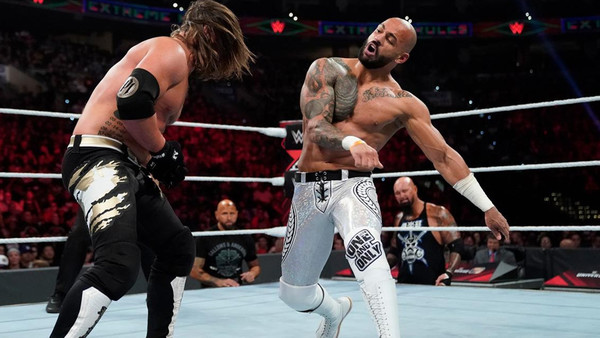
This worked for a dynamic like Triple H Vs. the Undertaker in the early 2010s; both performers, in their psychological primes, were genius in their grasp of working, as distinct from wrestling. It didn’t work for—in fact, it betrayed—a dynamic like AJ Styles Vs. Ricochet at the recent Extreme Rules pay-per-view. That match was worked with the athletic precision and ingenuity one would expect from two elite performers—AJ in particular put Ricochet over as a threat by reinventing his arsenal—but the pacing lost the audience. It was an AJ Styles Vs. Ricochet match in WWE, essentially. It did not reach its potential because it was not allowed to.
If AJ Styles faced Ricochet in NXT, the match would have banged. Ricochet incidentally hasn’t wrestled at the same breakneck pace he set in his thrilling TakeOver: Phoenix match against Johnny Gargano on the main roster—and he isn’t over. The cause and effect cannot be ignored.
CONT'D...(3 of 5)

Some might argue that a faster pace inhibits psychology—the dreaded “They are just spot monkeys” response. Just listen to the oscillating underdog roar of Korakuen Hall. Listen to the molten crowds during virtually every electric TakeOver main event. Picture the graduating, roaring comeback from the dead sell; if worked intelligently enough, all that incredible punishment informs the transition in the drama. It doesn’t peak.
Psychology in wrestling can be tied to logic, if the crowd appreciates logic, but broadly, the best psychologists are those with the ability to generate the loudest, sustained reaction to their work.
What does that say about WWE’s ability to manipulate its audience in 2019?
In addition to the constant recaps, the exposition, and Boss Time Big Dog marketing onslaught, the general match layout borders on insulting the intelligence of its audience. The babyface is in a rest hold, and we need to cheer them on to help them escape. The people have grasped this by now. They are all too aware of it.
TL;DR; WWE badly needs to embrace the banger. This isn’t as simple or as misguided as ‘New Japan does it!’, or ‘NXT does it!’. Or perhaps it is.
CONT'D...(4 of 5)

NXT’s more blistering, more complex matches are more acclaimed and popular than those produced by WWE’s main roster. The TakeOver events on Big Four pay-per-view weekends now out-draw RAW and SmackDown live tapings. WWE need not lose its sports entertainment identity, but it needs, quite literally, to catch up. NXT has set the pace; several of the cold, quiet crowds watch the action almost expecting the main roster to maintain it. WWE crowds are dead more than often in 2019.
Were they this quiet before NXT developed into the entertainment machine it is now?
WWE has recognised that the best talent is developed outside of its system, even if the resentment still manifests as a Baron Corbin push. To truly capture the imagination of the receding, disenfranchised fanbase, it must also allow this unreal generation of talent to get over on their own terms.
Methodical Ricochet is an oxymoron.
What good is recruiting the best talent, if they aren’t encouraged to perform as the best versions of themselves?