10 Outrageous Justice League Moments That Won’t Be In The Movie
Darkseid probably won't be beaten in a chess game.

Ever since Marvel struck movie gold with Avengers, DC have been racing to catch up. Now, they're finally ready to take the next big step to join Earth's Mightiest Heroes with this years Justice League movie.
Whether it will soar to the same level of love that Marvel's films have been enjoying or crash and burn like Batman v. Superman and Suicide Squad remains to be seen. However, one thing is for certain, it won't match the same level of lunacy that some of the comics have got up to.
The Justice League has been up and running since the 60's and its adventures have continued pretty constantly throughout the decades, through numerous line-up changes and even whole new iterations of the team. Of course, with so many pages to fill, fresh ideas can be hard to come by.
Luckily, comics are a medium that allow for a virtually limitless number of stories to be told and so, when you're in need of a plot, you can always just chuck out a random alternate universe or a not so subtle dig at the competition.
There are a whole host of great comic storylines that the Justice League movie could take inspiration from. These ten probably aren't going to be among them.
10. Vixen Meets The Brown Bomber

In Justice League of America Vol. 2 #26, the trickster god Anansi used his powers to rewrite reality. The Justice Leaguer Vixen was immune to it, but she woke up in a new world to find that her teammates were completely different.
Bruce Wayne was now a murderous vigilante named Paladin, Earth's Green Lantern was a man named David Kim and Wonder Woman was the grieving widow of a dead Superman. Black Lightning had the worst luck of them all though.
Black Lightning had been replaced by the Brown Bomber, an obese white guy who could transform into a hulking super-powered black guy (complete with Afro and gold medallion) when he yelled the words "Black Power". He was basically the awkwardly racist uncle of the Captain Marvel Family.
It may seem random, but the Brown Bomber was actually a fun in-joke based on Black Lightning's origins. The original idea for the character (who was even named Black Bomber) was that he was a white racist who could transform into a black superhero.
Thankfully, the editor who had that idea was let go and writer Tony Isabella realised that it wasn't a great idea for DC's first leading African American hero's power to be super-blackface.
9. The Founding Member That Everyone Forgot

One of the big advantages of the DC film universe is that it has a much more rigid continuity than the comics. This means we can avoid the cliche of having a new hero awkwardly retconned as having always been around.
In a blatant attempt to make him seem as cool as other heroes, Triumph was a character introduced in the 90's who was revealed to have been the original leader of the Justice League. Apparently, he had been trapped in an alternate dimension for years which made everyone forget he existed.
The ploy didn't work and everyone hated Triumph. Christopher Priest, writer of Justice League Task Force, decided to play with that idea and wrote the character as a gigantic douche. Triumph was an angry hothead who was obsessed with regaining his status as DC's top hero.
He was such a jerk that he managed to get himself fired from the Justice League during a period when their only entry requirement was that you own a pair of primary-coloured tights.
After that, he went insane and became a supervillain. He was eventually frozen in ice by the Spectre and then left to chill out on the Justice League satellite.
He later died because Grant Morrison forgot he was on the satellite when he blew it up.
8. The Fate Of The League Depends On A Chess Game
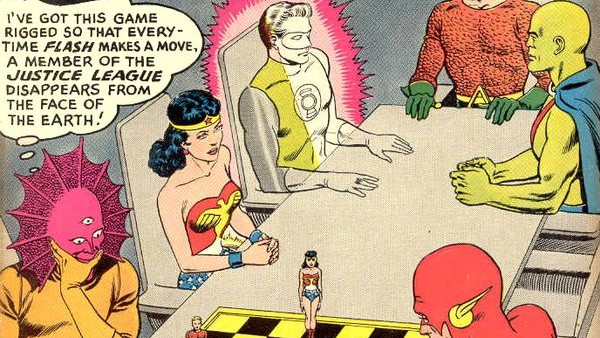
The Justice League first came together in 1960's The Brave and the Bold #28. After Earth's greatest heroes (and Snapper Carr) came together to stop an invasion by Starro, they decided to band together to fight the threats that no single hero could manage.
So what Earth-shattering crisis did they face in the first issue of their very own series? Chess.
When the rest of the League was captured by Despero, Flash was forced to play a special game of chess against the despot to save his teammates from the World of No Return.
The whole thing ended up being a pretty embarrassing start for the League. Despero rigged the game and so Flash managed to lose and get himself and all his friends banished to an alternate dimension. The League escaped though, but they returned from the World of No Return to find that Despero had already been defeated.
It turned out that while Despero may have been able to easily conquer this group of modern day gods, he was no match for their dumb teen sidekick. Snapper Carr had managed to sneak into Despero's doomsday weapon and use it against him, knocking him unconscious.
It's a wonder the entire team didn't just disband there and then.
7. Things Get Extreme
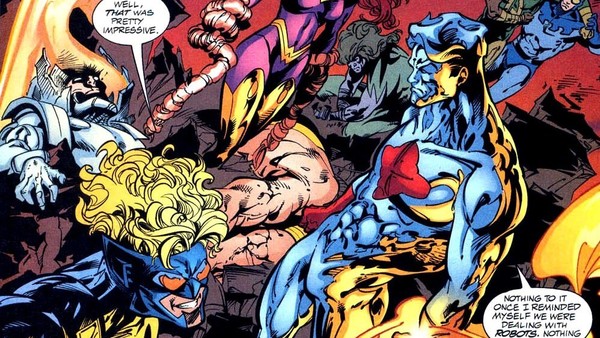
Extreme Justice was pretty emblematic of the problems the Justice League had when they weren't allowed to have any big heroes on the team.
The comic was a spin-off from the main team and was a very transparent attempt to cash in on the popularity of "edgy" heroes like spawn and featured all the usual 90's gimmicks. Booster Gold's suit was replaced by a ridiculous suit of power armour, the art made every character look like a pile of muscles randomly stitched together and Captain Atom had a mullet (which just adds to the confusion of how his hair is supposed to work when his body is basically a containment suit).
Apart from that, it was pretty much the same as the normal Justice League book but with all the plot and character development replaced by explosions and frowning.
It also didn't help that most of the team was made up of B-listers like Maxima (whose abilities included trying to sleep with every man on the planet and being useless despite having every superpower ever) and perpetual background character Amazing Man.
Extreme Justice even gave us "extreme" versions of Zan and Jayna from the Super Friends cartoon. Unsurprisingly, they didn't appear much after the series was cancelled.
6. The Champions Of Angor
Back when editors were more lax about their duties, the writers at Marvel and DC would occasionally arrange secret crossovers.
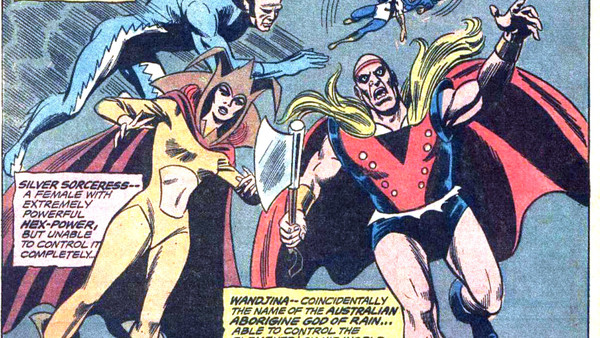
One such plan involved coinciding issues of Avengers and Justice League of America. Both teams fought a group of heroes from an alternate universe, each comprised of obvious copies of the other's heroes.
The Justice League wound up fighting the Champions of Angor, a team consisting of the wind god Wandjina (Thor), the size-changing Blue Jay (Yellowjacket), Captain Speed (Quicksilver) and the Silver Sorceress (Scarlet Witch).
After that first encounter, the team disappeared for a few years before popping back up in the pages of Justice League International. However, this time only Wandjina, Silver Sorceress and Blue Jay remained. Captain Speed had died with the rest of Angor in a nuclear holocaust.
The team initially opposed the League as they attempted to forcibly remove all the nuclear weapons on earth. After Wandjina died trying to stop a nuclear meltdown though, the other two members joined the Justice League.
They didn't have a great time. Silver Sorceress died and Blue Jay was a horribly incompetent loser until he left to travel the multiverse and find a world where he didn't suck so much.
5. The Team's Newest Recruit Isn't So New
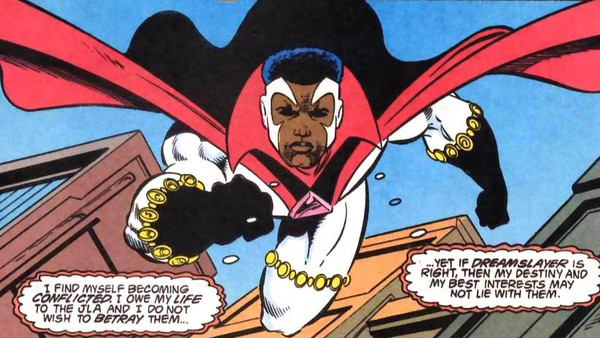
When Bloodwynd first appeared, a big deal was made out of how mysterious he was. No one else on the Justice League knew much about him other than that he had vague magic powers thanks to the Blood Gem on his chest and that he dressed like Dracula's glam rock cousin. For a long time, Bloodwynd's real identity was teased as a shocking revelation.
And, indeed, it was shocking. It was also really dumb.
Bloodwynd was actually Martian Manhunter who was being controlled by the demon inside the Blood Gem as part of a plan to infiltrate the Justice League by impersonating the real Bloodwynd so that he might find a power source strong enough to free the demon. Also, the real Bloodwynd was trapped in the Blood Gem as well.
The Justice League was eventually able to break Martian Manhunter's mind control and free the man who's name is literally just Bloodwynd. He then joined the Justice League for a while until he was fired for refusing to help out.
No one at any point ever wondered why exactly the Blood Gem didn't just have Martian Manhunter join the League as himself and avoid this whole debacle.
4. Justice Riders
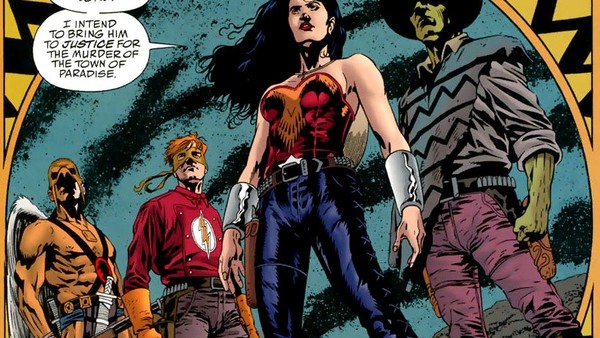
DC's Elseworlds line was a series that took familiar heroes and placed them in completely different times and places. The results ranged from a Victorian Batman to a grizzled Superman in a post-apocalyptic world.
The Justice League were no exception and were reinterpreted in numerous Elseworlds. One of the more well-known was Justice Riders, a one-shot comic that turned the members of the Justice League into cowboys.
In this world, Diana Prince was a US Marshall out to take down corrupt rail baron Maxwell Lord (ironically predicting the main universe Lord's turn to villainy several years later), Ted Kord was a mad inventor known as the Beetle, Hawkman was a Native American warrior, Booster Gold was a bounty hunter, Guy Gardner was a Pinkerton agent on the trail of the outlaw known as Kid Flash and Martian Manhunter was... well, he was an alien in a poncho.
Together they banded together to take down Lord, his army of mechanical soldiers and his war machine Lord Havoc. Then, with the day saved (and the story sold to a struggling writer called Clark Kent), the Justice Riders all rode off into the sunset one last time.
3. The Detroit Team

During the 80's, DC wanted to capitalise on the success of books like X-Men and Teen Titans and so decided to replace most of the Justice League with new characters in their early 20's.
The concept of the book actually came from a pretty interesting idea. The likes of Superman and Batman struggled to balance protecting their cities with their commitment to the League and so Aquaman decided to create a new Justice League of heroes who could stay on the team full-time.
Unfortunately, the result was a team consisting of veteran members Aquaman and Martian Manhunter, D-list (at least at the time) heroes Zatanna and Elongated Man and a group of new heroes.
These characters included Vixen, a totem-powered African, Vibe, a break-dancing former gang member who fell out of the Hispanic stereotype tree and hit every branch on the way down and Gypsy, a character who named herself after a slur for the culture that she decided to appropriate.
There was also Steel, whose main power was to be the most forgettable hero in existence.
The team's stories were plagued with heavy handed attempts to tackle current-day problems like gang culture and issues sold poorly leading to its cancellation. In the final story, Vibe and Steel were both killed and everyone else resigned.
2. The Justice League Form A Labour Union
The Justice League spent a surprising amount of their early days doing things that were not fighting supervillains.
In Justice League of America #28, Headmaster Mind (an evil headteacher, the perfect supervillain) tricked the world into hating superheroes by using the Justice League's "cardial vibrations", the energy given off by superhuman activity (you remember that from science class right?) to create a series of natural disasters.
As a result, the United Nations banned the League from using their powers, leaving Batman and Green Arrow as the only ones who could fight crime. This led to a bizarre sequence in which Superman, Wonder Woman, Flash, Green Lantern and Aquaman formed a union and picketed the UN building in protest (Meanwhile, Green Arrow was presumably bouncing arrows off Bizarro's head or something).
Eventually though, the team just decided to go off and fight crime anyway without using their powers (even though it's not like Superman can just be suddenly not-invulnerable). While they were doing that, Batman and Green Arrow were able to track down Headmaster Mind and expose that he was the one behind everything.
With the truth revealed, the UN lifted their injunction and everyone learned an important lesson about... something.
1. Cry For Justice
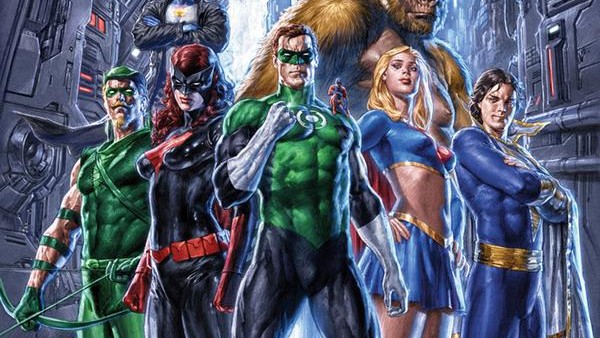
One of DC's worst habits is its occasional tendency to mistake "dark" for "good". The ultimate expression of this was the abysmal and appropriately named Cry for Justice.
The miniseries was a downright nasty story in which a new Justice League tried to hunt down the villain Prometheus. It's a hunt which was slightly hampered by the fact that every single member of the League was a drooling moron who felt the need to yell out "Justice" at least twice per page.
The comic is also notorious for its utterly gratuitous use of violence in an attempt to appear serious (a point which is somewhat undercut when one of your characters is a man with a gorilla's body). "Highlights" include Roy Harper losing an arm and the entire Global Guardians getting arbitrarily killed off.
The lowest point though, is the destruction of Star City, resulting in the deaths of thousands of people including Roy's daughter Lian. It's an act so overly awful that even Zack Snyder would think it was too much.
It also led to the unintentionally hilarious Rise of Arsenal, it which Roy Harper gets loopy on heroin and beats a bunch of criminals with a dead cat.