10 Actors Who Did Not Take Credit For Big Movie Roles
Pleasant, little Easter eggs along the way.

One of the most ego-boosting privileges of the modern celebrity is seeing your name in glittering lights aboard a marquee, or among the fancy opening credits sequence of a major blockbuster. To some it's a birthright.
Marlon Brando insisted he get top billing for his 20-minute role in Richard Donner's Superman, even before the lead and title character performer Christopher Reeve. Then there's the case of The Towering Inferno, for which Paul Newman and Steve McQueen not only insisted on equal billing, but also demanded to have the exact same amount of lines of dialogue throughout the two-hour plus disaster flick.
Fame is a drug, as has often been said, and what better high than having the power, wealth and street cred to know that the very syllables that comprise your name may be enough to draw millions of people to a darkened theatre?
But save your envy for the humble, the few brave souls who knew to put art before vanity. To them, the project is a pure, chaste creature and slapping their name over it would only tarnish its intangible beauty. Their appearances in certain films is less distracting and more a pleasant surprise.
10. David Hyde Pierce - Hellboy

As far as director Guillermo Del Toro and comic creator Mike Mignola were concerned, no living actor was more suited to play the hulking, red demon-cum superhero than Ron Perlman. There are few roles suited to Perlman's grizzled masculine features that lend themselves to a lead (for this writer's money, cast him as Tom Waits now).
The strange, faithful Hellboy adaptation may not be the best, but given its 2004 release date, it's among the first serious comic films before Marvel Studios ruled Hollywood. David Hyde Pierce's gentle, polite tone perfectly encapsulates the role of Hellboy's psychic fish-man sidekick Abe Sapien, granting him a humanity that otherwise could have been lost. The physical role was played by motion capture legend Doug Jones.
Pierce, reportedly every bit the gentleman of Niles Crane, demanded he be unbilled - claiming that the brilliance of the role belonged entirely to Jones. In the film's sequel, his voice was gone and Jones was allowed to use his own - turning in an acceptable substitute.
9. Gary Oldman - Hannibal

Ridley Scott's 2001 adaptation of Thomas Harris' eponymous novel is remembered for a particularly gruesome dinner climax...and not very much else. Fans of the novel disliked that the film did not go far enough, while the uninitiated felt it went too far. David Mamet's script was over-the-top, and audiences felt that Anthony Hopkins' portrayal of Hannibal "The Cannibal" Lecter was something best taken in small doses rather than the hammy lead role here.
Gary Oldman played Mason Verger, the only victim of the good doctor who lived, albeit horrifically deformed and wheel-chair bound. He's all but unrecognizable in the role.
Originally, Oldman had requested to share top-billing with Julianne Moore and Hopkins. But when the studio refused, he decided he should remain inconspicuous under the make-up instead.
8. Johnny Depp - 21 Jump Street

Phil Lord and Christopher Miller's reboot of the bafflingly well-liked 1980s police/high school drama 21 Jump Street impressively manages to be self-aware without grating on the nerves.
The original show was the first to put the FOX network on the map and was integral in launching Johnny Depp's career both as a teen idol and a serious actor. Shortly after leaving the show in 1990, he was quickly headlining major motion pictures.
Any audience assumed a film as self-aware as the reboot would have its original lead cameo at some point. After all, he granted similar thanks by appearing briefly in Freddy's Dead: The Final Nightmare (Wes Craven's first Elm Street was his "and introducing" credit). As 21 Jump Street comes to an end, we get our Depp appearance - only it wasn't a cameo. Lord and Miller pulled the rug under audiences by revealing he had been there the entire time, under heavy prosthetic make-up, playing the same character he did on the show.
Depp gladly appeared unbilled, as revealing his name in the credits or press would ruin the joke.
7. Kathleen Turner - Who Framed Roger Rabbit?

Robert Zemeckis' 1988 film noir-comedy Who Framed Roger Rabbit was not only a breakthrough for special effects (like much of the director's work, for better or worse), it also made people feel strangely comfortable ogling a buxom cartoon character.
There's a lot of trivia regarding the production of the film. The novel it was based upon, Who Censored Roger Rabbitt, is drastically different. In it, Roger and his cohorts are comic strip characters, and Roger is brutally murdered early on leaving only a word bubble behind as a clue. Rather, the script is derived from an un-produced sequel to Chinatown known only as Cloverleaf. Screenwriter Robert Towne initially intended the 1974 classic to be a trilogy focusing on the holy trinity of L.A. corruption - Water, the public transit system vs. the freeway, and finally oil; the last of which was made in 1990 as the Nicholson helmed-flop The Two Jakes.
Instead of Towne's gritty realization, they added cartoon characters. The most memorable to some was that of Roger's wife, Jessica.
Kathleen Turner, at the height of popularity, voiced the role as a favour to Zemeckis while she was nine months pregnant. No one knew until Turner revealed it on a radio show after the film's release.
6. Edward Norton - Kingdom Of Heaven

Ridley Scott's Kingdom of Heaven is known for having one of the most significant director's cuts ever released. The theatrical cut of the film was reviled by critics and audiences alike but the director's cut gained street cred on many a repeat viewing. It also gave more screen time to its very large cast.
Disregard Orlando Bloom (like we all do ow anyway) and any major or well-known UK actor shows up somewhere in the film's three-hour run time. They're fairly interchangeable.
One notable exception is Edward Norton. His role of the leper King Baldwin IV is entirely obscured by a mask, thus his performance is given exclusively through emotive, soulful eyes. As such, the actor refused credit on the initial theatrical run and most watched it probably not realising it was the Fight Club actor.
5. Jack Nicholson - Broadcast News

James L. Brooks' look at ethics, character, integrity and other things about which television news stopped caring led to several major Oscar nominations, including Best Picture. Brooks had worked in the field before becoming a director, and much of Broadcast News' humour and situations are inspired by his days behind the scenes of a news desk.
Jack Nicholson appears as the vain lead anchor in Washington in what initially seems like a brief cameo. However, after the cast experiences brutal layoffs, Nicholson appears again in person to send off the troops. Nicholson had become friends with Brooks on the set of Terms of Endearment and refused payment for his extended cameo here.
In America circa 1987, during one of the worst economic drops in American history (until recently), two things were certain: layoffs and Jack Nicholson.
4. John Houseman - Naked Gun
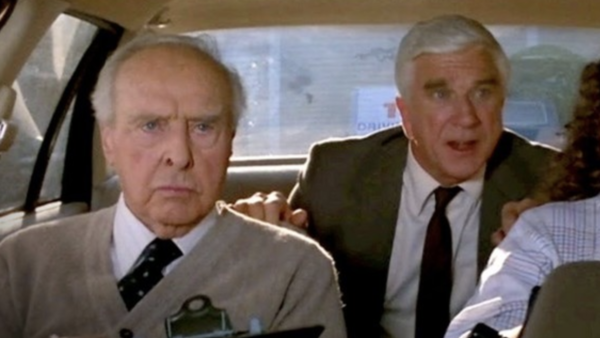
The first thing the Zucker Brothers got right when they made their seminal spoof Airplane! was the casting of Leslie Nielsen. Prior to 1980, Nielsen had been a serious actor, appearing in a few straight-laced disaster films like The Poseidon Adventure and The Day of the Animals.
His self-serious presence led to some of the greatest deadpan lines of the movie, and the Zuckers looked no further than Nielsen for the lead of Frank Drebin, the bumbling detective of the short-lived series Police Squad! and later The Naked Gun.
Running with the notion that serious actors deadpan the best, they also cast the legendary John Houseman, in his final role, as a driving instructor during a car chase in Naked Gun. It was his final role before passing away, but at least he went out laughing. The is loaded with oddball cameos, mostly related to the baseball-themed plot, but Houseman's is entirely out of the blue, a strange dash of class in an otherwise hysterical car crash.
3. Kevin Spacey - Se7en

One of the more legendary uncredited roles shocked audiences in the mid 90s when Kevin Spacey walked into a police headquarters shouting in a blood-covered shirt. Despite a frightening, intricate opening credits sequences that poured over the killer's maniacal journals, his name was nowhere to be seen (at least not until the very end of the picture).
In 1995, the year the film was released, the internet was in its infancy and outside of the most dedicated of message boards - spoilers were never an issue.
Spacey had recently come off the success of his Oscar-winning turn in The Usual Suspects, and director David Fincher was concerned his mere casting in another crime thriller would lead to audiences assuming his identity as the villain from the beginning. Fincher didn't want audiences to wait for Spacey to simply arrive but be shocked when he actually does enter the frame.
2. Matt Damon - Interstellar

Christopher Nolan's abhorrently overlong, mostly confusing yet strikingly beautiful film Interstellar caused a rift among fans of the director's oeuvre. His biggest defenders still shout about its scientific accuracy (still widely debated by celebrity scientists like Neil DeGrasse Tyson), its detractors point to the fact that, sometimes, there's no way to make science interesting if one isn't already invested.
While searching for a habitable planet as the earth suffers its final dust bowl, farmer-turned-somehow-astronaut Matthew McConaughey and Anne Hathaway run across a previous failed expedition. After the last survivor of said expedition is thawed out, audiences were surprised to see the familiar face of Matt Damon - who almost instantly succumbs to space madness and nearly kills the whole crew.
One can't help but wonder, watching them back to back (should you have 14 hours to kill), how The Martian would have played out had it been the same character. No reason was given by the studio or Damon, and save for a Variety report that mentioned he played an "unspecifed role". It wouldn't be the last time, as Damon appeared a few years later in Unsane, Deadpool 2 and Thor: Ragnarok, all without billling.
1. Robin Williams - Dead Again
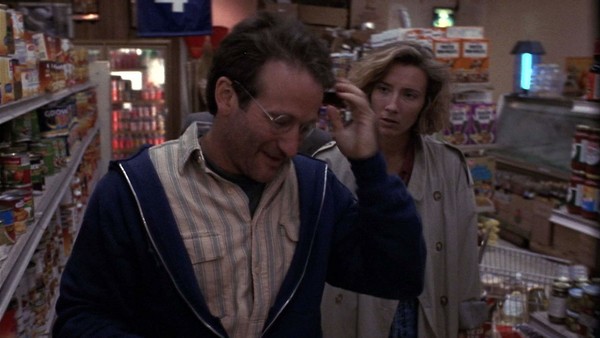
Robin Williams was one of the most beloved actors, comedians and all-around decent people to ever come out of Hollywood. To this day, he is celebrated by many for his iconic work in such films as The Fisher King, Good Morning, Vietnam and Awakenings.
But there's no question that his presence can often be a bit of a distraction in movies. This is in part thanks to jarring trailers that signify his appearance by blasting Hall and Oates' "You Make My Dreams" to tell you that, yes, Robin Williams is coming to shake up your milquetoast existence and life lessons will be learned.
It was William's decision to not be credited for his role in Kenneth Branagh's excellent, Hitchcockian 1990 thriller Dead Again as a bitter, disgraced psychiatrist who helps Emma Thompson's amnesiac. Much like Mel Brooks kept his public involvement in producing The Fly and The Elephant Man, Williams feared his casting would lead audiences to think it was a comedy.