10 Awesome Space Movies That Are Better Than Interstellar

Murphy's law - if a film can be better than Interstellar, it will be.
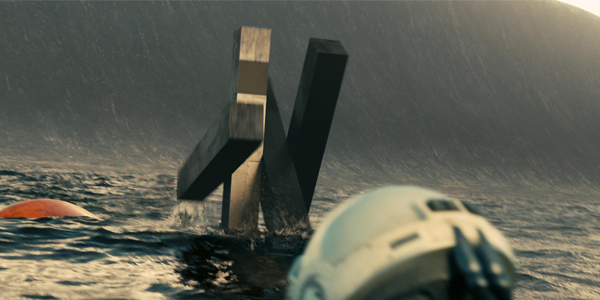
It's been over a week now since Christopher Nolan's Interstellar hit our cinema screens and it's divided opinion as predicted. Some are already hailing it as Nolan's greatest movie worthy of the label "masterpiece", while others are less forgiving and see it as a film riddled with flaws. The reality, as is often the case, probably lies somewhere in between - clearly Nolan is aiming for epic with Interstellar; nothing less than an insight into the nature of humanity and their place amongst the stars. But for all its ambition the film's shortcomings make it fall short of the instant classic it is clearly striving to be. For many, Nolan has overreached himself and the grand accomplishment Interstellar could have been has turned out to be a technically proficient movie lacking the depth it sought to impart. Movies set in space are given a literal blank canvas upon which to project storylines and themes, and the space setting has thrown up a number of great films which make the most of the potential offered by this setting. From colourful, fast-paced operatic adventures to low key character-driven pieces oozing claustrophobia, there's plenty of choice for all cinematic tastes. Here are ten must-see space movies which lack the obvious flaws found in Interstellar while at the same time taking our exploration of the stars in a variety of new directions.

10. Moon

If ever you needed any proof that you don't need a gigantic budget to produce an effective and thought provoking science fiction movie, Duncan Jones's directorial debut Moon, starring Sam Rockwell, provides all the evidence you need. Set - predictably - on the moon, Rockwell stars as the astronaut charged with maintaining an automated lunar facility which collects helium-3 to use as an energy source in place of earth's dwindled supply of oil. Alone on the orbiting rock, he suffers from hallucinations and after an accident discovers a vault full of human clones. The ever-underrated Sam Rockwell delivers a sterling performance which holds Moon together from start to finish, enunciating the increasingly fractured state of mind of a person living in such isolated conditions, while the philosophical dilemma posed by the cloning adds a futuristic note to his agonizing dilemma. Moon is a minor masterpiece and a stunning directorial debut.

9. Guardians Of The Galaxy

If you really want to escape from the grim and sombre mood which tended to permeate throughout Interstellar you won't go wrong by opting to watch Guardians of the Galaxy instead. This year's surprise summer blockbuster hit is about as light hearted as space action adventures come. There's nothing particularly new about Guardians of the Galaxy's plot - its story of unlikely heroes and huge space battles has been done a million times before. But what elevates the film above the usual fare is its boisterous pace, smart, witty screenplay and overall sense of fun that big mainstream blockbusters often feel like they're lacking. Guardians of the Galaxy certainly might not be as sophisticated as Interstellar but in terms of setting out to achieve its goals it's arguably far more successful. For sheer entertainment value space movies don't get much better than this.

8. Starship Troopers

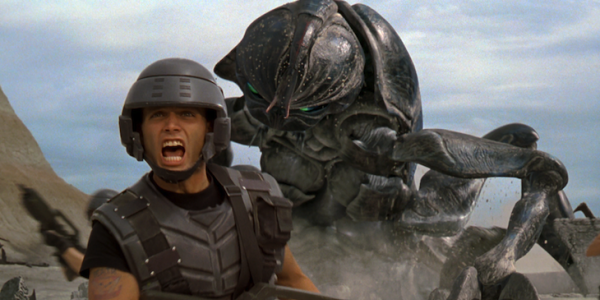
With an original script entitled Bug Hunt At Outpost Nine you'd be correct in assuming that Starship Troopers is something of an homage to the cheesy science fiction B-movies which proliferated in the 1950s - and on first impressions you'd be correct. However, as much as Starship Troopers clearly is an action-packed entertaining spacebound war movie - and there are more than enough over the top scenes of action as our human "heroes" battle hordes of Arachnids on their home planet - this is Paul Verhoeven, and as was typical of his movies at the time there's a strong satirical undercurrent lambasting the nature of propaganda and the fascist underpinnings of American politics. Starship Troopers might have polarized audiences and critics alike upon its release, but there's no denying that it packs a powerful visceral punch and more than a few lines delivered with sharp wit. It's a shame that all the straight-to-DVD sequels were so dire.

7. Wall-E

Wall-E might sound like a strange movie to mention in the same breath as Interstellar, but one wild fan theory doing the rounds is that Wall-E is actually the sequel to Nolan's latest blockbuster, the idea being that it takes Interstellar's barren earth one step further to the point where humans have left and all that remains are robots tending to the piles of rubbish. It's a neat little theory and Wall-E certainly shares some of Interstellar's preoccupations with environmental degradation and our species' tentative steps into space exploration. It's also one of the most beautiful looking Pixar films to date, with wonderfully quirky character designs full of personality set against some impressive space vistas. Perhaps another point of comparison lies in the personalities of Wall-E's robotic protagonists - as with Interstellar they are imbued with human characteristics and also appear to have more emotional appeal than their human co-stars.

6. The Right Stuff

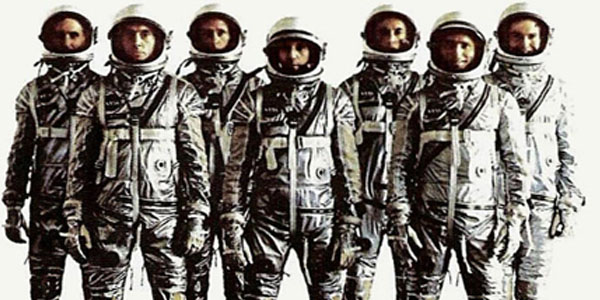
One space movie which is far more grounded in reality than any other on this list is The Right Stuff, Philip Kaufman's epic retelling of America's early forays into aeronautical research based on the best selling book of the same name by Tom Wolfe. Coming in at over 3 hours running time, The Right Stuff is clearly more of a slog to get through than Interstellar. But with its rich and diverse characters and compelling plot it never feels like its draining the audience. This is in no small part down to its willingness to focus not just on the central characters as they endure the tests they need to take before venturing into the skies but also to explore the wider political and societal ramifications of the space program. The Right Stuff emerged as one of the best movies of 1983 and remains one of the most engrossing films about our desire to reach beyond the limitations of our planet's gravitation pull ever made.

5. Royal Space Force: The Wings Of Honnêamise
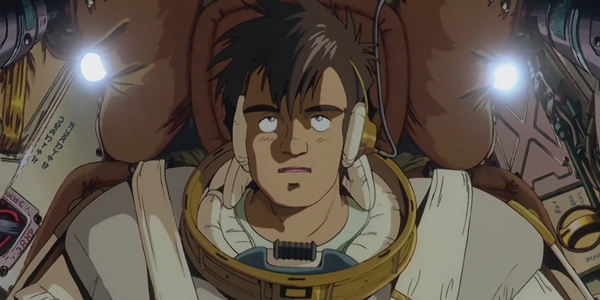
Like The Right Stuff, Royal Space Force: The Wings Of Honnêamise is far more preoccupied with mankind's burgeoning ambitions to reach to the stars rather than the time we actually spend there. This time, however, the setting is a fictional parallel version of earth, and the focus is on one man's drive rather than the team effort of The Right Stuff. A film that The Wings Of Honnêamise bears a great resemblance to is Hayao Miyazaki's latest Studio Ghibli movie, The Wind Rises - both films are centred around a committed, pioneering individual with an unstoppable drive to achieve his goals; both men find their ideals nearly thwarted by a system which has other, less noble aims driving it forward. It's a truly beautiful work of animation with a glorious soundtrack by Ryuchi Sakamoto (perhaps most famous for his work on Merry Christmas, Mr Lawrence), but the incredible art direction never overwhelms what matters the most - the humanity of the characters.

4. Solaris

Solaris If you're looking for the thinking man's science fiction then you need look no further than Andrei Tarkovsky's 1972 adaptation of Stanislav Lem's Solaris - the genre doesn't get much more cerebral than this. Following on from the news that the small crew of a space station orbiting the fictional planet of Solaris have fallen into an inexplicable emotionally deteriorating state, psychologist Kris Kelvin travels there in order to rectify the situation. Once there, however, he finds himself falling into a state of sorrow, and what unfolds was described by Tarkovsky as a "drama of grief and partial recovery€. Tarkovsky was saddened by the lack of intellectual depth in the science fiction genre and this is a meticulous and engrossing counterbalance - Steven Soderbergh demonstrated his cinephilic roots with his own remake of Solaris in 2002 starring George Clooney, which is an impressive and more faithful adaptation of the source material.

3. Alien
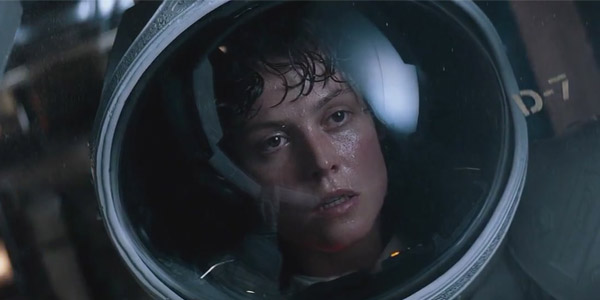
"In space no one can hear you scream." So read the tagline to Ridley Scott's Alien, a film which revolutionized the manner in which science fiction and horror could be successfully merged into a truly unique and unsettling experience for the audience. On paper the plot of Alien sounds about as threadbare as movies come - after discovering strange eggs on a desolate planet, the crew find themselves in increasing danger after one of their number is impregnated and gives 'birth' to a monstrous creature. But Alien is far more than the sum of its parts: from the incredible atmospheric production design and Scott's mastery of tension to the uniformly excellent performances, this is filmmaking at its most polished. Screenwriter Dan O'Bannon was happy to be frank about the influences which led to him pitching Alien as "Jaws in space," once saying, "I didn't steal Alien from anybody, I stole it from everybody." Such a shame that, Aliens aside, the many sequels which followed became increasingly inferior.

2. Star Wars Episode V - The Empire Strikes Back

The Star Wars universe may have spanned six movies and counting - not to mention the countless spin-offs, comic books, novels and other paraphernalia spawned over the decades - but few fans would argue with the statement that the pinnacle came with the release of The Empire Strikes Back in 1980. Ironically, the second installment of the original trilogy received mixed reviews upon its release, but time has been far kinder to director Irvin Kirscher's stunning contribution to this epic modern myth - it is the most unconventional of the series in which our heroes suffer one defeat after another and uncomfortable revelations are made which completely change the simplistic "good versus evil" dynamic. With more Star Wars on the way there's a new hope (sorry folks) that the franchise will once again reach the same heights attained in The Empire Strikes Back - with J.J. Abrams going back to the practical effects that made the original trilogy so endearing and much of the cast also returning, all that remains is for the writers to inject the same level of emotional depth. And now George Lucas' out of the picture there's a good possibility that might just happen.

1. 2001: A Space Odyssey

The endless and mostly negative comparisons made between Christopher Nolan's Interstellar and Stanley Kubrick's 2001: A Space Odyssey are perhaps justified when you consider that Nolan himself has cited Kubrick's masterpiece as a huge influence on his latest film. Of course, failing to live up to the same standards of such a seminal work of cinema is nothing to be ashamed of - 2001 is, after all, the benchmark by which all sci-fi with grand ambitions is measured. Still, when watching Kubrick's epic it's not hard to see why this is such a superior film - Kubrick's grasp of and approach to the philosophical themes, culminating in nothing less than the evolution of human consciousness, is played out with a notable degree of ambiguity which has led to countless scholarly - and amateur - interpretations. The evolution of life, mankind's hubris and the final encounter with the transcendental object at the end of time (as Terence McKenna may have put it) make 2001: A Space Odyssey a true masterpiece and one of the greatest movies ever made. The universe has never been presented in such a beautifully mysterious manner. Do you agree or disagree that the films on this list are better than Interstellar? Why not post a comment below and let us know?

Contributor
Contributor

Andrew Dilks hasn't written a bio just yet, but if they had... it would appear here.