10 Best William Shakespeare Film Adaptations
Shockingly, Kenneth Branagh isn't in every entry.

There are more than 400 filmed adaptations of William Shakespeare's plays, not to mention the countless live theatrical productions that occur each day. Such a body of work can be daunting for those who've never seen Shakespeare as anything but than the subject of boring English lessons, and there's nothing like a bad adaptation to put a newcomer off someone's work for life. But just as there are only several truly great Shakespeare plays in amongst the many good ones (and a few bad, like The Taming Of The Shrew), so there are a few truly great screen versions of Shakespeare in amongst a multitude of good, decent or passable ones.
This article is designed to serve as both an introduction for those not knowing where to start and at the starting point for discussions about different versions among Shakey's existing fans. To that end, there are a number of ground rules to be observed. Each play can only have one entry on the list: otherwise we would end up with a list of the ten best Hamlets, or Lears, or Macbeths, and that would be rather boring. We are not covering works which pastiche or parody Shakespeare, like the first series of Blackadder, nor are we including films like Infamous or Shakespeare In Love which focus on Shakespeare the person. Vernacular adaptations, which change the language, are (mostly) not included, nor are speculative works like Rosencrantz And Guildenstern Are Dead. Finally, we are not including recordings of theatrical performances: as Alfred Hitchcock once remarked, they are not films but "photographs of people talking".
So, with those rules in place, let us charge once more into the breach and take a trip to the undiscovered country from whence no traveller returns...
10. Chimes At Midnight (Orson Welles, 1966)
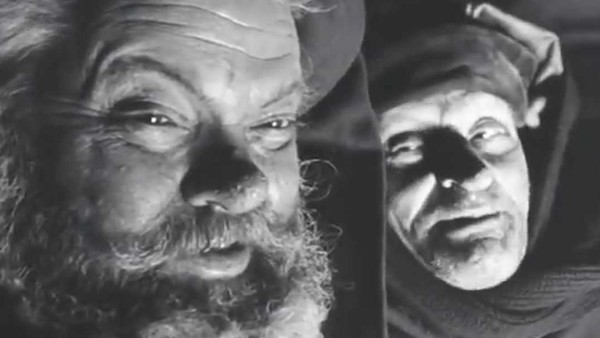
I'm know I'm already bending the rules, but Orson Welles' contributions to Shakespeare should not be underestimated. Before Citizen Kane, before his War of the Worlds radio drama which caused a major panic in America, Welles had made his name on the stage with controversial re-toolings of two Shakespeare plays - his 'Voodoo Macbeth', which transferred the play from Scotland to Haiti, and his Julius Caesar, which was the subject of Richard Linklater's film Me and Orson Welles.
But while his cinematic Macbeth remains compelling, the ideal pick for this list is the film which involves his favourite Shakespeare character: Sir John Falstaff. Chimes At Midnight draws on material from five of Shakespeare's plays: Richard II, Henry IV Parts I & II, Henry V and The Merry Wives of Windsor. While the original plays (or the first four at any rate) focus on the kings of England, Chimes At Midnight restages the action to revolve around Falstaff, a portly and cowardly soldier who befriends the young Prince Hal, later Henry V.
After much time spent cavorting in taverns, to the chagrin of his father Henry IV, Hal becomes king and promptly turns his back on Falstaff. Welles said that Chimes At Midnight was centrally about "the betrayal of friendship". While many adaptations characterise Falstaff as a stupid oaf, Welles' portrayal is more sympathetic, showing him as a well-meaning man trying to hold court with men greater than himself, and getting caught up in the cruel choice between kinship and friendship.
For all the jokes about Welles losing weight to play the part, and all the film's technical problems (the sound is often poor), it remains an interesting examination of one of Shakespeare's most distinctive and unfortunate characters.
9. Forbidden Planet (Fred M. Wilcox, 1956)
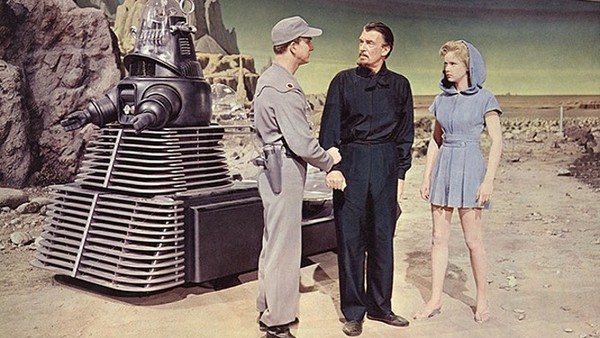
Again, I'm really bending the rules here, but let's be honest: no list of the best Shakespeare films would be complete without Forbidden Planet. The film which gave us Robbie the Robot (later of Lost In Space) is also the best cinematic adaptation of The Tempest, beating out Derek Jarman's version from the 1970s, Peter Greenaway's unfortunately tedious Prospero's Books and the recent version starring Helen Mirren.
The Tempest is the last play that Shakespeare wrote alone, collaborating on several further plays until his death in 1616. Set on a remote island, it follows the story of Prospero, the rightful Duke of Milan, who conjures up a storm to shipwreck his usurper brother Antonio and restore his daughter Miranda to her proper title. Containing elements of romance and tragicomedy, it has often been seen as Shakespeare's official farewell to the stage, epitomised in Prospero's final monologue.
While Forbidden Planet lacks the rich language that makes Shakespeare so distinctive, it is in many other aspects a very faithful adaptation. Boasting brilliant production values for its time and a ground-breaking electronic score, the film ties the plot and character arcs of Shakespeare's play to an interesting exploration of the psychoanalysis of Carl Jung. It's also an opportunity to watch Leslie Nielsen when he was making his way as a straight actor - and he's as convincing here in dramatic form as he would later be in the Naked Gun series.
8. The Hollow Crown: Richard II (Rupert Goold, 2012)
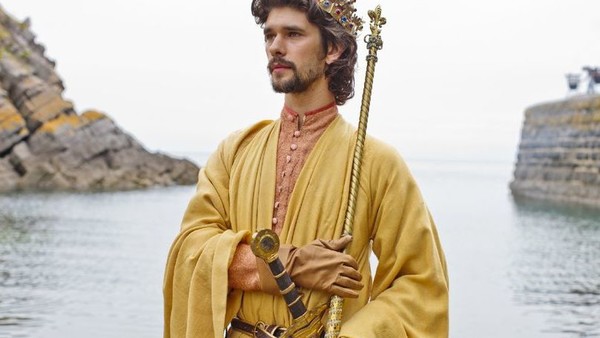
The only TV entry on our list is also the most recent, from the BBC's highly acclaimed adaptations of Shakespeare's second tetralogy. The other instalments had their merits too, with Jeremy Irons excelling in the lead role of Henry IV Parts I & II, and Tom 'Loki' Hiddlestone acquitting himself reasonably well in Henry V. But the jewel in The Hollow Crown series is Richard II, featuring Ben Whishaw in one of his finest performances.
Richard II concerns the last two years of the titular monarch's rule. Faced with a dispute between his cousin Henry Bolingbroke and noble Thomas Mowbray, Richard banishes the former for six years and the latter for life. After Bolingbroke's father dies, Richard seizes all his lands and imposes heavy taxes to fund a war in Ireland. Bolingbroke, banished to France, assembles an army and invades England to claim back first his money and then the crown. Richard complies and is imprisoned in Pomfret Castle, where he is murdered shortly after Bolingbroke becomes Henry IV.
Richard II is a compelling tragedy in its own right, in which a powerful leader falls due to a fatal character flaw (in Richard's case vanity) and is supplanted by those closest to him. But it is also an interesting look at the divine nature of kings, and how the physical body of the king relates to the body of England. This theme is drawn out in Rupert Goold's direction, where Whishaw is dressed and shot as a Christ figure, ethereal against Rory Kinnear's scheming and jaded Bolingbroke. It's a brilliant performance which cements the former's status as one of the best actors of his generation.
7. Othello (Oliver Parker, 1995)

There are a lot of versions of Othello that couldn't be included in this list due to changing attitudes. While Orson Welles and Laurence Olivier were immensely talented actors, blacking up to play the Moor of Venice was not exactly their finest hour. I almost included Christopher Eccleston's version on here, in which he played Iago as a racist police officer, passed over for promotion in favour of the main character. But for all-round excellence, I commend to you Oliver Parker's version from 1995, which marks Kenneth Branagh's first appearance on this list.
Othello is a tragedy about pride, jealousy and spite. Othello is a Moor (a North African Muslim) and a general in the Venetian army. Iago, a battle-hardened ensign in the same army, hates Othello for promoting the young and inexperienced Michael Cassio ahead of him - and believes that Othello has secretly slept with his wife Emilia. He resolves to destroy Othello by appealing to his character flaw of pride, planting rumours about his wife Desdemona being unfaithful...
While Oliver Parker's subsequent career leaves a lot to be desired (St. Trinians, Jonny English Reborn), his debut effort is a ravishing and murky piece of work. While not the first version to cast an African-American actor in the title role, it is the most successful thanks to a commanding performance by a pre-Matrix Laurence Fishburne. Kenneth Branagh is brilliant as Iago, capturing his Machiavellian scheming with gleeful relish. It's also a surprisingly raunchy effort, epitomised by the pivotal scene involving Iago, Emilia, a handkerchief and sudden lovemaking...
6. Much Ado About Nothing (dir. Kenneth Branagh, 1993)
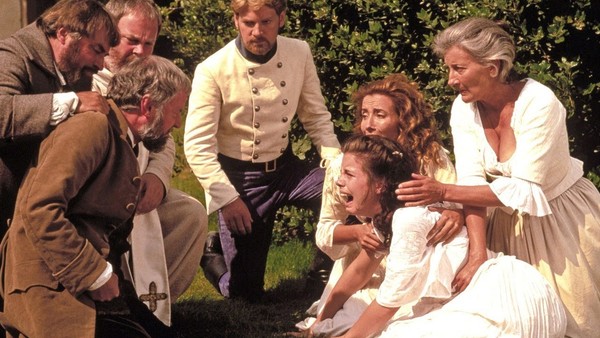
Much Ado About Nothing is the only comedy on this list, and that reflects a general trend regarding Shakespeare adaptations. The vast majority of Shakespeare's histories and tragedies remain fresh and relevant because of their dramatic weight and themes, while the conventions that underpin his comedies so often don't stand up on film (e.g. the convention of women dressing up as men). To do justice to a Shakespeare comedy takes someone with great patience and boundless energy and what better man to set the standard than Kenneth Branagh.
Like many of Shakespeare's comedies, Much Ado About Nothing revolves around romance and confusion. Set on the island of Sicily, it follows the fortunes of two young couples: Benedick and Beatrice, who hate both marriage and either other with a passion, and Claudio and Hero, who are positively besotted with each other. The play revolves around characters overhearing gossip about each other, which leads the first couple to confess their love and the second to almost fall apart. The title derives from 'noting', meaning overhearing gossip, which in Elizabeth England was pronounced the same as 'nothing'.
I'm a big fan of Branagh's Shakespeare films, because he goes out of his way to strip away the stuffy reputations of the plays and make them accessible to modern audiences. He's more than happy laughing at himself in the process, turning in a great performance as the aloof and sexist Benedick. Equally good, however, are Denzel Washington as Don Pedro and Branagh's then-wife Emma Thompson as Beatrice. It's a feisty, spirited and beautifully shot adaptation, which is guaranteed to put a big smile on your face. Plus it has Brian Blessed in it.
5. Richard III (Richard Loncraine, 1995)

You may have noticed by this point that none of Sir Laurence Olivier's interpretations have made it onto this list, at least so far. It's not that I consider him a bad actor, or a bad director of Shakespeare not unless I were looking to be lynched over the internet. But this list is concerning itself with the most cinematic adaptations, whereas Larry's films are very stagey, even by the standards of the day. There is no better way to illustrate this point than with Richard III.
Richard III is the final part of Shakespeare's first tetralogy, following the three parts of Henry VI. It follows Richard, Duke of Gloucester, the deformed brother of King Edward IV and a highly regarded military leader. With the House of York on the English throne and the War of the Roses seemingly over, Richard plots to set Edward and his other brother against each other, killing all those before him so that he may have the crown. It's one of the darkest and most political of Shakespeare's plays, whose moral questions still resonate today.
While Olivier's version resembles a recording of a stage play (albeit a very good one), Richard Loncraine's version is perhaps the play's most cinematic rendering. It relocates the action to a fascist vision of 1930s England, commenting about the corrupt nature of the English aristocracy and using familiar buildings to make the action resonate, e.g. making St. Pancras the seat of Edward's government. Best of all, it features Ian McKellen in one of his most terrifying and visceral performances, with his reading of the opening speech being perhaps the best on record.
4. Romeo + Juliet (Baz Luhrmann, 1996)

I'll admit it: I'm a sucker for Baz Luhrmann. I love the manic, often insane energy of his films, the ideas they raise about cultural values, the ravishing cinematography and the wonderful music. But I'll also admit that Romeo + Juliet left me cold the first time around. In hindsight this was due to my initial disdain for Leonardo di Caprio: by the time I saw this film, Titanic had been in cinemas for months and I was sick of him playing the pretty boy.
Looking at the film now, it's a really remarkable artistic vision. In case you have been living under a rock (for over 400 years), Romeo and Juliet is the classic story of two "star-cross'd lovers", whose families (the Montagues and Capulets) are bitter enemies. Drawn together by fate when Romeo infiltrates a masked ball, their romance blossoms in secret as their families continue to murder each other. After Romeo is banished from the city of Verona, Juliet plots with a priest so they can be reunited but being a tragedy, things don't quite go to plan...
The influence of Romeo and Juliet is so wide-ranging that I could have put any number of adaptations on here, but Luhrmann's version is perhaps the best introduction to it for young audiences. Like Branagh, he goes out of his way to make the play accessible, wringing the most out of both the present-day settling and the young performers (Claire Danes is especially good as Juliet). It's not the most stately Shakespeare film you'll ever see, but it does have a great, youthful spirit which makes the central romance resonate and the comic moments sparkle all the more.
3. Henry V (Kenneth Branagh, 1989)

While playing Hamlet remains the dream, many young actors are drawn to Henry V, either as a starting point or as a worthy challenge in itself. The character arc, from upstart drunken slacker to victorious monarch, resonates with young people, showing them what wonders can be achieved with the right attitude and application. It's no surprise therefore that Kenneth Branagh chose it as his first film, which he directed, adapted and starred in aged only 28.
Henry V follows the actions of said monarch in his bid to reclaim territories in France once held by his ancestor Edward III. Having scorned the French king's gestures of peace, and exposed a plot to murder him at Southampton, he arrives in France and lays siege to the town of Harfleur. Soon afterwards, his army are confronted in Agincourt by the full force of the French army. Their unlikely but emphatic victory results in Henry marrying the French king's daughter Catherine and becoming ruler of both England and France. Branagh has often been compared to Laurence Olivier, long before he ended up playing him in My Week With Marilyn.
While Olivier's version was shot on the cheap for the Ministry of Information, and is essentially Allied propaganda, Branagh's version takes a much more nuanced and revisionist approach to both the conflict and the character. The film takes pains to show the terrible scars of battle and the pain Henry feels for having to turn his back on Falstaff et al. for the sake of the crown. Arguably Branagh's most entrist adaptation, it is at turns funny, thrilling, maudlin and regal, and Branagh's performance is one of the best of his long and illustrious career. Plus it has Brian Blessed in it.
2. Macbeth (Roman Polanski, 1971)

Whatever you may think of Roman Polanski as a person, it's very difficult to deny his power as a film-maker (read more about that here). His classic period, from Knife in the Water to The Tenant, contains some of the most extraordinary, terrifying and mesmerising scenes in modern cinema, and he has few rivals when it comes to creating an atmosphere of oppressive, horrifying dread. But while Rosemary's Baby and Chinatown often come in for the lion's share of praise, his version of Macbeth is every bit as compelling and worthy of recognition.
Macbeth is a tragedy rooted in the influence of the supernatural. Macbeth, a war hero, is visited by three witches who prophesy he will one day be King of Scotland. After the incumbent King Duncan announces Malcolm as his heir, Macbeth plots with his wife to murder Duncan and blame it on his sons. With both heirs fled to England and Ireland respectively, the prophecy is fulfilled and Macbeth is crowned but that is only the beginning of the bloodshed, driven by the witches' tricks and the couple's mental disintegration...
Polanski's Macbeth has personal resonance for me, because it is one of the first films that genuinely terrified me. Co-scripted by the legendary theatre critic Kenneth Tynan, the film combines naturalistic acting with extraordinary use of montage and gallons of blood; when Macbeth sees Banquo's ghost, he sees Banquo in increasing states of decay, a la Griffin Dunne's character in An American Werewolf in London. Its crowning glory, however, as Francesca Annis as Lady Macbeth, who goes from a sweet, loving wife to being utterly unhinged. Her version of the "out, damn spot!" monologue, delivered entirely in the nude, is one of the most intimidating scenes in 1970s cinema.
1. Hamlet (Kenneth Branagh, 1996)

It makes sense that Hamlet would be at the top of this list, since it's considered Shakespeare's finest play. And there are many very fine versions from which we could choose Laurence Olivier's Oscar -winning version from 1948; the 1964 Russian version with a score by Dmitri Shostakovich; Franco Zeffirelli's 1990 version with Mel Gibson in the lead; or David Tennant's 2009 rendition for the BBC. But in the end, the most fully realised version is Kenneth Branagh's, which still stands as the jewel in his crown as both an actor and director.
Hamlet is the tragic story of the young Prince of Denmark. At the beginning of the play, he is visited by the ghost of his father, who tells him that he was murdered by Hamlet's uncle Claudius, who is in turn now married to his mother Gertrude. Hamlet swears revenge, beginning to behave erratically as he wrestles over whether he really did see his father or whether he is simply going mad. After much deliberation, and the casting-off of his love Ophelia, the play climaxes in a bloody confrontation in which most of the cast are killed.
If Henry V is Branagh at his most accessible, this is Branagh as his most fully realised. Being completely unabridged and running at over four hours long, it's certainly not for the faint-hearted, but it is an immensely rewarding experience. The 19th century setting, using Blenheim Palace as Elsinore Castle, brings a stately, ethereal feeling in which the moments of insanity and impulse become all the more intriguing. The film has the beauty of Lawrence of Arabia and Branagh's direction brings out the weight of the play with great dexterity. Both as a Shakespeare adaptation and a film in its own right, it is nothing short of a masterpiece.
Disagree with my choices? Drop me a comment below or visit Mumby at the Movies for more film reviews.