10 Deceptively Innocent Movies With Incredibly Dark Moments
Read between the lines, if you dare.

For many genres, gloomy and depressing moments are all part and parcel of the cinematic experience. In the context of horror, thrillers, or even action movies to name but a few, viewers are so accustomed to such instances that they rarely even bat an eye when one comes along.
As such, there's a legitimate sense of shock when these instances arrive in films that the average viewer wouldn't expect to see them in. Often targeted towards younger audiences, these movies traditionally feature less complex plotlines, narrative devices, and characters in comparison to those designed for an adult demographic.
Accordingly, when these offerings take a sudden turn into morbid territory, they can leave a genuine lasting impression. This isn't to say that the inclusion of these elements is a bad thing; far from it. Highlighting the complexity of the human experience, these ventures into the grimmer aspects of storytelling can often add gravitas and legitimacy to proceedings, heightening the emotional resonance of the scene and the wider picture.
With all that being said, this does little to dampen the impact of the shock factor, and these dark moments still land with an almighty clang when utilised against the backdrop of a seemingly innocent film.
10. Stand By Me

Stand By Me is consistently acclaimed as one of cinema's finest coming-of-age tales; an innocent story on paper if ever there was one. That said, it's hard to escape the fact that large swathes of Rob Reiner's ultimately uplifting picture are as dark as Satan's armpit.
Despite the youthful nature of the movie's 12-year-old protagonists, Stand By Me's central theme is arguably death, considering the film's core premise concerns the hunt for a corpse. The movie's central quartet set off in search of the body of Ray Brower - a young boy who had recently gone missing.
However, it's the kids' backstories that constitute Stand By Me's most unsettling aspects, serving as case studies in multiple forms of child abuse. A grieving Gordie LaChance is ignored by his parents following the death of his elder brother Denny, while Teddy Duchamp's mentally ill father is revealed to have attempted to burn his son's ear off.
However, Chris Chambers is arguably the film's most tragic example. In addition to having to deal with his loathsome elder brother and his psychotic friends, River Phoenix's charge was also framed by a teacher for stealing money at school. More heartbreaking still, is the revelation of how an adult Chris met his end - stabbed to death in a diner whilst attempting to break up a fight.
9. Thor: Ragnarok

While it may not fit the textbook definition of "innocent", Thor: Ragnarok is one of Marvel's more lighthearted entries. The third Thor-centric instalment is renowned for its consistent comic relief and colourful tone, with director Taika Waititi injecting his infectious sense of humour and wit into proceedings from the very get-go.
However, it's worth noting that without the unrelenting comedy on display, Thor: Ragnarok features so many dark moments that it would be a frontrunner for the MCU's most depressing film. Thor loses his father Odin in the early goings, before the majority of the Asgardians - including the Warriors Three - are brutally dispatched by Cate Blanchett's Hela in a bloody purge, with the remaining Asgardians forced into hiding to avoid intergalactic genocide.
There isn't even a happy ending to fall back on! The prophecy of Ragnarok ultimately comes true, destroying Thor's home and turning the entire Asgardian population into refugees. Almost unbelievably, it somehow gets even worse from there. With Thor attempting to guide his people to Earth for a new beginning, any sense of hope technically doesn't even last past the post-credits scene, with their vessel being intercepted by a large spacecraft.
2018's Infinity War reveals that said spacecraft belongs to Thanos, who massacres most of the remaining survivors. Even Korg's hilarity ultimately can't distract from the morbid material born in the purportedly comedic Ragnarok.
8. The Karate Kid

1984's wildly successful martial arts drama The Karate Kid served as a springboard for multiple sequels and even a Netflix series, featuring the now-adult versions of the original characters. However, for what is purportedly a feel-good coming-of-age tale, John G. Avildsen's original production happens to feature a jaw-dropping amount of bleak material.
In the first instance, chief antagonist Sensei Kreese is clearly dealing with a significant amount of PTSD from his service in the US Special Forces during the Vietnam War. This spillover of unexpressed psychological trauma is directed towards his students, teaching them a form of karate that emphasises violence and aggression rather than the peaceful tenets upon which the martial art was originally built.
However, matters get even darker from there when Mr Miyagi's desolating backstory is duly revealed after he eventually opens up to Ralph Macchio's Daniel LaRusso. An Okinawan immigrant and a 442nd Infantry Regiment veteran of WWII, the Medal of Honor recipient heartbreakingly confides in his new pupil that he lost his wife and unborn child in an internment camp during his military service.
While The Karate Kid is primarily associated with the notion of conquering bullies and "no can defence" crane kicks, it's hard to shake some of the darker elements associated with this classic picture.
7. The Incredibles

Acclaimed as one of the greatest superhero films of all time, trailers for 2004's The Incredibles hinted at little more than an animated action offering that was typical fare for a children's film.
As such, the amount of disquieting elements that came crashing out of Brad Bird's effort almost defied belief. For starters, the movie is barely five minutes in before viewers have been treated to the sight of an attempted suicide. The aftermath of said suicide attempt swiftly morphs into a storyline featuring collateral damage lawsuits, the depressing effects of a monotonous civilian existence, and a mid-life crisis storyline that stops just short of full-on infidelity from a purported family man.
Bird wasn't done cramming morbid material into this seemingly innocent narrative vehicle, either. The once wide-eyed superhero fan Buddy is eventually unmasked as "Syndrome", a now-wealthy weapons designer who made his fortune off a systematic and bloody purge of former superheroes. A seemingly endless catalogue of names marked "Terminated" highlights the sadistic extent of Buddy's campaign, having used his Omnidroid robot to mimic the powers of its victims to create a terrifying killing machine.
The Incredibles ultimately delivers a message of family unity and the importance of embracing what makes one unique, but decidedly does not skimp on the darkness.
6. The Boy and the Heron

Returning for one final piece of cinema, legendary filmmaker Hayao Miyazaki's The Boy and the Heron was released to critical acclaim in the summer of 2023. Prompted by a mysterious talking grey heron, the star-studded Studio Ghibli production follows the journey of Mahito Maki, a young boy who enters a magical world through a derelict tower near his new home.
This all sounds relatively benign in terms of stakes - The Boy and the Heron is allegedly an animated fantasy flick, after all - but featured amidst Miyazaki's mindbending narrative lie several elements that belie the movie's surface appearance as a children's film.
Between the appalling visual of Mahito losing his mother in a hospital fire in the picture's early goings, a disturbing instance of juvenile self-harm, and hordes of man-eating parakeets, The Boy and the Heron is shockingly sombre in patches. Emphasising the devastating impact of loss and grief through the lens of a child's perspective, Miyazaki's tale is inescapably soul-destroying at times. Despite what is ultimately a soulful and uplifting conclusion, it's legitimately difficult to shake the sense of despair associated with these previous flashpoints.
This is far from the stereotype that one would typically associate with a film centred on an animated talking bird.
5. Up
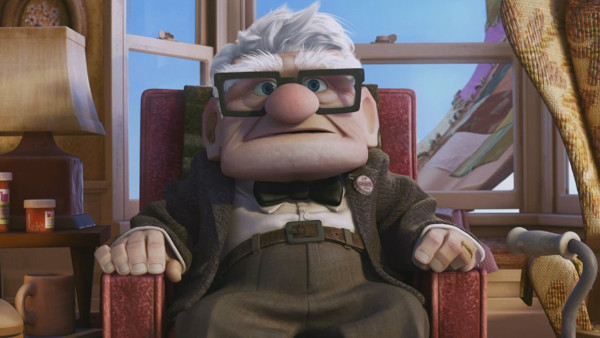
Only the second animated feature to receive an Academy Award for Best Picture nomination upon release in 2009, Pete Docter's Up was universally acclaimed for the movie's stellar vocal performances and the emotional depth of its uplifting narrative.
However, despite the film's central themes of hope, resilience, and dealing with loss, Up is decidedly not all sunshine and rainbows - ironic stuff for a story featuring a bumbling "Wilderness Explorer" scout, a flightless bird named "Kevin", and a talking Golden Retriever.
The most obvious example of this contradictory status quo would be the backstory of Carl Fredricksen, with the late great Ed Asner's gruff protagonist undergoing heartbreak after heartbreak throughout the film. The devastating realisation that Carl and his wife Ellie cannot have children is compounded by her premature death from illness, and Carl then slides into reclusive isolation and is relentlessly harassed by a greedy development company - pretty harrowing material when juxtaposed with the whimsical notion of using balloons to fly an entire house to South America.
Factor in the slide of Carl's childhood hero Charles Muntz into murderous insanity, or young Russell's longing for connection in light of his parents' neglect, and viewers are left with a much darker story than a glance at the poster would have initially promised.
4. Willy Wonka and the Chocolate Factory

Based on Roald Dahl's classic novel of the same name, 1971's Willy Wonka and the Chocolate Factory is one of the most beloved family films of all time. For anybody unfamiliar with this fantastical and whimsical tale, the notion that a movie about a renowned candy maker would feature a litany of macabre instances would be hard to fathom.
However, it doesn't take long for the darkness to rear its head once the golden ticket winners enter the chocolate factory, as all of the children bar Charlie are duly punished in accordance with their character flaws. While these exaggerated punishments have their share of comic relief, the real-life notions of an obese boy being waterboarded through chocolate-filled plumbing or a young girl being thrown down a garbage chute are unsettling, to say the least.
These punishments also serve to reinforce the alarming notion that Willy Wonka is a narcissistic psychopath, and they're not the only indicators. The chocolatier merrily places the competition winners in danger throughout the film, responds to most questions as though they were personal attacks on his character, and wears gaudy clothes to place himself at the forefront of everybody's attention at all times.
Factor in some downright terrifying cautionary tunes from the endlessly creepy Oompa Loompas, and a psychedelic boat ride that wouldn't feel out of place after imbibing a litre of psilocybin-laced ayahuasca, and Mel Stuart's film takes on a troubling new aura.
3. Home Alone & Home Alone 2: Lost In New York

While Home Alone and its 1992 sequel are arguably the finest Christmas comedy offerings of all time, this is a pair of films concerning two adult criminals attempting to murder a child and ransack his home.
Joe Pesci and Daniel Stern's Harry and Marv may hardly be Bonnie and Clyde in terms of criminal notoriety, but they're still dangerous felons with a history of violence. While Macaulay Culkin's Kevin McAllister ultimately triumphs over his foes in both of his appearances, the notion of a young boy being held at gunpoint or hung on a door hook while his captors threaten to bite off his fingers, seems more suited to a horror movie than an innocent comedy.
This is all without even touching upon the sheer barbarity of Kevin's iconic booby traps. In the real world, the acts of lighting people on fire with blowtorches, smashing them in the head with bricks and paint cans or shoving nails through their feet - to name but a few - are about as dark as it gets.
It speaks volumes to the quality of the comedic performances featured in both of the inimitable original instalments that such violence lands to howls of laughter as opposed to gasps of horror.
2. Toy Story

The Toy Story franchise has been traumatising audiences for years - and not exclusively through the use of emotional damage associated with the series' meditative take on the nature of friendship, loss, and impermanence.
Take 1995's original as the prime example. The arrival of Erik Von Detten's Sid precipitates a terrifying slide into Jeffrey Dahmer-esque territory with the revelation of the perverse child's pastimes. Sid destroys toys for fun - a terrifying notion in the context of a film about sentient playthings - and the depraved adolescent's room is filled with deformed "mutant" beings that Sid has constructed from the dismembered remains of his original toy collection. Yikes!
Unsurprisingly, Woody and Buzz come face to face with this young psychopath's horrific inclinations in short order after being captured. Buzz is strapped to a firework to be blown into tiny plastic shreds - to infinity and beyond, if you will - while Sid sadistically burns Woody's face using a magnifying glass. It's legitimately shocking stuff, to the point that many parents likely wondered what on earth they were allowing their child to witness when the movie originally debuted.
Our heroes may have ultimately escaped Sid's clutches by the film's conclusion, but the memory of his nightmarish proclivities will live forever in viewers' minds.
1. Shrek

Where to even begin with 2001's Shrek?
Chronicling a grumpy ogre's quest to return peace and tranquillity to his beloved swamp, DreamWorks' animated fantasy somehow managed to embrace traditional folklore while gleefully subverting all preconceived notions concerning the former at the same time.
It's wickedly brilliant that, despite featuring essentially every fairytale character in history, Shrek manages to implement so many dark instances. Whether it be Gingee being sadistically tortured by Lord Farquad, or storybook characters being banged up in literal internment camps, there's enough grim material to leave children weeping.
Still, Shrek's crowning jewel in this regard is undoubtedly the fate of Mother Bear. Long before Puss in Boots: The Last Wish reimagined these characters, Shrek's take on this children's tale met the most morbid of ends. The family of three bears can initially be seen in cages after being rounded up by Farquad's soldiers. However, when the displaced fairytale creatures show up at Shrek's swamp, Mother Bear is mysteriously missing as Baby Bear weeps disconsolately.
Cut to a later sequence depicting John Lithgow's diminutive villain in his chambers, and a bear rug complete with Mother Bear's signature pink bow can be seen adorning the floor. Fairytales may traditionally be associated with innocence, but that's a preconception that dies swiftly after watching this iconic offering.