10 Essential Movies Christopher Nolan Demands You See

If you want to understand what makes Christopher Nolan tick, start here.
If one director can be said to have brought a touch of class to mainstream Hollywood blockbusters it's without a doubt Christopher Nolan. Both his visual style and consideration of character and narrative is a far cry from the ADHD-inducing cacophony of noise and explosions which pass for Michael Bay movies. When it comes to understanding how a director finds a style and rhythm for which they are best known, going straight to the horse's mouth is the best way of discovering the movies which inspired them. As Paul Thomas Anderson said when asked about his own career as a director, "My filmmaking education consisted of finding out what filmmakers I liked were watching, then seeing those films." Watching Nolan's films and you can't help but be struck by a particular formality to his compositions and the clarity of mise-en-scène accomplished through judicious editing. The lack of showy camerawork and fast cuts is one of the reasons why they stand out as far more mature than most of the competition. How much of this aesthetic sensibility can be drawn from the films Nolan himself admires depends on the film in question. Here are ten incredible films which come with a strong recommendation from Christopher Nolan. If you haven't already seen them make sure you check them out soon.

10. The Thin Red Line

Terrence Malick has had a turbulent relationship with the general public - more often than not the vast majority of people find his movies pretentious and boring, even if they will readily admit that they look absolutely fantastic. But if there's one thing that can be said about Malick it's that he's a director's director through and through, roundly admired by his peers. Malick's war epic The Thin Red Line is a far cry from the action-packed spectacle of Steven Spielberg's Saving Private Ryan (released around the same time), focusing more on the existential musings of men at war and the metaphysical questions concerning fate and man's negative impact on the natural world. Not exactly the Normandy beach landings in terms of the thrills most audiences would expect. Reflecting on the "pure cinema" aspect of Malick's film, Nolan highlighted just how effectively The Thin Red Line functions beyond the conventions of narrative cinema: "It has a hypnotic quality where the viewer's relationship with the photography, and the sound particularly, creates narrative points; it creates emotions that drive the narrative. These things are created by the combination of picture and sound rather than the dialogue."

9. The Hit

Watching Stephen Frears's early hidden gem The Hit and it's hard not to be struck by the similarities with another great British gangster movie made many years later, Sexy Beast. Both revolve around an ex-gangster living out his retirement in sunny Spain; both are forced to face up to their past. While The Hit doesn't share Sexy Beast's overly stylised direction, it does offer a similarly deadpan portrait of very British criminals eager to break from a cycle of violence. Tim Roth, John Hurt and Terence Stamp each bring their own unique bearing to their characters (Hurt's soulless hitman is particularly impressive), while Frears makes the most of the Spanish landscapes. Subtle choes of The Hit permeat throughout Nolan's movies, notably in the manner in which desperate men take huge risks to achieve their goals, a dynamic perhaps most evident in The Prestige.

8. Koyaanisqatsi

While much of the film industry went into a flurry to make the transition to digital, a few tenacious filmmakers insisted on retaining film stock as the primary means by which to get their vision on the big screen. The debate between film and digital is outlined wonderfully in the documentary Side By Side, and it is on the side of film where Christopher Nolan firmly stands. Watching Godfrey Reggio's Koyaanisqatsi and it's impossible not to be reminded of the epic scale IMAX sequences in The Dark Knight and The Dark Knight Rises - this is a film which is all about showcasing cinematography in which nothing less than the planet and all that lives upon it is the subject matter at heart. As a defender of film it's no surprise that Christopher Nolan shows a great deal of respect for Koyaanisqatsi - as a document of mankind's greatest endeavours - and failures - it matches Nolan's equally ambitious attempt to fictionalise man's strengths and weaknesses in the fictional universe of Interstellar.

7. Merry Christmas Mr. Lawrence

Many film directors tend to revere cinema history's truly great filmmakers, and Nagisa Oshima deservedly earned such a reputation as one of the greats throughout the 60s and 70s, crafting movies which challenged cultural and social conventions both in his native Japan and elsewhere. His most famous film outside Japan, Merry Christmas Mr. Lawrence, is certainly one of his more accessible productions, centering around the experiences of Japanese prisoners of war and the relationships which develop with their captors. It also features an early performance from Takeshi "Beat" Kitano, who would go on to be a notable Japanese filmmaker in his own right. Nolan said of the film, "Few films have been able to capture David Bowie's charisma, but Oshima's wartime drama seems tailor-made for his talents. Tom Conti has rarely been such a sympathetic guide for the audience's emotions." Ryuchi Sakamoto's wonderful score adds to this emotional depth.

6. The Testament Of Dr. Mabuse

There's an unfortunate tendency for modern audiences to write off old black and white movies as out of date and not worth the time, which is a crying shame as many of the old classics still hold their own against - and are often superior to - contemporary movies. One such gem is Fritz Lang's The Testament Of Dr. Mabuse. Mabuse begins with the titular doctor in a lunatic asylum furiously plotting his crimes, leading Inspector Lohmann to try and ingratiate himself with the criminal fraternity in order to stay one step ahead of the villain. At the time of its release it was slammed by none other than Nazi propaganda minister Joseph Goebbels as "dull" and coarse", which is perhaps as good a reason as any to check it out. Nolan's take on The Testament Of Dr. Mabuse is considerably more favourable - he describes the film as, "Lang at his most wicked and entertaining. Essential research for anyone attempting to write a supervillain." If the Dark Knight trilogy proved anything, it's that Nolan knows a thing or two about supervillains.

5. 2001: A Space Odyssey

Of all the films which can be seen to have influenced Christopher Nolan's latest epic Interstellar, Stanley Kubrick's 2001: A Space Odyssey is by far the most obvious. While the motivation behind mankind's foray into outer space might be different, the metaphysical implications are relatively close between the two films. Interstellar has been described by some as a mainstream, more optimistic remake of 2001, and while this is perhaps a simplistic definition there's still an element of truth to it (it's less explicit than 2001, for one thing). From a visual standpoint Nolan's approach to the effects shows a great deal of continuity with Kubrick's, too, reinforcing his adherence to practical effects over computer generated imagery. €œThis is the first film I have made where the actual experience of the film is paramount to the audience,€ Nolan said with regards to Interstellar. In that sense, his approach bears a close resemblance to Kubrick, who sought to produce "pure cinema" which transcended the conventions of cinematic storytelling.

4. The Man Who Would Be King

When speaking of the films which have influenced his own filmmaking career, Nolan said, "When I look at the films that have really influenced me, most of them are box office failures: Blade Runner, The Man Who Would Be King - a terrific movie - but there's no correlation between my favorite films and box office success." It's a sentiment that many movie lovers will share - you only have to look at the number of truly awful releases which clean up at the box office to understand the point Nolan is making about the lack of correlation between quality and financial success. John Huston's The Man Who Would Be King should have been both - Sean Connery and Michael Caine's presence on screen alone would certainly have convinced investors of a guaranteed return. Nolan has often collaborated with Michael Caine on his movies: it's possible that the director first became aware of the star in his youth, and The Man Who Would Be King may well have been the film which first got his attention.

3. 12 Angry Men

Of all the films which come with a strong recommendation from Christopher Nolan, 12 Angry Men is the one which sits most at odds with his own filmography. Sidney Lumet's film is far removed from Nolan's sense of visual grandeur, replete with claustrophobic sets and tight close ups. Still, it's a truly fantastic film and Nolan's inclusion of it on his list of great movies shouldn't come as a surprise. 12 Angry Men possesses a psychological depth any filmmaker would dream of matching, as the titular men of the jury debate over the fate of a young Hispanic boy accused of stabbing his father to death. Conflicting personalities form the essential backbone of much character development in movies, and Lumet's mastery of this dynamic is something any aspiring filmmaker could learn a great deal from.

2. The Black Hole

It won't come as a surprise to hear that Christopher Nolan counts Star Wars among his favourite films - after all, he's a human being just like the rest of us. More interesting is his guilty pleasure, the much lesser known science fiction released two years after Luke Skywalker's first adventure, The Black Hole. Nolan recalls the first time he saw the film, saying, "even to a nine-year-old Star Wars fanatic this seemed pretty uneven, but some of the special effects still impress, and it boasts one of the most unexpectedly weird climaxes in cinema history. I actually had to rent it as an adult just to check that I hadn't made up the whole ending." It's fitting that many decades later he would go on to direct a science fiction film of his own also featuring a black hole and with an ending that could prove to be equally weird to a 9-year-old sitting in a cinema...

1. On Her Majesty's Secret Service

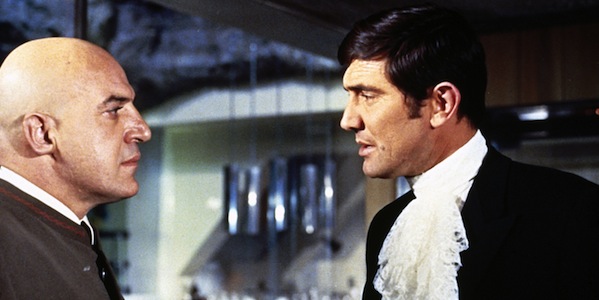
On Her Majesty's Secret Service tends to get a rough ride in the James Bond canon, often overlooked in favour of Sean Connery's outings and laughed at for being the most forgettable Bond movie of them all (a harsh and inaccurate judgement). Even Nolan understands the lack of appeal for its main actor, conceding that "George Lazenby is no one's favorite James Bond." For Nolan it is the fact that Lazenby is forgettable - in his words "anonymous" - which makes On Her Majesty's Secret Service so streamlined and effective; "the Bond machine firing on all cylinders: superb editing and photography, incredible score, great setpieces." The romanticism in the film is also something Nolan finds appealing, and it deserves credit as being the only entry into the increasingly long franchise where Bond's relationship with women stretches beyond the restraints of the formula. While Nolan's next project is uncertain, helming a Bond film would certainly an interesting choice - he's already proved he can handle Bond-style action scene with the snowy base assault from Inception. Which, it has to be said, bears a striking resemblance to an action scene On Her Majesty's Secret Service... Have you come across any other film recommendations from Christopher Nolan? Why not tell us about them in the comments?

Contributor
Contributor

Andrew Dilks hasn't written a bio just yet, but if they had... it would appear here.