10 Famous Things That Were Invented By Movie Time Travellers

Those guys and girls who really invented modern day innovations.
One of the most enjoyable aspects of any time travelling film is the concept of our heroes inadvertently inventing something crucial to modern society. It almost feels like a waste of an adventure if they don't do something to influence the future, even if they don't have the foresight or in depth knowledge of patent law to get the credit for their inventions. But think about it: if you had the opportunity to go back to a more primitive time, it would be next to impossible to avoid using your future knowledge to contribute something to their society. Realistically, it's totally possible that a good 40% of the cool things we have nowadays are the result of some stealthy guy from the future, helping the metaphorical cavemen discover fire. For example, the other day Motorola got FDA approval for an Edible Password Pill, which uses stomach acids to emit a specific signal that can be detected by your electronics, making you the password. Come on. You know no one from 2014 came up with that idea. At any rate, the concept of the accidental timey-wimey invention is an undeniable crowd pleaser, starting off as a gag but developing into one of the most tried-and-true tropes of the genre.

10. Lou Reinvents Google As Lougle - Hot Tub Time Machine

Lougle By Tarelexie

Hot Tub Time Machine's entire concept can pretty much be summed up by the film's title. Four old friends trying to relive their glory days at a dilapidated ski resort manage to use their room's hot tub to travel back in time to their teen years. It's a wonderful send-up of 80s teen comedies as well as a thoughtful commentary on the nature of nostalgia. Hot Tub Time Machine is, in all fairness, way better than it really had any right to be. But it really knocks one out of the park at the end. When they finally find a way back to the present day, one of the group (Lou, played by Rob Corddry) decides to stay behind, seeing the possibility to have a second chance at a good life. When they get back to 2011, a lot of little things have changed, but the big surprise is Lou -- who is now a billionaire, having invented a little internet search engine called Lougle. Get it? Because it's Google, but invented by a narcissistic guy named Lou? Screw you guys, that's hilarious.

9. Marty McFly Invented Rock Music - Back To The Future

Once upon a time, a young man named Marty McFly went back to the year 1955 and changed history. Without this intrepid trailblazer, we'd probably all still be sitting around in poodle skirts listening t0 Perry Como. Because at a humble high school dance in Southern California, Marty McFly gave us the gift of rock. He busted out a cover of Johnny B. Goode, ripping off stylistic elements from every major guitarist from the past fifty years. His work is so groundbreaking that Marvin Berry calls his cousin Chuck and encourages him to steal Marty's sound. And that, kiddies, is how the white man actually taught black people how to play rock music. Is this potentially problematic revisionism? Sure. Given the fact that most of early rock music was stolen from black artists only to be made popular and lucrative by white crooners, it's possibly a little racially insensitive to suggest that the opposite happened. Except, of course, in this film, because Marty McFly is awesome and clearly invented rock music. There also needs to be a quick shout out to Marty for inventing the skateboard...roughly eleven years after it first made its appearance in Paris. But who cares, it's Marty McFly, he can invent whatever he wants whenever he wants, no questions asked.

8. Joan Of Arc Gives The 15th Century French Army Aerobics - Bill And Ted's Excellent Adventure

Bill Ted 1 This is an interesting case, because unlike a lot of the other entries on this list, it doesn't involve a person going back in time and inventing something. Instead, Bill and Ted bring historical figures with them to the present day and upon being exposed to modern technology, they choose bits of it to take back with them to their own time. Joan of Arc is fascinated by the aerobics class she sees at the San Dimas Mall, which she plans on implementing in the French army upon her return. Could this be a factor in their success against the English while under her leadership? Perhaps. It could also explain why they burned her at the stake, because no one like aerobics. It's also worthy of note that Napoleon takes back a little something of his own. His experience at the water park serves as inspiration for a planned military strike, as he demonstrates at Bill and Ted's presentation. Unfortunately, this strategy was to be used in the French invasion of Russia. You know how one of the most basic rules of war is that you never march on Moscow in winter? Well, it wasn't a rule until Napoleon tried it and was basically laughed out of Russia.

7. Scotty Brings Transparent Aluminum To 1986 - Star Trek IV: The Voyage Home

Whenever a mysterious Scottish engineer comes up to you with a crazy idea, it's usually a good idea to listen to him. In the case of Star Trek IV: The Voyage Home, such a foolhardy move paid off, giving us one of our greatest inventions: transparent aluminum. It's pretty much like plexiglass on steroids, much stronger and lighter than anything we currently have. The nerds over at Memory Alpha say that a one inch thick piece of transparent aluminum can withstand the pressure of over 10000 cubic feet of water. It's hard to get an exact estimate though, on account of it, you know, not being real. But anyway, how did we get such a technological marvel? Oh, no big deal, Scotty just popped back in time to 1986. He needed some plexiglass at the time, so he was pretty much like, "Hey, give me some plexiglass and I'll give you the formula for something way better than plexiglass." But in a Scottish accent. One of the things that's awesome about this subplot is they actually address the fact that he went and tampered with time, but Scotty just kind of shrugs it off and points out that the guy he gave the formula to might have always been the one who invented transparent aluminum. Because Scotty does what needs to be done and anyone who doesn't like that can go find another starship.

6. Jazz Comes To Arthurian England - A Connecticut Yankee In King Arthur's Court

Jazz Arthur A Connecticut Yankee in King Arthur's Court is a 1949 adaptation of Mark Twain's novel by the same name, which features an American man who travels back in time to Arthurian England. (How he manages to get from Connecticut to England is, oddly enough, swept under the carpet.) Since the film was made in the 1940s, it seems only natural that the man in the story would introduce something to the natives that was a major element of popular culture in his own time. So he takes the castle's troupe of musicians who would normally be playing a madrigal or something, and teaches them jazz. Which yes, is another prime example of white people actually inventing music traditionally credited to African American musicians. No big. To be fair, the scene is pretty iconic, and it was the 40s, we're probably just lucky they didn't call it colored music and perform it in black face. One can't help but wonder, though, if there wasn't something more potentially useful he could have taught them. Hygiene, or the basics of sanitation, for example? Jazz is fun and all, but one can't imagine it will be much comfort to them while they're all dying horribly of the plague.

5. Marty McFly Invents The Frisbee - Back To The Future Part III
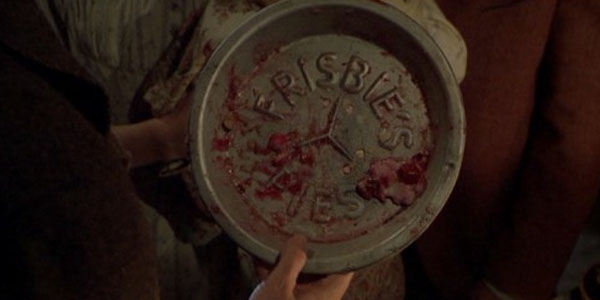
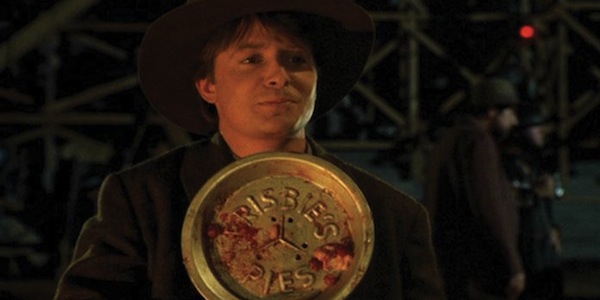
Marty McFly seems to have a made it a personal goal of his to go through time, coming up with new inventions with the frenzy of an old-timey tinkerer. If only he had the presence of mind to file a few seemingly minor yet historically significant patents, he'd have been able to build up quite a little nest egg for himself and Jennifer back in 1985. It stands to reason that the further back in time one goes, the more opportunities one has to re-appropriate future tech. If McFly is about to invent things after going back a mere 30 years, imagine the field day he could have in the 19th century. That's where we see Marty, in the criminally under-appreciated conclusion to the Back to the Future trilogy. In this one, he takes an empty pie dish and flings it across the room to help in an Old West brawl. And yes, that is technically what the old style Frisbees used to be, although they didn't acquire the name Frisbee until the 1950s, and were originally called Flyin' Saucers. How the Frisbee Pie Company, based in Bridgeport, CT, managed to get one of their pies all the way out to Hill Valley, CA in the 1800s is just another one of life's great mysteries. But if we're going to let the time travel slide, we should probably cut them a little slack in the Frisbee department.

4. Extreme Sports - A Kid in King Arthur's Court

A Kid in King Arthur's Court is essentially the tiny humans' version of A Connecticut Yankee in King Arthur's Court. Given the number of its adaptations that have made their way onto this list, it's clear that the concept of Robin Hooding technology from the present to give to the past is a very very old idea. In this film, a young Peewee baseball player (played by a pre-American Pie, post-Rookie of the Year Thomas Ian Nicholas) gets sucked into a magical portal and turns up in Arthurian England. The modern marvels he brings along with him in his backpack are both exciting and terrifying to the locals -- his camera amounts to nothing less than straight up witchcraft to them. But he soon sets about helping them create the most crucial of all modern inventions: the bicycle. Hey, he is a twelve year old boy in the 90s, after all. From that perspective, bikes are the most obvious thing to share with one's new medieval friends. For an encore, he introduces roller blading. Credit where credit's due, though -- this film also managed to invent the careers of Kate Winslet and Daniel Craig, so despite its humble origins, we owe it a debt of gratitude.

3. Owen Wilson Gives Luis Buñuel The Idea For The Exterminating Angel - Midnight in Paris

In Midnight in Paris, Owen Wilson is dissatisfied with his life. He longs for the glamour and artistic achievement of Paris during the Jazz Age, when F. Scott Fitzgerald and Ernest Hemingway rubbed elbows in the city's cafes, discussing life, love, and literature. To be frank, he's coming dangerously close to overdosing on nostalgia. But all his dreams come true when he somehow stumbles into 1920s Paris. He happens upon the inner circle of the literary elite, and even manages to have Gertrude Stein take a quick look at his manuscript. How many people alive can say that? While gallivanting in the 20s, he meets Luis Buñuel, one of the most famous surrealist filmmakers in history, and they discuss ideas for a movie. Wilson comes up with a brilliant idea, about a group of rich guests at a formal dinner party who find themselves psychologically unable to leave. Trapped in the house, the thin veneer of society begins to break down, and chaos reigns. Which would be tremendously clever of him, if it wasn't already the story of The Exterminating Angel, one of Buñuel's most celebrated works. Too bad he didn't slap a copyright on that one.

2. Irrigation - Idiocracy

Brawndo Unlike all the other films on this list, which have inventions being made prematurely thanks to time travellers, the underrated satire Idiocracy features irrigation, which actually has to be reinvented because the human race has devolved to the point where we've forgotten one of the most basic farming techniques. Seriously, the Incas had a grasp on this, and they practiced ritual human sacrifice. In the future, all the stupid people have Duggar-sized families, while the more educated are sensible and have historically lower numbers of spawn, leading to an intelligence level that has gradually decreased over the span of several hundred years. These people have basically been trying to feed energy drinks to plants, and are somehow shocked when nothing grows. Until a visitor from the past appears and suggest that they give water a try. Water? From the toilet?! Unsurprisingly, this has an immediate effect on the crops, and the future of this ridiculously depressing society is ensured. Although really, we shouldn't be so hard on them -- Bad Grandpa was recently nominated for an Academy Award, so we're probably looking at Idiocracy in about twenty years or so.

1. Hot Air Balloons - Norman's Awesome Experience

Balloon Forsaken Norman's Awesome Experience is a Canadian film that came out shortly after the surprise success of Bill and Ted's Excellent Adventure. (This film was in production before its American counterpart's release, but as you can probably tell the name was changed to capitalize on Bill and Ted's popularity.) Essentially, the film is about a guy named Norman who is sent back in time just before the Battle of Hastings. He has just enough working knowledge of modern technology to make a significant impact on the war. But his crowning achievement, without a doubt, is his introduction of weaponized hot air balloons. The regular variety wouldn't have been invented until right around the French Revolution otherwise, and to my knowledge no one has ever thought to use them in battle. Unfortunately. Oh yeah, and you know how there's a place called Normandy, and people from there are called Normans? Not a coincidence. Norman apparently had big enough cajones that he felt good about naming an entire people after himself. This film is often unfairly maligned as a Bill and Ted knockoff, but it's actually not too bad. A little low budget perhaps, but far more fun than it gets credit for.

Contributor
Contributor

Audrey Fox is an ex-film student, which means that she prefers to spend her days in the dark, watching movies and pondering the director's use of diegetic sound. She currently works as an entertainment writer, joyfully rambling about all things film and television related. Add her on Twitter at @audonamission and check out her film blog at 1001moviesandbeyond.com.