10 Films That Were Probably Imagined By Insane Heroes
 When it comes to the movies, what's real anyways? When the cinema first arrived, it opened up the door to creating whatever mad dreamscapes, desired fantasies or dreaded nightmares our minds and resources could imagine. Over the years we've seen hundreds of fantastical or artificial environments realized on screen. There's another kind of dream world in films, though, that serves a narrative function. Some pictures aren't always playing entirely fair with us, and they bid us to look more deeply--whether purposefully or as a result of their own deranged nature--into the context of their madness. As it turns out, not all narrators are reliable, and if 'It was all in his mind" is just as much a cop-out as "It was all a dream", there are times where this motif can turn our heads and get us talking about the movie itself. The list that follows combines films that clearly have something strange going on with their possibly insane protagonists and films that may not have intended that reading, but have achieved it anyway. I'm putting the SPOILER tag up now, as essentially, none of this discussions can happen without talking extensively about the contents of each film. If some of these choices seem off-kilter or unlikely, well, they are and that's the point. It's not a bad thing to have a healthy suspicion regarding whether or not things are what they seem to be. Without further ado, here are ten movies that were probably imagined by insane protagonists...
10. Rob Zombie's Halloween 2

9. Babe: Pig in the City
 Wait, what? Surely this is a joke? The first Babe film was a wonderful, sweet childrens fable about a tenacious little piglet that dreamed of being a sheepdog and eventually realized that dream with a little help from his barnyard friends. The sequel was a beautifully strange and surprisingly dark effort that looked like Roald Dahl fell asleep watching Blade Runner, following the little pig from the comfort of his farm to the dangers of the big city. Despite the friendly narrator and the assurances that everyone lives happily ever after, something feels off. Theres an odd sense that only the first scenewith Babe accidentally causing Farmer Hoggett to fall to the bottom of the well, with the pulley system landing on his headhappens in the same universe as the award-nominated first feature. After that, when Babe and Mrs. Hoggett set off to the city, they encounter a world that looks completely fabricated from a childs limited perspective, complete with a horizon line that has the Statue of Liberty, the Golden Gate bridge, and the Sydney opera house all crammed together. The streets and their inhabitants, including a grimy, scary clown played by Mickey Rooney, feel ported in from a Terry Gilliam film. Babe gets separated from Esme and comes to the rescue of an entire apartment full of animals that need his help. In the end, they all go back to the country together, having saved the farm, and Farmer Hogget is on the mend and capable of mustering a Thatll do pig, thatll do. Far too convenient, even for a fairy tale. As an optimist, Id never subscribe to this theory, but here it goes. Death was always a part of the Babe world, even if it was mostly off-screen. There doesnt seem much chance of the farmer surviving the fall down the well, less so when you consider the machinery crashing down upon him. After his presumed death, the farm animals know their world is in danger, and they know that Babe feels the guilt for it. What probably starts as a kind-hearted attempt to lighten the pigs load and give him a quest to preoccupy his mind becomes a full-blown delusion. I dont doubt the bit about Mrs. Hogget and Babe going abroad to get funding for the farm, but the rest of this strange nightmare world is Babes coming to grips with the death of his master and the jeopardy hes placed his friends in. Look at the facts; the new animals he meets all live in an enclave that reminds of the farm, but doesnt make too much sense existing in a city environment. For Babe, this is how domesticated animals livegrouped together and resisting the world of the humans. The first really telling point is the death of Rooneys clown, the father figure and provider of this half-way house. When hes gone, the animals are brutally taken away and locked up. So, Babe must go and rescue them, facing death along the way, seen in a drowning pit bull and the deceased Fleanik who is literally called back from the great beyond by Babes pleading. In the end hes reunited with Esme in a scene where she, wearing the dead clowns costume, swoops in and rescues Babe. The entire trip, in a sense, has been the little pig fending off his guilt, triumphing over mortality, and realizing that his old master is gone and someone else cares for him now. His delusions follow him home in a world just the left of the 20th century" and the fact Babe generates income is probably the only thing that keeps his crazy little ass from being shipped to the meat plant.
8. Black Swan
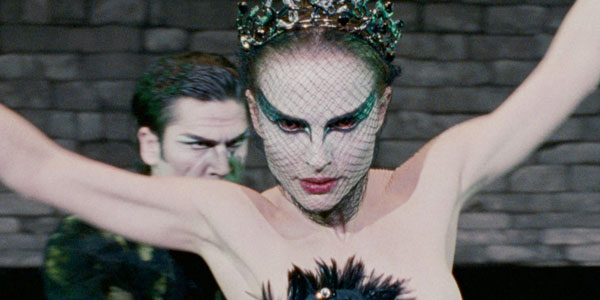 It's completely obvious that not every single sequence in Black Swan actually happens in the film's reality, but what if much less than we think takes place outside of Portman's damaged mind? It seems clear that the late-in-the-game murder and transformations are safely a part of the disintegrating ballet dancer's delusion, but further still, it's unlikely that Winona Ryder's disfiguring moment in the hospital or the lesbian tryst with Mila Kunis actually occur in the film's real-world context (sorry, guys). Both instances help foster a world view that feeds Nina's obsession and neither sequence is really acknowledged by the other characters. Nina has set about the metamorphosis already, and as her mind spins towards the Black Swan, so does the reality surrounding her. If, however, she's crazy from day one, this might serve to cast Barbara Hershey's demanding, over-bearing mother in a different light. There's a point, when we observe the collection of paintings that suggests Nina's might be a family illness. What if, though, Nina is only seeing what she wants to? Hershey may be doing the best she can to hide Nina's madness from her, while trying to steer her away from that which threatens to break her. It makes us question more deeply her constant questioning of her daughter; what seems like sadistic baiting and unreasonable standards might be the true worry of a concerned parent who doesn't know what to say or what curtains to pull back in the face of her daughter's downward spiral.
7. Return to Oz
 Yes, children's fantasy films are easy targets for the 'they were mad the whole time' game, mostly because they often play fast and loose with reality. Return to Oz, a deliciously off-kilter and twisted concoction, steps over this line purposefully at first, and then later accidentally, probably because its trying so hard to reference both the 1939 Wizard of Oz film and Frank L. Baum's sequels. Right off the bat, this is the only one of the Oz films that sees Dorothy sent to an asylum by Auntie Em and then receiving shock therapy (which, to be fair, Em didn't know about beforehand). Dorothy has continued to talk about Oz well beyond the point of a harmless childhood fantasy, and so her aunt and uncle are worried; she manages to escape from the institution though, running away with a girl who falls into the water. After this she and her talking hen (yes, really) are swept back to Oz, except everything is in ruins, her friends have been turned to stone, and a diabolical witch, Mombie, and the Gnome King are ruling the land. In Baum's book it was undisputed fantasy. In the Victor Fleming movie it was a dream. But here, due to trying to keep some of the same visual conceits as its predecessor, Return to Oz is something in the middle, which ends up relating to madness. Like the classic film, many characters in the real world of Kansas also appear in the fantasy world, except now it's primarily the villains who show up both places. Is it a coincidence that the Gnome King and Mombie, the usurpers of Oz, are the same performers as the asylum doctor and his nurse? Their attempt to dissuade Dorothy of her belief in Oz sees them as conquerors in her fantasia. Ozma of Oz turns out to be the little girl Dorothy escaped with, although even that is in question by the end. Does it strike anyone else as strange that a Disney movie require an epilogue where it's pointed out that the doctor was killed during the storm? The reason Return suggests Dorothy is on the road to extended mental divergence is down to the dual approaches. If Oz is a real place, why would it incorporate Dorothy's real-world experiences and headspace into its architecture and population? If it's just another dream, this one with elements that are spilling into her waking world, then Dorothy might really be in danger of losing her mind to these fantasies over time and by the end of Return she's beaten back the emissaries of logic. If this is all in her head, than Dorothy is one messed up little chica. What is the deal with those Wheelers anyway?
6. Radio Flyer
 Completely insane might be an extreme term for the narrator of Radio Flyer, a grown man telling his kids about an adventure he had with his little brother growing up. Still, there's something fishy going on here. The story proper follows young Mike and Bobby, who hatch a plan to send Bobby away in a flying machine built from their Radio Flyer wagon. Why does the younger brother have to leave? Their stepdad, a recent a-hole acquisition of their mother, has been abusing Bobby pretty hard, and instead of telling her (they don't want to disrupt her happiness) or the police, they both decide sending the boy out of the brute's clutches is the only way. The reason this movie makes the list is the way it ends, a confused muddle that renders it an abhorrent concoction as far as films about child abuse go. After meeting the last kid who tried to make the leap off their chosen departure point--an adult with a broken body--the two boys do launch Bobby on his flight, and what happens? He sails off into the night, safe and sound, never to be seen by the narrator again. We see postcards from various destinations all over the world, supposedly sent from Bobby, who went on to become a pilot. There's even a scene where Mike shows one of the postcards to his mother, and she cries. For a film that has largely been realistic, what gives? Did Bobby really just fly away from abuse through the power of sheer childlike will? Is it that he died in the crash, and Mike's been spinning this BS story all these years to assuage the guilt? How, exactly, is one supposed to interpret the story in a way that makes sense? Director Richard Donner has long said there's nothing cryptic about the film, that it's meant for face value, but screenwriter David M. Adams says that Donner scrapped the original script's ending so that it might be a "Rorschach Test" for the audience. That finale featured the Radio Flyer machine sitting inside the Smithsonian National Aerospace Museum next too the Wright Flyer, just floating there, not held up by any visible suspension and Bobby is there in the flesh, as a pilot. While it can be agreed that this ending wouldn't have improved anything in regards to that idea of "suicide/wishful thinking" being an escape from abuse, it's absence leaves a different impression. After looking it over, another possibility comes to mind. Is there a Bobby at all? The narrator talks about the seven laws that kid's believe, and over the course of the film every last one minus the flight is proven wrong. If Bobby tried to fly and died, why isn't there some attempt by the mother or others to correct Mike's delusion through grief counseling? Why does one seemingly look for Bobby? Are mom's tears at the postcard because she sees it as a method of Mike dealing with his brother's death, or is it some inner acknowledgement that this process is how Mike has come to deal with abuse committed against him, not an imaginary brother figure? Was Bobby, in fact, some innocent part of Mike's psyche who he sent away in order to preserve it from dying at the hands of the King's abuse?
5. The Descent
 Neil Marshall's grueling horror classic The Descent is another picture whose reality is tweaked by different cuts of the film. The American cut has the sole survivor of the monster attack, Sarah escaping the cavern and getting back to the car, and in a truly rubbish DTV sequel she even goes back into the cave and recovers Juno, who's still alive down there. The original British release has the more compelling ending, showing Sarah to have hallucinated her escape, and instead she's still there in the darkness with her daughter holding a birthday cake as the shadows flicker around her and the crawlers scream in the distance. When she blows out the candles, the film ends. Theoretically, then, so does Sarah's self-inflicted Hell, one she's been conjuring up since the death of her husband and daughter. With the original ending taken into consideration, it becomes highly plausible that even the monsters are just figments of Sarah's psychotic break, and that it was she who murdered all her friends, finally confronting the duplicitous Juno and then arriving at the end of her journey, a reconciliation with the daughter she lost. The final scene reminds of Plato's Myth of the Cave, and the shadowy figures and hideous echoes suggest that it is the shadows, not the actual objects, that are real for Sarah. She's the first one to get glimpses of the crawlers, and she's also the one who experiences a bloody baptism of sorts--separating the moment she embraces her feral murderess-- before fighting her way to Juno, who she has unfinished business with. The fact that there's no single attempt at explanation or even foreshadowing why the crawlers are down there is an effective way of leaving this tantalizing possibility an open door, as is the ending, which does establish that Sarah has imagined her escape, and if that, how much more has been the product of a splintered mind?
4. American Psycho
 Unlike many of the other entries on this list, American Psycho is a film that achieves its question of madness through form and purpose as opposed to random details that accumulate incidentally. Did Patrick Bateman really go on his gory murder spree, or was it all in his head, the blood-soaked daydreams of a morally adrift yuppie who's world view has gradually enclosed him within a snow globe of homicidal madness? Ellis' book walked this line carefully, but suggested that, no matter, Bateman's was a voice not to be trusted to logical reality. The film, doing its best to emulate that ambiguity, has a harder time because of the visceral and concrete sequences of Bateman's slaughter. As a serial killer, he's of course expected by the audience to be a bit off his rocker, but incidents like his return to the apartment to find it clear and clean of the aftermath of his activities do alert us to the ephemeral nature of his 'reality'. In fact, almost every incident that occurs is subsequently rebuffed or dismissed by some real-world element that either refuses to see his depravity or cannot reflect it because it belongs completely to his mind. It almost doesn't matter whether Bateman has killed or not, because at some level, the entire film has been a morbid fantasy in his brain, tweaked and turned and allowed to run its fearsome course because this high-class guy seems so unlike the murdering type. When the lawyer laughs off his confession, he also mentions that he's seen one of Bateman's victims just recently. In the book, I suspect this was something Ellis was actively hinting at--that the wall between real killer and an unhealthy fantasy life of imaginary violence and destruction can be very thin indeed.
3. Mulholland Drive
 Isn't every David Lynch film sans The Straight Story just an extrapolated journey through the inner life of a questionably sane protagonist? Perhaps, but Mulholland Drive, which is surprisingly straightforward for one of Lynch's dream-trip movies, goes to explicit lengths to emphasize that this isn't just a tale of insanity, but its one individuals insanity, shot through with an entire imagined world built from old noir films and La-La Land fairy tales. Lynch shows us two versions of Diane's life, but melds them together to suggest a mystery. The real world shows a rock-bottom would-be actress rejected by her lover, who has apparently hired someone to kill said lover (or done it herself) and is now so despondent and guilty, she's going to take her own life. The second version is a constructed reality that is painstakingly self-centered; Diane is a talented actress who has clandestine and shadowy forces adjust the Hollywood power game so she gets roles, and her lover experiences bouts of amnesia that force her toward a dependent role. The stranger segments that feel less tied to Diane--the man in the room, the creature behind the dumpster, Billy Ray Cyrus, the tiny munchkin old couple--can be seen as the mental emissaries of Diane's guilt, the forces that will "rescue" her from this false world of lies and return her to responsibility, even if that ultimately leads to her own tragic demise.
2. Dellamorte Dellamore (Cemetery Man)
 I am not convinced there's a perfect reading of Dellamorte Dellamore out there, but kudos to its creators, who see this one through all the way to the very weird end of its mind-boggling conclusion. At first, everything seems pitched like an over-sexed version of Raimi's Evil Dead films, with ex-engineer Francesco Dellamore guarding the gates of a cemetery where the dead are constantly trying to escape. Life's a dreary slog for Francesco, dispatching the zombies, filling out paperwork, rinse and repeat, while his grave-digger accomplice Gnaghi trundles about in a blissful idiot's stupor. Without reciting the rest of the plot here, let's get down to it. Things get inexplicable real quick once Francesco's love is bitten and turned into a zombie. The final scenes, after much odd crap has gone down, feature Francesco finally trying to exit the suffocating town of Buffalore and leave the shadow of death behind him. At one point the Reaper himself shows up and asks Dellamore how he expects to escape him. What he and Gnaghi find through the tunnel to their freedom is nothing...nothing at all. The world just ends at a broken cliff, and they are seemingly trapped within a snow globe. When Francesco pulls two bullets and plans to kill himself and Gnaghi, something awakens the rotund mute and he becomes the voice of reason, throwing the gun away, as Dellamore can merely sit on the ground and mutter to himself unintelligibly. Combine this with imagery early in the film that showed Dellamore's twin in a hospital bed, dying, visions of Dellamore meeting his beloved as a prostitute he possibly murders, and you can begin to piece together a reasonable narrative of the subconscious trying to reconcile itself with oblivion. Francesco Dellamore, as it turns out, is on the verge of death the entire film, in a coma after going on a murder spree that began with a hooker he was having an affair with and ending with seven random people and his family. Now he's in a created hell of his own making, with the resurrected dead representing his own inability to process or come to grips with death and what he has done. In this land of mundane, repetitious functions and constant horror, Dellamore has split his soul into two sides. There's the contemptuous, miserable dark other, who we assume is the protagonist, and the unassuming, good-natured and genuine Gnaghi, who we take for the fool for a majority of the picture. When Dellamore's dark side has run as far as he can go, his other, more serene side--ready to face what's on the other side of the veil--takes the reigns and ushers in the resignation that will allow Francesco to rest at last.
1. The Burton/Schumacher Batman movies
 What am I on about here? From the grotesque, vaudevillian rabble that run through the streets, to the revolving door of faces and characters--certain inhabitants actually change race and others seem to vanish completely-- to the unquestionably artificial nature of the German Expressionist city of Gotham, it's clear that the world of the first Batman series is one big theater stage. Think about that for a moment. A young man out to the theater with his parents witnesses them killed directly afterwards, and has his view of everything completely changed that night. So, instead of simply inspiring Batman, this episode triggers a mental break that sends young Bruce into a grand world of surreal, larger-than-life melodrama where every single day he's but an actor on the stage of his own theatrically-driven imagination. There's a typical criminal mastermind who re-emerges after his fall as a painted clown with a rictus grin, but that face reminds not of circus folk but the thespian masks of tragedy and comedy. Bats' ultimate villain is a homicidal theater geek that's flung from the top of a cathedral, only to be replaced by an S&M contortionist and a fat, oozing Shakespearean tragedy whose birth name summons memories of Dickens, followed by a spandex-wearing creep who speaks in riddles and a character literally divided into warring dramatic facets that make sense to a boy fighting for hope against despair. Just as the world itself is about to cave-in completely, the antagonists are reduced to pure carnival kitsch, an unintelligible performance artist who freezes stuff, a preening transvestite who likes to play with vines, and a beefed-up Mexican luchador wrestler. Throughout this miasma there are very few recurring faces, ultimately just the butler and the police commissioner, arguably the only "real " people that Wayne ever actually interacts with. Even his own visage continues to change as he charges through the collapsing floors of his madhouse, his mind continuing to rid itself of the Bat and find a pleasing illusion it can latch onto. As young Master Wayne grows and absorbs more theatrical culture, he adds to this universe--at first Gotham reminds of noir and dark opera, but it grows cold and frigid and sexualized, and eventually it's a whirling, psychedelic merry-go-round of Freudian nightmares and fetish gear, and when he can stand it no longer, everything turns to shards of ice, the feared freezing of his long broken heart. Along the way, there are comrades who insinuate themselves into his fantasy and attempt to correct it. None of the women are very successful at drawing out Wayne (are they four different therapists, all with varying methods?) and he incorporates his parent's death into his concepts of fear and responsibility. When a young man comes into the picture, he's got the same past as Bruce and ultimately needs the same solution; hiding his impotence behind black, nipple enhanced rubber. Still, it might be most interesting to consider Batman, Batman Returns, Batman Forever, and Batman and Robin as the various degenerating levels of an opium-induced dream that Bale's Wayne has while with the League of Shadows in Batman Begins. Once Bruce finds his way out of this epic fever-dream, he realizes exactly the importance of being dour, shrewd and mopey, lest he ever fall face-first into the dark netherworld of mad flamboyance.