10 Good Movies Made Great By Their Endings
 It's no surprise that the ending of a movie is usually the point at which our thoughts linger - any ending, after all, marks the exact moment where a story ceases to continue, where we're left to ponder the events of all that we just witnessed, or consider the future of the characters, be it hopeful, sad or purposely ambiguous. Writing an appropriate ending is, of course, an art in itself. Get it wrong, and you risk alienating your audience. Get it right, and they won't forget your movie in a hurry. After all, isn't it the responsibility of any truly good movie to stay with you afterwards? You'll often hear about endings which ruined the movies that came before them - and there are lots and lots of motion pictures out there which adopted ill-judged climaxes and trigged a negative reaction. What you hear about less, though? Good movies that were made great by their endings - movies that were enjoyable for the length of their runntime, but were suddenly propelled to the realms of greatness because the final few minutes were so damn impressive. In a lot of ways, this might translate simply as: "The movie was good, but the ending was definitely the best bit." So here are 10 movies that fit into such a category: all good, but made genuinely great because their endings were so unforgettable or mind-blowing. It really does drive a rather interesting point home... that an awesome ending alone can separate a good movie from a great one.
10. The Usual Suspects (1995)
 The Usual Suspects is a movie that, alongside The Sixth Sense, is often credited with having one of the most brilliant and shocking twist endings of all-time - even if you haven't seen the movie, you know about its twist ending, right? And if you didn't... well, sorry about that - the movie's almost twenty years old, c'mon. Anyway, aside from being hailed as a movie of twist-related genius, The Usual Suspects is also cited on a frequent basis as one of the greatest movies of all-time, too. Fair enough, but isn't that - in a way - just misdirected affection for its famed ending? The plot of Bryan Singer's crime classic is based around a massacre on a boat, and the interrogation of a small-time con-man in the aftermath, who relays a long and complicated story as to how it all went down to the cops. Don't get me wrong: The Usual Suspects is a good film. But the movie itself almost never surpasses being "just good" until its shocking ending, one which has helped to propel it into the pantheon of all-time awesome. Viewed a second time, though, and it's clear to see that the ending of The Usual Suspects is the trump card in a pretty good hand.
9. Don't Look Now (1973)
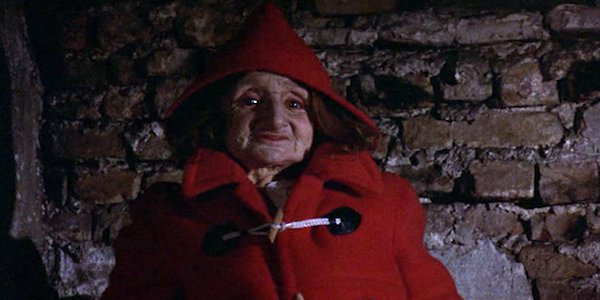
Nicholas Roeg's terrifying, haunting, keep-you-up-at-night-because-you're-too-scared-to-turn-the-light-off horror classic is all about the patient build- up - it's a movie that, essentially, works because you slowly move towards its horrifying climax, almost without expectation. Without it, it's a good movie, but with the ending, it becomes a truly great one. The story takes place mostly in Italy, with a couple, played brilliantly by Donald Sutherland and Julie Christie, who take a trip to Venice in order to take their minds off of the accidental death of their child, who drowned in a lake. For much of its runtime, Don't Look Now lingers in a state of unease - it's an uncomfortable watch, filled with a few weird, edgy scenes, but it's all about the atmosphere in the beginning. Then comes the finale, as Sutherland spots a small figure clad in a red coat moving through the claustrophobic, foggy back streets at night - is it his daughter, back from the dead, who died in a red coat? Nope: it's a disfigured dwarfen serial killer, who proceeds to slash his throat with a razor during one of the most heart-pumping reveals in cinema history. At this point, we're shocked and drained, and Don't Look Now has gone from creepy horror flick to gut-wrenching classic.
8. The Graduate (1967)
 The Graduate was well-received when it was first released in the late '60s, and continues to be well-received to this day, generally speaking. Some critics, however, Roger Ebert, went on to retract some of their praise for the movie as time as gone on, mainly due to the character of Benjamin Braddock, as played by Dustin Hoffman. Is he somebody we can sympathise with? Whatever your feelings about Mike Nichols' meditation on post-college malaise (is it a satire, a comedy, or a dark drama?) there's no denying the movie is a good one - funny, ripe, resonant. Without its ending, though, I think it's fair to say that The Graduate would fall just short of greatness - in just a single look, a glance between two characters, this movie ensures its status of a classic. Having convinced himself that he wants Elaine, the daughter of the famous Mrs. Robinson, after all, Benjamin proceeds to break off her wedding to another man, and the two - blinded by the excitement of the situation - jump onto a bus and escape. But their enthusiasm soon turns to confusion, as they realise the repercussions of what they've done - Nichols lingers on a single shot of the young couple as they stare blankly, silent, the future unknown, their anxieties suddenly apparent, as Simon & Garfunkel's seminal soundtrack eases in.
7. Toy Story 3 (2010)
 When Pixar announced that they were making Toy Story 3, fans of the series were left with something of a divided opinion: Toy Story 2 was great, so why not make another one? Then again, Toy Story 2 was great, so why make another one? I know: Toy Story 3 is a great movie, and there's no denying that. But try to view it without its incredibly emotionally, pitch-perfect ending attached, and it's clear to see where the sum of that greatness comes from. The ending scene, as Andy donates his toys to a young girl named Bonnie, is perhaps one of the most heart-wrenching finales in all of cinema. As Andy describes each one of his favourite toys to this bright-eyed child, it's near impossible not to find yourself reduced to tears, because, after all, Andy is passing on the toys for us, too - those adults who watched Toy Story as children and are also coping with growing up. As Randy Newman's beautiful score plays over the top, it's a scene that caps not just Toy Story 3 as a great movie, but the entire series.
6. Who Can Kill A Child? (1976)
 Similarities might be made with another movie on this list, Don't Look Now, when it comes to the more obscure Spanish horror flick Who Can Kill A Child?, which shares a comparable tone (edgy, unnerving horror) and also features a couple who go on holiday to disastrous consequences. Who Can Kill A Child? is a far pulpier affair, however, but one that - thankfully - doesn't look to dodge the question in its controversial title. Had it opted out, it might still be a good movie, but its in Narciso Ibanez Serrador's willingness to take the plunge that his horror touches greatness. Who Can Kill A Child? follows a couple, Evelyn and Tom, as they holiday in Spain. They end up travelling to a remote island, devoid of adults, where the remaining locals - all children - have turned murderous. It's never explained why the children have resorted to such ways, nor is it necessary: most of the movie is slow and atmospheric, with occasional injections of terror, but it all builds to climax that is genuinely worthy of the film's title, in which the couple are forced to take action, shooting children dead in order escape. The point? What would you do, in their situation? Who Can Kill A Child? is great because it at least attempts an answer in its ending.
5. The Great Silence (1968)
 If you're into spaghetti westerns, the name Sergio Corbucci will be largely familiar to you, given that the man directed pretty much all of the other great spaghetti westerns that Sergio Leone didn't (including the original Django, don't you know?). The best of all the Corbucci westerns is, arguably, his 1968 movie The Great Silence, though, best-known for its snowy setting and a venomous Klaus Kinski performance. The plot concerns a mute gunfighter, nicknamed "Silence," who is hired by a widow to kill the bounty hunter who murdered her boyfriend in cold blood. For much of its runtime, The Great Silence is an assured and engaging spaghetti western, made haunting by a brilliant Ennio Morricone score, though one could argue it's nothing special. And then it comes: the brutal, bleak and totally unexpected anti-ending, one which justifies this movie as a great one in a matter of minutes. As our hero prepares to face off against the bad guy, he's simply shot dead, and the people who he was trying to save? Brutally massacred. The movie ends on that note, with Kinski alive and well. As a bounty hunter, everything that he's done has been well within the "bounds of the law." It's heartbreaking, unbelievable, and undeniably great.
4. Dogville (2003)
 Dogville comes to us courtesy of one Lars Von Trier, a director with one quality inherent to all his films: they're difficult to digest. That's true of Dogville, anyway, a strange and brilliantly experimental movie that Von Trier decided would work better on a sound stage, void of convention sets or location shooting - instead of buildings, we just get lines marked out on a black floor. John Hurt narrates the action, which concerns a young woman named Grace (played by Nicole Kidman), who is taken in by the small town of the movie's title when she turns up one day. Von Trier's movie tackles lots of bold ideas, some of which are lost in the conceit of the movie's scarce stylings, but for the most part it's an interesting, if not overlong, take on narrative minimalism, as Grace is used and abused by a town that seemed so normal on the surface for the sum of its runtime - Von Trier looks to explore the dangerous mentality of "the community." And then, in its ending, Dogville ascends to greatness: we learn Grace was the daughter of a powerful gangster (she ran away as she despised his profession), and - having been broken by the community - orders him to wipe Dogville from the face of the Earth. Which he does, by machine-gunning everybody down in a horrific finale. Grace's original innocence has been replaced with unabashed resentment, and she's driven to murder, having been corrupted by... well, the corrupted.
3. The Conversation (1974)
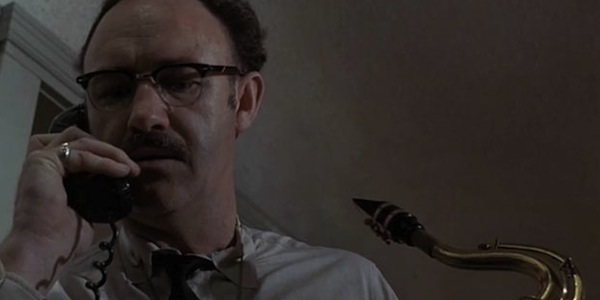 The Conversation was the movie that Francis Ford Coppola decided to make after The Godfather, a tense, paranoid thriller about a man named Harry Caul (played impeccably by Gene Hackman) who works as a surveillance expert. After recording a conversation one day, Caul becomes convinced that something terrible is going to happen. In true Coppola style, The Conversation is brilliantly constructed, gripping, and delicately layered, but the movie drives towards an ending that ultimately seals the deal and makes it truly great in its final moments. That's to say, at the end of The Conversation, Caul realises that - having deluded himself into thinking that an unfaithful wife and her boyfriend were going to be murdered by her husband - everything he believes is wrong, and that it was in fact the other way round: the cheat and her boyfriend planned to murder the husband. In the final, heartbreaking scene, Caul tears down his apartment, looking for bugs, after receiving a call warning him to remain uninvolved. Lonely and lost, Caul sits down and plays the only thing left undamaged in his apartment - his saxophone.
2. Roman Holiday (1953)
 You could make the mistake of thinking that William Wyler's Roman Holiday was just an excuse for its stars, Audrey Hepburn and Gregory Peck, to travel abroad, make a conventional rom-com, and sell it the masses - and you might have been right, had it not been for a few essential elements, one of which is the brilliant, giddy atmosphere that surrounds the whole picture, Hepburn's Oscar-winning performance, and - most importantly - the phenomenal, lingering ending that defied romantic comedy conventions of the time and makes the movie truly great. Having spent the day in Rome with runaway Princess Anne, newspaperman Joe has officially fallen in love - unfortunately, the princess is on a tour of Europe, and must be moving on. In the final scene, Anne address the a crow of journalists, and the pair share a final glance before she disappears. Conventions at the time would denote that - as Joe stares, waiting for her to return - Anne come running back to him... but, no, she doesn't come back, and - in a heartbreaking moment - he walks away, hands in pockets, as the orchestral score swells sadly, before giving one final glance to the place where the Princess was standing but a moment ago. The movie ends on this melancholic note, with the pair unable to continue their romance, but it's the perfect note to go out on - one that transforms Roman Holiday from a jolly romantic comedy and into a classic.
1. The Long Good Friday (1980)
 The Long Good Friday is probably the film that Guy Ritchie screens for his cast and crew before he sets out to make another Lock, Stock and Two Smoking Barrels rip-off - a true London crime flick, free of irony and led by what is still perhaps Bob Hoskins' greatest ever performance. As mobster Harold Shand, who returns from a business trip in New York to find that his crime syndicate is crumbling and somebody is killing off his men, he's dynamite. Viewed away from its ending, The Long Good Friday is gripping, memorable, and filled with great characters. It's not until the last few minutes that John Mackenzie's film marks itself out as a great one, though. After "resolving" the issues plaguing him for the sum of the story, Shand heads to the Savoy and finds that his Mafia co-partners are bailing on their proposed deal because they don't want to associate with his risky operation. Furious, Shand launches into a brilliant speech about how great and valuable England is ("The Mafia? I've sh*t 'em!") and storms out, climbing into the car where he believes his wife, played by Helen Mirren, is waiting for him. Not so. Shand looks out of the window of his own car to see her being driven away, screaming, in another vehicle. A silence pistol is then pointed on Shand from the front seat, and he realises the game is up: the IRA, who Shand believed he had won out over, have tracked him down. What follows is the best part of the film: as the jazzy soundtrack plays out, we stick on a close-up Shand's face. We watch as this man displays a whole range of emotions in rapid succession: fear, calculation, blind fury, bewilderment, amusement, and finally... acceptance of his death. Then, suddenly, we cut to black (pre-empting the ending of The Sopranos, perhaps), feeling a pretty similar range of emotions as Shand just was, in fact. The Long Good Friday is a fine movie, but the ending is dazzling: the very definition of a good movie made into a great one by its ending. Like this article? Let us know in the comments section below.