10 Incredibly Innovative Uses Of Slow Motion In Movies
 Though slow motion might be one of the most overused cinematic techniques out there, that's because it's also one of the most versatile. Whether you're watching a horror, action film or comedy, slow-motion has a sure purpose; it can scare the s*** out of you, it can give you an adrenaline rush, or it can make you laugh uproariously. Primarily used to focus on something that would simply bypass us in real-time, it is able to draw attention to an Earth-shattering, epoch-making event that is generally of grand significance in a movie. While it's been somewhat run into the ground as a technique - as practically everything that could have been done has been - these 10 films managed to find ways to innovate the technique and provide an awe-inspiring cinematic experience in the process. Whether funny or just totally badass, here are 10 incredibly innovative uses of slow motion in movies...
10. The Van - Inception
 Christopher Nolan's Inception is a technically marvelous film from every perspective, no less its stunning use of hyper slow-motion to depict the disparity between the various dream levels the characters "reside" in. One of the keys of the narrative is time dilation within the different dream layers, and how each successive layer moves at 20x slower than the one above it. Thus, the first layer, in which Yusuf is driving a van is 20x faster than the hotel lobby level, which is 20x faster than the James Bond-esque snow fortress, and so on. To convey this effect, Nolan constantly cuts back to the van in extremely slow-motion, which has careened off the edge of a bridge in order to provide the "kick" (the feeling of falling) necessary for the dreamers to be woken up once the mission is complete. In cutting between the various time states, Nolan employs slow motion in a manner like no other filmmaker ever has.
9. Bullet Dodge - The Matrix
Likely the most iconic and memorable shot on this entire list comes from one of cinema's most innovative action movies, The Matrix. Before we even get to the rooftop scene in question, this is a film that has already wowed us with its stupendous visual effects, including countless other panoramic slow-motion shots, presenting a style that would be readily copied by just about every action movie and video game ever since. The scene that blew us all away, however, featured Neo (Keanu Reeves) running out of ammo on top of a roof while being faced with an agent. The agent fires his gun, and so begins a technically astounding shot, as the camera appears to spin around Neo in slow motion while he dodges the bullets (though does get grazed by that last one, admittedly). The shot was achieved by using a 360-degree rack of cameras, with each being timed to take one frame, which were then all blended together into the mind-blowing final shot.
8. Final Shootout - The Wild Bunch
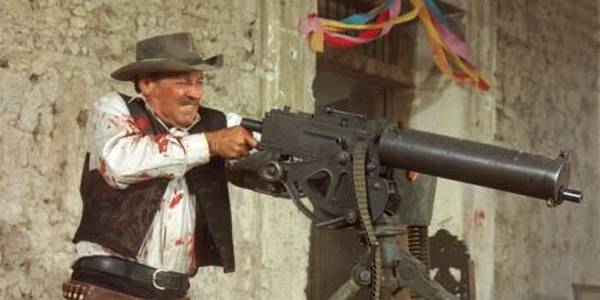 Sam Peckinpah proved throughout his career that he could direct a shootout like nobody else, and perhaps his career-peak came with this climactic shootout from the sublime The Wild Bunch, in which the gang face off against Mexican forces. Unlike most scenes on this list, this shootout expertly mixes regular-speed footage with slow-motion, using the slower shots to accentuate the regular ones. For instance, a man is shot, and we're allowed to observe, perhaps savour the squib of blood bursting out of his side in slow-mo. Peckinpah knows exactly when to employ it and when not to (take note, Zack Snyder), using it to bracing effect when a mounted machine gun rips through some soldiers, and when explosions are detonated. The scene is extremely frantic and violent, yet these slowed-down moments help to provide a slight, very slight respite between all the carnage while at the same time allowing us to focus on the results.
7. Opening Titles - Reservoir Dogs
 So iconic is Tarantino's use of slow-motion that it doesn't even matter he couldn't afford a high-FPS camera and simply opted for stilted "enforced" slow-mo that would under most circumstances look awful. However, the context of the scene is what makes it work; after the colour-coded gang of thieves have introduced themselves to us through some pop-culture and tipping-related banter, they leave the diner. Suddenly, the iconic tune "Little Brown Bag" hits, and the group strut along looking like total badasses. This is pure Tarantino; stylistically adept and well aware that the scene wouldn't work if it played any other way. Without slow-motion, this scene would just be a bunch of guys ordinarily walking along, but this judicious use of the technique gives the film real swagger from the get-go.
6. The Bomb - The Hurt Locker
 An already extremely intense opening scene is made even more exciting with the use of slow-motion. A team of bomb experts attempting to defuse a bomb realise there's nothing they can do, and one of the team gets caught in the blast, causing director Kathryn Bigelow - who won a Best Director Oscar for her work here - to cut to a heart-stopping slow-motion image of the bomb detonating in the background as the soldier desperately flees in the foreground. Exceptional sound editing combines with some gorgeous imagery of dirt flying into the air and a car contorting from the shock-wave of the bomb to give the explosion an even more visceral thrust. If many films abuse this sort of effect, The Hurt Locker was rewarded with Editing, Sound Editing, Sound Mixing and Best Director Oscars, as well as its Best Picture win, of course.
5. The Twist - The Usual Suspects
 Here's the example for how to use slow-motion to depict a revelation coming to light. Agent Kujan finally comes to realise the truth, that Kerbal Kint is Keyser Soze, and Bryan Singer conveys the gravity of the situation by having Kujan let go of his coffee mug out of sheer shock, making it clear that we're about to learn something Earth-shattering. The almost graceful way the mug explodes as it hits the floor, spinning around and sending coffee everywhere, leading into the momentous reveal that, of course, the bad guy has been sitting opposite Kujan for the vast majority of the movie. http://www.youtube.com/watch?v=-_6560AW1zQ So well-known has this shot become that it's now something of a cliche; a shocked character drops a drink, which shatters at their feet, and then we find out what shocked them. One cannot be sure if this was the first film to do it, but it's definitely the best - impactful, smart, and gorgeously shot.
4. Opening Credits - Zombieland
 Here's a brilliant opening credits sequence that combines action and humour into one beautifully controlled mix. Propelled by Metallca's cracking tune "For Whom the Bell Tolls", the Zombieland credit roll depicts various scenes of people being attacked by zombies, usually in comical circumstances, such as a zombie stripper chasing an overweight client and a zombified wife attacking her groom. The slow-motion only accentuates the hilarity and also lets us linger on the gorgeously violent imagery, completely setting the tone for a film that is absolutely both of those things - gratuitously violent and uproariously funny. Even if you're not a fan of Metallica, there's little point denying the awesomeness of this fully slow-motion scene.
3. Slo-Mo - Dredd
 Last year's Dredd was a pleasant surprise in many areas, most of all its technical proficiency, namely its clever use of slow-motion to convey the effects of the film's pervasive drug, itself called Slo-Mo. The drug tricks the brain into thinking that time has slowed down to 1% its normal speed, creating some wildly hallucinogenic, saturated images in slow-motion. http://www.youtube.com/watch?v=hyjfNQ0lJn4 One of the highlights of the film comes when we see various characters being hopped up on the drug before they are hurled from atop an apartment block, giving their brain the sensation of a very long ride to the floor. This is repeated at the climax of the film as the villainous Mama (Lena Headey) is administered some Slow-Mo by Dredd himself, and she is then promptly lobbed out a window. Director Pete Travis captures all of this in a beautiful combination of slow-motion and effects-aided saturation, making for one of the most conceptually provocative uses of slow-motion in recent memory.
2. Shootout - The Untouchables
 Quite possibly the best sequence Brian De Palma ever directed, the famous steps sequence from The Untouchables is a masterclass in how to use slow-mo effectively. The director initially employs it to build suspense with long, lingering glances at the gangsters entering the building, before the scene explodes in gratuitous violence as Eliot Ness unloads shotgun shells into a fleet of gangsters while trying to ensure that a baby in a buggy doesn't get caught in the crossfire. The true virtuoso moment comes when Ness runs out of ammo despite still having one goon left to kill. Ness' partner (Andy Garcia) throws him a gun, still in slow-motion, which he slickly catches and uses to kill the last baddie, bringing to a close a technically magnificent, superbly-staged sequence that proves you can milk slow motion without it getting too silly (though the scene was amusingly parodied in the film Naked Gun 33 1/3).
1. Head Over Heels - Donnie Darko
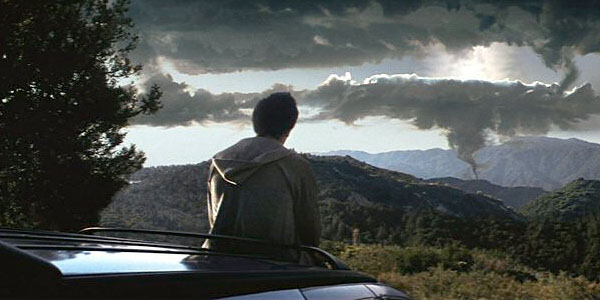 Richard Kelly's debut feature boasts one of the best slow-motion sequences ever put to film, as the titular character (Jake Gyllenhaal) disembarks from the school bus and enters his high school. What most kids will remember as a quick dash to class is slowed down in order for us to focus on the various cliques and relationships within the school; we have the bully who taunts Donnie and does drugs by his locker, unimpressed school teachers and Donnie's love interest Gretchyn. What's so great is that the scene ramps up in speed and back to slow-mo depending on the importance of what's being shown. When we get outside, it's no less brilliant; awkward meetings between teachers and Donnie's youngest sister dancing at once convey the sinister underbelly of the school and its innocence. Simply, this is a scene that encapsulates almost all of the film's central characters, and manages to say something about each of them without actually speaking any words. Which slow-motion sequence is your all-time favourite? Let us know in the comments below.