The final shot of a movie is arguably its most important; it can intelligently deploy numerous questions into the minds of the viewer and elevate even a mediocre film to cult status. Moreover, it leaves the audience with their final impression of their movie-going experience, and - as such - is the shot which needs to shine that little bit brighter than all the others that have preceded it. Since the inception (hint) of cinema, filmmakers have understood the raw power of the final shot and its ability to allow their film to echo throughout the annals of movie history. Some encapsulate the essence of a particular film to such an excellent degree that it becomes iconic. Others poise interesting questions through their ambiguity, allowing the film's entire narrative to marinate in our minds like a thought-provoking bolognese. Here are 10 examples of such brain-food. Needless to say that when examining final shots there will inevitably be some discussion about certain events in the film, and thus there will be some spoilers, so don't say you weren't warned beforehand...
10. The Wrestler
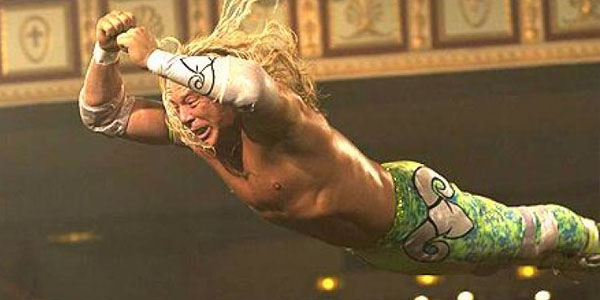
Aronofsky's The Wrestler examines the theme of self-destruction in graphic and disturbing detail, and is perhaps best exemplified by the final shot of the film. Throughout the narrative Randy "The Ram", an aged wrestler, searches for some form of acceptance, be it from his romantic pursuit of a stripper called Cassidy, his daughter with whom he has fallen out of favour, or the crowd that watch him wrestle. In spite of his good intentions Randy is unable to find the happiness that he so desires. In the final scene of the movie Randy, who has recently undergone heart surgery, returns to the ring once more. Determined to give the enthusiastic crowd a show, and knowing that the execration of the fight may well kill him, an emotionally and physically battered Randy takes the plunge off the ropes in hopes of returning to his former glory as a beloved champion of the ring, disregarding the pleas of Cassidy or the trouble his weak heart is evidently causing him. The shot ends with Randy in midair, a symbolic sacrificial "Ram" as his ring name highlights. Is he jumping into oblivion or glory? Though the former is hinted at we are never shown the aftermath of the jump. Whatever the outcome, the truth behind the shot is that Randy has found a reason to live within the prospect of death. Even if he doesn't die on this particular occasion he will inevitably continue to exert himself in the ring until it gets the better of him, as it is the only thing that makes him feel worthwhile. This shot is made all the more powerful thanks to the humanistic depiction of a desperate man searching for something that will make him feel like more than a worn out piece of meat, and the exquisite performance given by Mickey Rourke that marked his return to form. Perhaps most haunting is the fact that the cheers of the crowd that are heard as Randy makes the plunge continue long into the closing credits - a continuous reminder of the approval that Randy may well have leapt to his demise for.
9. The Thing (1982)
After battling the alien monster that has killed all of their comrades, only two men are left alive: MacReady and Childs. Worn out, both men slump on the ground amidst the burning rubble that was their facility. What makes this final shot interesting is that neither man can trust the other, unsure if their former ally is the dreaded, shapeshifting "Thing." Knowing death to be a certainty due to the freezing climate the men decide that rather than doing anything to uncover the truth to instead wait and "see what happens," sharing a bottle of alcohol and not letting the other out of their sights. Thanks to this end shot the suspense continues long after the end credits, and also allows audiences to play detective. Many theories have circulated through cyberspace as to which of the two is the intergalactic murderer, if either, and the sheer fact that this final shot still raises so much debate to this day is testament to its effectiveness. But nobody knows with absolute certainty who the Thing may be. We may never be 100% sure of the answer, but mysteries are far more interesting when left unsolved.
8. The Graduate
The comedy staple of the 1960s, The Graduate is a classic of American cinema, and provides us with an interesting finale which takes some time to sink in and comprehend. Viewers are often split on how to interpret this ending, with some believing it to be joyful, and others morose. Its final shot is made all the more powerful thanks primarily to the subsequent shot before it. After Ben rushes to stop Elaine's wedding and appears as her knight in shining armour the two flee their relatives and friends and escape on a bus. They laugh for a while, but the penultimate shot lingers on past the point of comfort, and we slowly see the smiles drain from their faces as realisation dawns upon the pair. The length of this shot is no coincidence, and as such many have interpreted the sinking in the couple's facial expressions to denote a negative ending. I'm inclined to agree. The film ends on a shot of the bus driving off into the distance, Ben and Elaine still silent, sat in the back. They don't begin to laugh again, they don't even begin to actually talk to one another. The pair now understand the full extent of what they have committed to, and rather than ending on a cheesy slice of Hollywood happiness the final shot instead presents us with a grim reality and the prospect of the consequences that may come as a result of their rebellion. Simon and Garfunkel's "Sound of Silence" compliments this end shot well. Being a song about the emptiness of life and how one can fill this emptiness is, once again, no coincidence. Living lives in which they were forced to conform both Ben and Elaine rebelled by running away with each other. But they aren't really in love, and the emptiness persists within them, and boy do they know it. A very dark sequence for a comedy, but a very rewarding and highly intriguing final shot to say the least.
7. The Texas Chainsaw Massacre (1974)
A simple but extremely effective finale to a simple yet extremely effective story. Where most horror films attempt to shock audiences at the last hurdle or implement some sort of twist Tobe Hooper's The Texas Chainsaw Massacre leaves us with a much more disturbing image that doesn't aim to scare as much as it does to unsettle, attacking the mind rather than the nervous system. It is for its unorthodox approach to ending a film of the horror genre that makes this such an interesting final shot. Despite its savagery this is one of the most exquisite end shots in terms of its aesthetics. Leatherface manically swings his chainsaw around in a fit of rage, prompted by the escape of his prey. His gruesome mask is on full display, illuminated by the light of the rising sun, and like a sexualised title of a Disney classic truly showcases the beast inside the beauty. This shot doesn't end ambiguously. We know the girl escapes and that Leatherface has failed. The interesting aspect of this shot is the way it is able to encapsulate the entirety of the narrative to such an excellent extent that it is etched into the minds of its viewers. Simple, brutal marvellousness.
6. Inception
Perhaps the most discussed final shot of contemporary cinema, and for good reason, with numerous theories circulating across the internet. But what's all the hubbub about, you might ask? For those of you that have been asleep for the past few years I'll explain a little. After much hardship and emotional distress Leonard DiCaprio's character "Cobb" finally manages to return to his children that he has been separated from for years... or has he? In order to find out whether he is still dreaming he removes his "totem", a small spinning top, and spins it on a table. If it topples over he will know for sure that he is finally home. If it rotates endlessly he will know that he is still dreaming. For a while he stares at it, waiting to see if his quest is finally over. But, distracted by the voices of his children, Cobb rushes towards them rather than waiting to find out the truth, and whether they are even real or just projections within his own mind. We are then presented with the top spinning in close-up. The question on our collective lips: does it topple? Well, we never find out. The screen cuts to black before any definitive answer. Yes, it does wobble slightly just beforehand, but this is not evidence that it falls over in-and-of itself. No matter how many times you watch Nolan's intelligent blockbuster this shot still forces you to hold your breath in anticipation, desperately looking (or googling) for any subtle clue that might give you some sort of answer. Has Cobb finally made it home, or is he still in the dream world? Ultimately this is unimportant, with the true power of the shot being the fact that he no longer cares if it topples or not. Cobb finally accepts the reality that he wants to believe, whether that be a true reality or a perceived one, and as such we should interpret the shot in the way that we see most fitting ourselves.
5. Oldboy (2003)
Please don't be put off seeing this exquisite piece of cinematic brilliance if you happen to have been unfortunate enough to see the American rendition of Park Chan Wook's masterpiece. The original is without question far superior, and its greatness is only enhanced by its end shot. After uncovering the mystery behind his imprisonment and discovering that the women he loves is his long-lost daughter Oh Dae-su hires the help of the same hypnotist that worked for his adversary to wipe his mind rather than end his relationship with the girl. Feeling compassion for his plight the hypnotist agrees to help, and attempts to erase the knowledge of their biological relationship from his brain so that he may continue to be with the one he desires. Creepy. An interesting dilemma, no doubt, but it is the final shot that truly makes this a great ending. After the procedure Mido, Oh Dae-su's daughter/lover (who has no idea about their familial ties) embraces him. We end on a shot of our anti-hero's face, at first lightly laughing and smiling, but slowly fading into what can be perceived as emotional pain. His face clearly resembles that of the painting that hung in his prison, which came with the caption "laugh and the world laughs with you. Weep and you weep alone." Has Oh Dae-su taken the advice of the painting? Does he laugh because he still remembers, but chooses to forget? There is no way to systematically uncover whether Oh Dae-su still maintains his memories. His grimace can be interpreted as one of relief, knowing his ordeal is over, or one of despair, the knowledge of his incestuous actions inescapable, resulting in another ambiguous ending. But it is precisely because of this ambiguity, mixed with the unconventional and dark subject matter, that makes this a truly thought-staining shot that lingers in the mind. Speaking of minds...
4. Eternal Sunshine Of The Spotless Mind
As well as being known as the film that showcases Jim Carrey's acting abilities - alongside The Truman Show - Eternal Sunshine of the Spotless Mind also has a stellar end shot. After their relationship suffers from some turbulence, Clementine (Kate Winslet) has Joel erased from her mind. Joel subsequently does the same, but during the process comes to the realisation that this was a massive mistake, and desperately attempts to cling onto his memories. He fails. Nevertheless, instinct brings the two back to the same location where they met. But have the pair been reunited to live on in loving paradise? Their past relationship is brought to the attention of the couple, and the realisation of their incompatibility dawns upon them. Despite this, it is implied that the two decide to give love another chance. The final shot is of a previous scene in which Joel and Clementine gleefully run through the snow, reminding us of their happy past. The image repeats itself, as if on an endless loop, before fading into whiteness. One can either interpret this as a somewhat happy ending, or if you're like me and a fan of the darker things in life it can be read rather more bleakly, with the repetition of the shot representing the fact that the couple are cursed to repeat the same doomed relationship which will inevitably result in the same conclusion: with them erasing each other from their respective memories, only to be reunited once again in an endless cycle of heartbreak. As we have seen, and as the duo acknowledge, a successful and long-lasting relationship is evidently an impossibility.
Joel: "I can't see anything I don't like about you." Clementine: "But you will."
The reuse of Beck's melancholic rendition of "Everybody's Gotta Learn Sometime" that is played in an early scene in which Joel is seen crying hugely contributes to the chilling, yet massively intriguing final image.
3. Boogie Nights
Boogie Nights is an often playful, sometimes intense look at the porn industry, revolving around the life of Dirk Diggler, a well-endowed young man played by Mark Wahlberg. His natural talent doesn't go unnoticed, and he is brought into the world of porn, becoming one of its brightest stars. The story has some tragic twists and turns, but it is at the very end that the audience receives its biggest shock. After continually being shown the amazed reactions of those who had seen Dirk's man-zone throughout the film we are finally rewarded with the ultimate payoff: a sneaky peek at the trouser-snake ourselves. Stood in front of a mirror, psyching himself up for his big comeback, Dirk whips out his weapon. Nothing is censored as we finally get to see what all the fuss was about, and suddenly every male viewer is left with a deep and painful sense of inadequacy. The true power of this shot comes from the shock factor of seeing the purple helmeted warrior in all its glory. In hindsight this was an awkward movie to watch with my parents...
2. Blade Runner
Oh, Blade Runner: potentially the film that has faced the most studio interference in cinematic history, or at least the one with the most incarnations! For clarity's sake we are talking about the final cut of the film, also known as the only version worth its salt.
After all of the replicant enemies that he was hired to kill are disposed of, Deckard (Harrison Ford) goes to his apartment and collects Rachel, his replicant lover who is now classified as illegal herself, and the pair begin to make their escape. However, Deckard discovers an origami unicorn on the floor as they make their way to the elevator. He examines it and recalls Gaff's words: "It's too bad she won't live, but then again who does?" He nods, as if realising something, and makes his way to Rachel who awaits him in the elevator. The elevator doors close and the screen cuts to black. Roll credits. This final shot leaves us with the suggestion that Deckard may in fact be a replicant himself. The origami figure left by Gaff can be seen as an acknowledgement of this. The unicorn that frequents Deckard's dreams is therefore suggested to have been implemented into him as an artificial memory, and as a result Gaff is aware that leaving the figure would serve as sufficient proof that he knew Deckard was a replicant. This ending can, however, be read in many different ways, and the debate that it inspires amongst fans is truly riveting. The fact that not even Harrison Ford and Ridley Scott can agree on how to interpret this ending only reaffirms the multitude of ways it can be viewed, and as such is one of the most interesting and important end shots of all time.
1. Seven Samurai
An exceptional piece of art created by one of cinema's greatest directors: Akira Kurosawa. The film centres around a group of samurai hired to protect a small farm and its people from a group of bandits. A simple enough premise. But it is choreographed and executed with such skill that it is heralded as the greatest Japanese film of all time, and a true behemoth of international cinema as a whole. Since it is on this list you can probably gather that this is all partially due to the movie's end shot. The film ends on an extremely well framed shot of the few survivors of battle, observing the graves of their four samurai comrades who fell during the skirmish, their katana's marking their resting places. After the storm of warfare has calmed the image stands out as a harrowing one, highlighting the defeat that hangs inside of victory. The farmers that have been saved may feel joyous, but the now three samurai, and the audience, cannot share in such blessed relief. The final image allows us all to ponder on the actual cost of success. So those are our picks for the 10 most interesting final shots in cinema. There are, of course, hundreds of other excellent examples that are missing from this list that would have been equally worthy, but we only had a small quota to fill! Perhaps you feel there are some glaring omissions? What are some of your favourites that we missed out, then? Let us know in the comment section below.