10 Most Nerve-Wracking Scenes In Non-Horror Films
You don't need a slasher or a monster to deliver a good scare.

Films blend genres all the time, creating hybrids of genre that lead to subgenre. Mystery-thrillers have aspects of slasher films. Comedies commonly have romantic subplots that lead plot conficlit. Ther are occasions, however, when such mixtures don't pay off that smoothly.
It can be jarring, out-of-place or downright inappropriate. It can also be intentional, jolting an audience out of their comfort space and thrusting them into a much more grim reality. In The Bedroom's seeming romantic conflict of a young man dating an older divorcee of whom his parents disapprove take a sharp left turn into a revenge thriller about half-way through. But so long as the film's thematics fit within whatever narrative structure has been set up, we're generally willing to go along for the ride.
Here are the occasions that didn't - or did in the wrong way - pay off.
10. Pee Wee's Big Adventure - Large Marge

When Pee Wee's Playhouse - the brainchild of Paul Ruebens - debuted on CBS, critics and audiences didn't quite know what to make of it. It had the noise and energy of similarly designed children's programming of the late 80s, with the host getting into a hyperactive frenzy over a moral or ethical quandary, animated shorts and other things commonplace for a kid's show, but the jokes were a little dirtier, the issues more mature and buried under the wackiness there was a sincerity that somehow made it coherent.
But Ruebens had been doing the character on stage five years prior to the show, and he had quickly become a cult staple amongst those in the know. The show proved enough of a hit for Warner Bros. to throw the oddball a budget for a feature film. He set out with a then-unproven Tim Burton to make a feature film - a light remake of The Bicycle Thieves as a parody. For the most part, it stays true to the spririt of the show, light and goofy and mostly harmless.
Save for Large Marge. Early Pee Wee's cross country journey to find his missing bike, he hitches a ride with the ghost of a truck driver, who reveals monstrous self in a moment that could have only come from the mind of Burton. It's a moment that sticks with 80s kids to this day.
9. Willy Wonka And The Chocolate Factory - Tunnel Of Hell

When one thinks of Roald Dahl's magical children's novel and its first adaptation, they're reminded of the lovably strange and inventive design of the Oompa Loompas, the catchy tunes that - to this day - wind up in car commercials, the loving relationship between a grandfather and his grandson and Gene Wilder's earnest, whimsical turn as the owner of the chocolate factory.
At least, that's mostly what we remember. There's really no erasure of the Tunnel scene, or the other rather horrifying things that occur to the possible future owners of the business. Dahl himself was certainly no fan of turning the minor character of Slugworth into a corporate spy in order for the film to have a villain, and it's the mystery of Slugworth's actual purpose that leads to the tunnel.
It starts off innocent enough, with Wonka leading his guests onto a boat and through a hypnotic tunnel. Then the Wilder begins his unhinged slam poetry, as hypnotic imagery of corporate sabotage and 2001-esque lighting effects start to put his passengers on edge. What's even more unnerving is how everything after the ride goes back to normal, as if nothing happened. Back to the show!
8. Lost Highway - Robert Blake

It's impossible to truly categorize most of David Lynch's work unless you're simply putting them under the vague blanket of "art" films. Perhaps his only identifiable film is The Straight Story, which features the scariest thing in any of his work: the phrase: "Walt Disney Pictures Presents A David Lynch Film".
But his work is always interesting, often open to interpretation and nothing if not intentionally vague. Books have been written, analyses have been conducted, but ultimately, the work is up to the viewer.
Part of the reason for this lack of clarity is that Lynch admittedly doesn't always know quite what inspires his narratives. Take, for instance, Lost Highway, the first in a loose trilogy of L.A. films (followed by Mulholland Dr. and Inland Empire) that features a mysterious murder seemingly carried out by saxophonist Bill Pullman, body-switching, Robert Loggia pistol-whipping a driver for following his car too closely and Richard Pryor.
The first of many strange occurences in the film takes place when Pullman is approached at a party by a pale-skinned man who tells him that he is, in fact, at his house and hands him a cell phone. Sure enough, the pale-faced man standing in front of him is on the receiving end of the call as well. He has something to do with the murder of Pullman's wife, but it's unclear what.
That the pale man is played by future accused murderer Robert Blake only makes it more discomforting.
7. Return To Oz - Most Of It

Everyone remembers the joy of The Wizard of Oz. For many, it was one of the first films to which their parents exposed them. There were menacing images, from the wicked witch herself to the flying monkey battalions, but it was all harmless fun set to songs that are a part of pop culture to this very day. The shift from drab brown and white to magical colour is a landmark moment in visual storytelling, and it's overall dreamlike fantasy. Those who don't have some reaction to it have less of a heart than the Tin Man.
In 1985, Hollywood decided to revisit the world created by author L. Frank Baum with Return to Oz. Though it performed poorly, it does retain a cult status - particularly among horror fans. That may seem odd, until you see it. The creature designs range from terrifying to downright bizarre, with creature designs better suited for a Mad Max, steampunk sequel. While more faithful to Baum's vision, it's generally considered too nightmarish for children.
What do you expect when one of the cinematographers was an uncredited Freddie Francis, fresh off a run of the gothic horror of Hammer Studios?
6. Marathon Man - Dental Surgery

Marathon Man is generally considered one of the best thrillers of 1970s, featuring a vulnerable but determined performance from Dustin Hoffman squaring off against a paranoid escaped Nazi war criminal (Sir Laurence Olivier) out to collect diamonds he extracted from the teeth of Jewish prisoners.
Hoffman is largely an innocent bystander, accidentally roped into the conspiracy be his murdered undercover government agent brother. After he makes it back to Hoffman's apartment before dying, Olivier becomes convinced he provided him information that would prevent him from safely retrieving his bounty, so he tries to torture it out of him the only way a 1970s dentist knows how - by being a 1970s dentist.
"Is it safe?" Became a catch-all line in popular culture at the time, given the film's popularity, and the dental torture includes jabbing scalpels into the gum line and worse. But it's what we don't see that's ultimately the most disturbing, as the camera pans away after Olivier explains how much more painful it is to drill into a live nerve than a dead one.
Somehow, William Goldman's (who also scripted) novel is even more sadistic.
5. Watership Down - The Prophecy P

In fairness, those going in to Watership Down having read Richard Adams' classic novel, which follows a group of anthropomorphic rabbits seeking a new home, may have had some idea what they were in for when they first sat down to view the 1972 adaptation. But even they couldn't have expected the amount of bloodshed filmmakers willingly and gleefully coloured gorily in an animated film.
It all begins when Fiver, a seer, has an apocalyptic vision of his community that largely goes ignored, he and a small group flee their home as it is threatened by hunters and the erection of a new housing development. But humans aren't the rabbits' only threat, as other, larger predators pos e an equal and often worse threat. By the end, in-fighting, jealousy and totalitarianism all collide in pure rabbit torture porn.
4. Rear Window - Raymond Burr's Confrontation
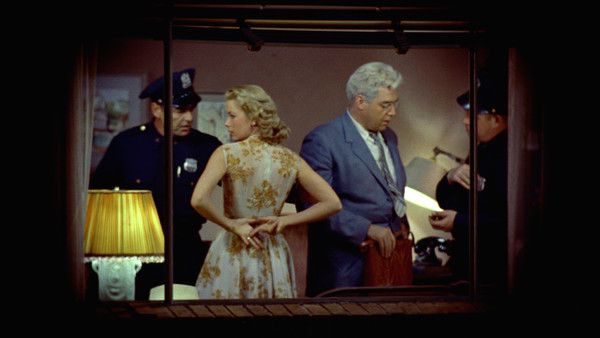
Rear Window is one of Alfred Hitchcock's more personal films, exploring in detail his own curiosity with voyeurism with a twisted sense of humour. While photographer Jimmy Stewart is holed up in his apartment with a broken leg, he finds he has nothing to better to do by spy through the windows of his neighbours in his back alley.
A lot of what he sees is funny or downright quirky, some of it tragic - such as the poor woman who dresses up and set dinner for two every night only to eat alone. It's just a slight glimpse into the other doors we normally don't get to open, and it's as much a privilege as it is a perversion to have a look inside.
That very look takes a sinister turn when the journalist in Stewart starts to put small details together and realizes one of his neighbours - the lumbering Perry Mason himself, Raymond Burr - has murdered and disposed of his spouse.
It only gets worse when Burr turns the tables, breaking into the cripple's apartment and approaching him with intent to kill unable to defend himself due to injury, Stewart does all he can - slow him down with bright flashes from various camera bulbs, temporarily blinding him,and screaming for help until he's dangling outside his high apartment window.
3. The Ruling Class - Jack The Ripper
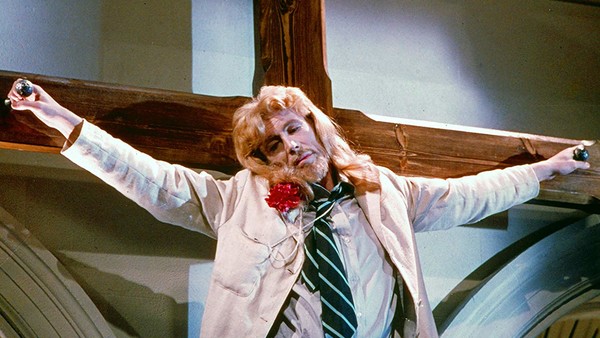
There was little Peter O'Toole could do wrong in the 70s, so when he called his manager after hitting every pub in Soho with director Peter Yates and said, "I'm with the crazy Hungarian and I know I'm drunk but I give you 24 hours to set this movie up," you know you need to get your ass to work.
The product, a satirical play and script by Peter Barnes, features O'Toole as a newly appointed Earl of Gurney after his predecessor dies of autoerotic asphyxiation. He also happens to believe he's the reincarnation of Jesus Christ and pledges to bring peace and love and charity back to the world. While everyday English politicians meddle and fight to have him committed, he seems unstoppable.
It's a brutal satire and takedown of the absurdity of privilege, with O'Toole regularly breaking into song and exposing himself. Divisive among critics at the time for being a little too over-the-top, it's also a film that seems to have fallen through the cracks in recent years - a shame for O'Toole's performance alone.
Things take a much more frightening turn, however, after he has taken his rightful place in the House of Lords, seemingly freed from delusion and preaching right-wing political points to rapturous applause. But, in his mind, his audience is full of rotting corpses and he's no longer Jesus of Jack Gurney, but Jack the Ripper.
2. Zodiac - The Lake Murder

If there's one thing director David Fincher is known for, it's his obsessive attention to detail, shooting takes of scenes up to 70 times or more before he is certain he gets what he wants. His epic coverage of the Zodiac murders and the chaos and dread that haunted San Francisco and its surrounding areas was no exception. We may never know who the Zodiac was or is - though the film offers a fairly solid argument, even a special feature on the DVD points to an entirely different suspect.
What we do know are first-hand witness reports of the two survivors of the confirmed Zodiac kills - the ones that had information in letters to police and press not released publicly.
The most disturbing is the second killing at Lake Berryessa, where a hooded figure entirely in black slowly walks a loving couple on a picnic through what appears to be a procedural robbery before suddenly, brutally and repeatedly stabbing them. The male survived - like the first attack outside a lover's lane - and the painstaking, scoreless tension is chilling.
Even scenes meant to drum up tension that are largely invented or exaggerated don't reach the levels of such stark terrifying reality.
1. Arlington Road - The Garden Party

Screenwriter Ehren Kruger is a bit of a hack, there's no denying it. He's tossed off useless drafts of Transformers movies as "scripts" for years now, single-handedly took the Scream franchise and somehow made it more obnoxious with its callbacks and his original works are typically anything but.
His successes, like The Ring's Americanization, are few and far between, usually relying more on a solid cast and director than words on a page. Nevertheless, Kruger got his foot in the door after winning the Nicholl Fellowship for his script for Arlington Road, Mark Pellington's paranoid, suburban terrorist thriller. And once again, the cast is what holds it together, with everyday professor Jeff Bridges growing more and more suspicious of his too-nice new neighbour Tim Robbins.
Of course, by the end, Bridges suspicions that his neighbour is plotting a major attack and threatening the life of his son is confirmed, though there's little he can do to stop it. Bridges confronts Robbins at his own little gathering, but he knows he's at the lion's den, she's treated as a friend even when he's having a breakdown.
If one suspends enough disbelief, it's a fun enough ride. Ask a few logical questions, however, and it ruins the overall tone.