10 Most Spiteful Horror Movie Easter Eggs
Wes Craven got the best revenge against his childhood bully.

Who among us doesn't love a movie Easter egg? Even the worst film can retain some cursory value by sneaking a few sneaky nods to other works - references that only the most eagle-eyed and attentive of viewers will ever fully appreciate.
Easter eggs are more often than not used to affectionately wink at an adjacent property or actor, but sometimes they can be used for more cheeky, even nefarious means, to poke fun at or savagely mock a deserving target of derision.
And no genre proves more ripe for a spiteful Easter egg than horror, which - per its more permissively nasty, heightened tone - gives filmmakers ripe opportunities to get creative with their subtle (and not-so-subtle) mudslinging.
It's clear that each of these horror movie Easter eggs stemmed from a very real place of vitriol, and that the creatives wanted to vent some of their frustrations in a way that would fly over the heads of the vast majority of viewers.
Living well might be the best revenge, but you know what's a close second? Immortalising your scorn in cinematic form until the heat death of the universe...
10. "F**k You, Lucky Charms" - Leprechaun

Leprechaun writer-director Mark Jones was inspired to create a horror movie centered around an evil, vengeful leprechaun (Warwick Davis) by watching the iconic commercials for the beloved breakfast cereal Lucky Charms.
Hilariously the film also makes a number of cracks at Lucky Charms' expense, apparently as a result of the cereal's parent company (General Mills) refusing to partner with the movie in a mutually beneficial product placement opportunity.
The first occurs when the leprechaun hungrily raids some cupboards and comes across a box of "Lucky Clovers," but after eating a mouthful spits them out, their taste apparently not to his liking.
But the more pointedly vitriolic Easter egg comes right at film's end, when young Alex (Robert Hy Gorman) uses his slingshot to defeat the leprechaun, but not before legendarily shouting, "F**k you, Lucky Charms!"
You can't really blame a breakfast cereal conglomerate for not wanting to get involved with a daft, low-budget horror movie, and ultimately the film is all the better for including these thinly-veiled jabs anyway.
9. Taking A Bite Out Of The "Competition" - Jaws 2
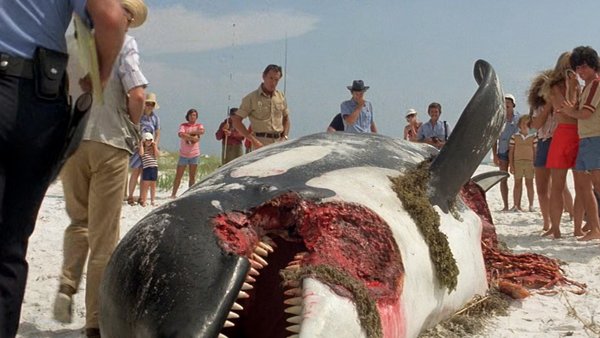
Early on in Jaws 2, an orca's brutalised carcass washes up on Amity Island beach, which Chief Martin Brody (Roy Scheider) believes is the result of a shark attack.
While at face value this might seem like a typical plot point for a shark movie, it was actually a sly thumbing of the nose at the film Orca: The Killer Whale, a shameless Jaws rip-off which was released in 1977 - two years after the original Jaws - and unsurprisingly failed to find the same success.
Not content to merely imitate Jaws, though, Orca: The Killer Whale also arrogantly lampooned Spielberg's film by featuring a sequence in which an orca slaughtered a great white shark, in effect implying that Orca's titular creature was a major upgrade from Jaws' own great white.
And so, as great whites generally don't attack orcas in the wild, Jaws 2 dumping an orca's chewed-up corpse on the beach was Universal clapping back at Orca: The Killer Whale and throwing down the gauntlet.
8. "Dead Things Don't Run!" - Diary Of The Dead
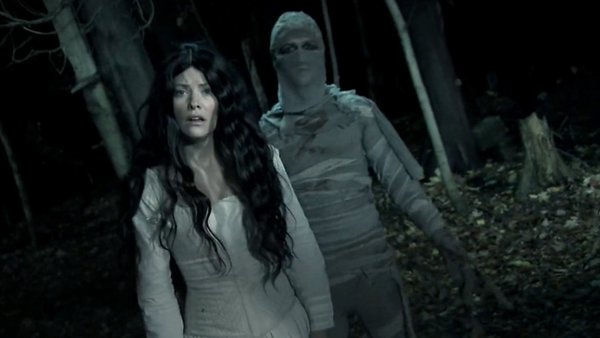
While it's absolutely fair to say that George A. Romero's better filmmaking days were long behind him when he made 2007's found footage zombie movie Diary of the Dead, the director nevertheless decided to make fun of the tendency for the undead to move fast in modern zombie flicks.
In one of the film's opening scenes, filmmaker Jason (Joshua Close) is shooting a horror film and tells his undead cast member that he's moving too fast, exclaiming, "Dead things don't run! If you run that fast, your ankles are gonna snap off."
Jason insists that the actor "shamble" instead, and there are numerous other sly references to the running zombies popularised by not only the remakes of Romero's own Dawn of the Dead and Day of the Dead, but also films like 28 Days Later.
If there was somehow any doubt about Romero's intent, he confirmed as much in an interview with Vulture:
"I took a big swipe at [fast zombies] in this film: There's a running gag in the movie that dead things don't move fast. Partially, it's a matter of taste... In the original Halloween, Michael Meyers never ran, he just sort of calmly walked across the lawn or across the room. To me, that's scarier: this inexorable thing coming at you and you can't figure out how to stop it. Aside from that, I do have rules in my head of what's logical and what's not. I don't think zombies can run. Their ankles would snap! And they haven't yet taken out memberships to Curves."
7. No Thanks Whatsoever - Scream

In a rare case of an Easter egg being concealed in a film's closing credits, Wes Craven's masterful Scream features a very peculiar note near the end of the credits following the usual "the filmmakers wish to thank" dedications.
A notice reads, "No thanks whatsoever to The Santa Rosa City School District Governing Board." This is due to the board meddling in production and forcing planned location shoots to be changed shortly before filming.
Originally the production had received verbal permission from Santa Rosa High School's principal to film Scream on its grounds, but once the School District Governing Board heard about it, they stonewalled filming altogether.
With pressure subsequently mounting from locals none-too-pleased about a slasher film being shot on their back yard, Craven and company had no choice but to up sticks and move shooting to the nearby Sonoma Community Center.
But not content to simply let the matter quietly rest, Craven immortalised the Governing Board's refusal to play ball by disparaging them in the end credits of his movie. On the balance of circumstances, Wes won.
6. Trolling Twilight Fans - Fright Night (2011)
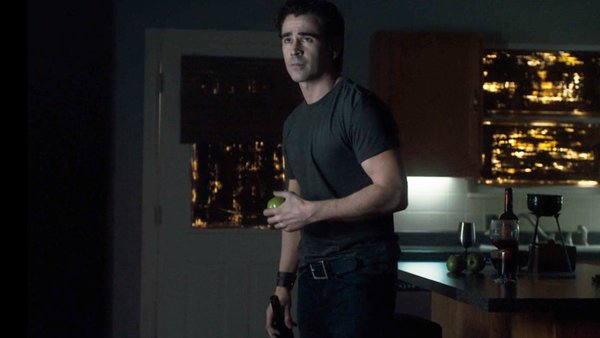
2011's surprisingly good remake of the 1985 cult classic vampire film Fright Night released in the midst of the Twilight phenomenon sweeping the globe, and being a self-aware comedy-horror as it was, gleefully took the opportunity to throw some shade at the very un-cool vampire franchise.
Early on in the film there's a straight-up joke about Twilight when protagonist Charley (Anton Yelchin) tells his pal Ed (Christopher Mintz-Plasse), "You read too much Twilight," to which Ed is incredibly offended.
But there's a far more subtle allusion to one of the first Twilight movie's more infamous scenes about half-way through Fright Night, when vampire Jerry (a brilliant Colin Farrell) rolls an apple off his kitchen worktop and catches it while Charley is sneaking around his house.
Though Jerry also had a fondness for apples in the original Fright Night, this is actually a specific nod to an oft-ridiculed scene from Twilight.
In the scene in question, Bella (Kristen Stewart) drops her apple in the school cafeteria, only for her vampiric crush Edward (Robert Pattinson) to catch it with his foot and bounce it back up into his hands.
5. The Edited-For-TV Jacket - Return Of The Living Dead
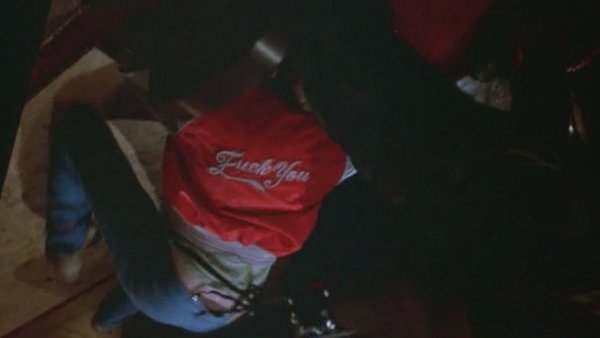
Cult classic horror-comedy Return of the Living Dead certainly holds nothing back in the gore, nudity, or profanity department, enough that you have to wonder why any TV network would even bother making an edited-for-content version.
Yet it's extremely, bizarrely common in the U.S. for R-rated movies to get sanitised TV edits, typically either using alternate takes shot specifically for that purpose, or more hilariously getting soundalikes to re-dub any offending dialogue.
In the case of Return of the Living Dead, one of the more prominent edits involved changing the lettering on the back of Freddy's (Thom Mathews) jacket.
In the theatrical version of the film, the text reads, "F**k you," but these scenes were re-shot for TV with a message that could be enjoyed by all the family.
Seemingly not thrilled about the idea of having to shoot a cleaned-up alternate version, though, the filmmakers had a second jacket made with the phrase "Television version" written on the back, poking fun at the very idea of such a graphically violent and sexual film being edited for TV.
Sadly with the movie being almost 40 years old there aren't any images of the edited jacket available online, though somebody, somewhere, must surely have a grotty VHS copy lying around. Hopefully one day we might get to see it for ourselves. It's quality trolling all the same, though.
4. Stephen King's Endings Always Suck - It: Chapter Two
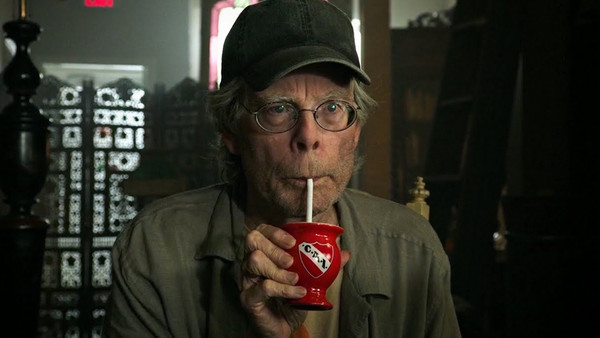
There's a running gag in It: Chapter Two where people tell author protagonist Bill (James McAvoy) that the ending to his book sucked, which to anyone familiar with Stephen King's own novels is sure to feel loaded with meaning.
King, despite his enormous success as a writer, has been frequently criticised for the unsatisfying endings to his stories, even It itself.
This recurring joke is a frustrated jab at King's tendency to lose his way in the final stretch, though to be completely fair to both the movie and King, the author seems to take it in his stride, as he even shows up for a brief cameo in the movie where he himself mocks Bill for his book's ending.
Even so, there's a very real, barbed meaning behind the gag, considering how many damn times King's fans have had to suffer through a woefully disappointing climax to an otherwise incredible book.
3. Throwing Shade At Jaws - The Giant Spider Invasion
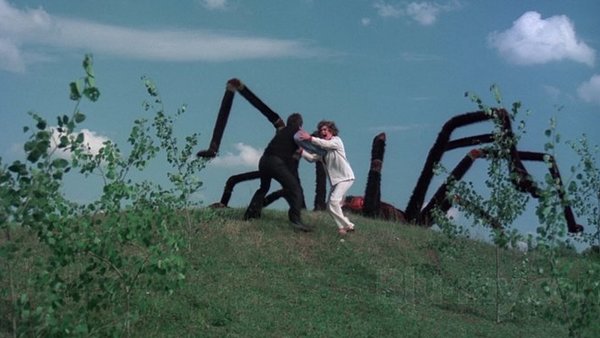
Released just four months after Jaws, The Giant Spider Invasion was a sci-fi horror movie about, you guessed it, gigantic spiders terrorising a Wisconsin town.
Originally the film's spiders were actually going to be more modestly sized at about 10 feet tall each, but when the producers got wind of Steven Spielberg's Jaws going into production, they insisted that the spiders would have to be bigger in order to compete at the box office.
A tongue-in-cheek reference to this is made in the movie's own climax, when Sheriff Jones (Alan Hale, Jr.) tells another character that the spiders make the shark from Jaws "look like a goldfish," to which the character agrees.
Trying to compete with Jaws is one thing, but actively trying to denigrate it in the movie itself? Unsurprisingly this did little to harm Jaws' reputation and likely only reminded audiences they could be watching that far superior movie instead.
Reviews ultimately compared The Giant Spider Invasion unfavourably to Spielberg's suspense classic, and despite turning a profit on its low budget, the film is best remembered today for being featured in a 1997 episode of Mystery Science Theater 3000.
2. Wes Craven Named Freddy Krueger After His Childhood Bully - A Nightmare On Elm Street

A Nightmare on Elm Street's iconic antagonist Freddy Krueger (Robert Englund) is basically drawn from a grab-bag of filmmaker Wes Craven's most traumatic formative experiences, and even the antagonist's name was inspired by real-life terror.
Much as the moniker Freddy Krueger might sound totally made up, it's actually the name of a bully who tormented Craven in his childhood - Fred Krueger, to be precise - who the director opted to spitefully immortalise by naming his terrifying villain after him.
Given that Krueger is himself a bully and a tormenter, it's certainly a fitting designation for someone who evidently brought Craven much misery in his younger years.
In fact, this isn't the only of Craven's films where he's referenced this person - in The Last House on the Left, released over a decade earlier, the rapist and serial killer played by David A. Hess is named "Krug."
If nothing else, this all just confirms the lifelong scars that can be caused by playground bullying. As with Scream's clapback against an unhelpful school board, though, Wes came out on top.
1. Retconning Laurie's Past - Halloween (2018)

2018's Halloween manages the mostly graceful feat of serving as a direct sequel to the original 1978 movie while kicking all subsequent sequels to the curb.
Yet its tidiest bit of table-clearing is a throwaway line of dialogue that's easily missed if you're not totally paying attention or not a hardcore fan of the series.
In one of the film's establishing scenes, Allyson (Andi Matichak) is talking to her friends about her grandmother Laurie (Jamie Lee Curtis), when one of them asks about killer Michael Myers being Laurie's brother.
Allyson quickly replies that this isn't true, saying, "That's just a bit that some people made up, to make them feel better, I think."
This single, 10-second dialogue exchange does away with one of the most divisive aspects of 1981's Halloween II, which reveals Michael and Laurie to be siblings, a fact that went on to define the original run of sequels.
In a matter of seconds, Halloween 2018 wipes that ill-advised plot twist off the map and returns to the much scarier notion of Michael simply being an unstoppable merchant of death motivated only by the need to kill.
By getting this retcon out of the way so quickly, director David Gordon Green clearly didn't want fans to think much about the prior sibling relation at all, but at least managed to slip in a continuity-resetting dig at it.
It was certainly a worthwhile retcon, but even in those precious few seconds, you can feel Green's disgust for that fateful plot twist.