10 Movie Endings You Can Only Work Out For Yourself
Don't expect any help figuring these movie endings out.

Generally speaking, audiences expect a movie to deliver a satisfyingly concrete ending which ties off all the hanging narrative threads and resolves any major mysteries.
But there's certainly pleasure to be had in ambiguity, in a story which refuses to give viewers all the answers they're expecting, but rather leaves them to meditate on the mystery forever more.
While films that refuse to commit to a hard ending can absolutely come off as cowardly or unimaginative, when it works, it really works.
And so we come to these 10 films, each of which eschewed a more conventional, defined ending in favour of one you were left to figure out for yourself.
Though in each case there are at least two clear possible outcomes, the scripts don't come down on one either way, leaving audiences to decide for themselves which one makes the most sense.
Even if you pore over these movies dozens of times, they're so expertly calibrated to be ambiguous that it's difficult to categorically say what the true outcome is one way or another.
And that's a sign of a great storyteller at work...
10. Martha Marcy May Marlene

Martha Marcy May Marlene stars Elizabeth Olsen in her stellar film debut as Martha, a young woman who has been living with a cult for two years and, upon deciding to leave, struggles to pull herself away entirely.
Even when exiting the cult and living with her sister Lucy (Sarah Paulson), Martha has PTSD-induced delusions that the cult's members are pursuing her, leading to a climax where Martha finally agrees to be taken to a mental hospital.
As Lucy and her husband Ted (Hugh Dancy) drive Martha there, however, Martha notices a man she spotted earlier in the day get into his car and seemingly follow them. Martha looks out the back window of the car and then the film just... ends.
The whole point of Martha Marcy May Marlene is its ambiguity, namely that Martha is an unreliable narrator and we as the audience have no idea if her perspective is correct or delusional.
Whether you believe she's reacting to a fantasy or is indeed being followed by the cult, they're both completely valid readings sufficiently backed up by everything leading up to that point.
9. The Gift

In Joel Edgerton's outstanding debut, married couple Simon and Robyn Callem (Jason Bateman and Rebecca Hall) run into Simon's old high school classmate Gordy (Edgerton) - an eccentric but seemingly well-meaning man who begins intruding on their personal life.
Simon quickly grows uncomfortable with Gordy's presence while Robyn is more accommodating, and eventually, Robyn becomes pregnant.
It's later revealed that, in high school, Simon made a false report that Gordo had been molested by an older boy, resulting in him being bullied and almost murdered by his own father, who believed he was gay.
This revelation drives a wedge between Simon and Robyn, who after giving birth to their son decides to separate from him. But at film's end, Simon finds a gift box left for him by Gordo, containing a video which implies he may have drugged and raped Robyn, and may therefore be the father of her child.
The movie concludes without Gordo confirming the agonising truth to Simon one way or another, in revenge for Simon refusing to own up to his own horrific act years prior.
The gift of the title, ultimately, is the doubt that Gordo plants in the mind of both Simon and the audience, and if both outcomes weren't equally plausible, the ending wouldn't really work.
8. Shame

Steve McQueen's Shame is a terrifically crafted depiction of sexual addiction, as executive Brandon (Michael Fassbender) struggles to quell his overpowering urges.
The film opens with Brandon travelling to work on the New York City subway when he makes flirtatious contact with an engaged woman, who eventually grows uncomfortable and disappears into the crowd.
Throughout the film, Brandon is forced to confront the self-destructive nature of his addiction, and at the end he once again crosses paths with the engaged woman on the subway, who this time appears far more interested in him.
As the train pulls to a stop, McQueen cuts to black, leaving the audience to decide whether or not Brandon succumbs to his urges and follows the woman.
The film gives you basically nothing one way or another to decisively determine what Brandon does.
Him successfully turning the implied invitation down or giving in to his addiction are both 100% believable outcomes, and it's really down to individual viewers whether they perceive the scene optimistically or not.
7. Horse Girl

Netflix's Horse Girl stars Alison Brie as Sarah, a shy, awkward young woman who begins to have strange dreams and unaccounted for lapses of time in her memory.
Those around Sarah believe her to be going through a mental health crisis, given her own mother's recent suicide, but Sarah becomes convinced she was abducted by aliens and may in fact be a clone.
Sarah's beliefs only become more rigid as the story progresses, even after a stay in a psychiatric hospital. The film ends with Sarah being discharged, laying down on the ground, and suddenly being levitated into the air and seemingly abducted by a UFO.
This is one of those endings you're free to take literally or not - it's entirely possible Sarah was indeed seeing reality the entire time and was abducted at the end, but it's also entirely probable she's in the midst of a delusional episode, and the abduction could even represent her suicide.
The film makes no attempt at all to come down on one side or the other, and as such it's left viewers baffled and divided ever since.
6. Crash (1996)

David Cronenberg's Crash is a fascinatingly twisted erotic thriller about a group of individuals who are sexually aroused by car crashes.
Following a brutal car accident, protagonist James Ballard (James Spader) enters this strange subculture, where those who partake in fetishising car crashes often end up killing themselves in accidents.
At the end, James and his wife Catherine (Deborah Kara Unger) embark on a consensual vehicular chase with one another on the freeway, with Catherine unbuckling her seat belt and being rammed violently off the road by her husband.
However, James finds that Catherine is largely unharmed, and as the pair begin having sex on the ground, he tells her, "Maybe the next one."
There are certainly conclusions which can be drawn from this ending, most notably that James may be referring to death being the only realistic outcome of their fetish - a fate which befalls several other car crash fetishists in the film - and that it just might come to fruition next time.
It's worth mentioning, however, that Catherine utters this same line near the start of the film when James openly discusses an unsatisfying extramarital sexual encounter he had.
It's certainly possible that Cronenberg's film is simply speaking more broadly about the unending pursuit of an unattainable, ultimate pleasure which continues to elude the pair.
Or better yet, James and Catherine's interactions throughout this scene are oddly more tender and loving than any leading up to it, suggesting their plunge into this extreme fetish has brought them closer together.
It's possible Cronenberg intended audiences to pick up on all of this, and yet he leaves it ambiguous enough for viewers to decide for themselves.
5. Doubt

John Patrick Shanley's Doubt, adapted from his own Tony Award-winning play, is centered around the possible guilt of Father Flynn (Philip Seymour Hoffman), a priest who may or may not be abusing a young altar boy.
On one hand there's Sister James (Amy Adams), who is more willing to believe Flynn's innocence, and on the other Sister Aloysius (Meryl Streep), who is convinced of his guilt.
Aloysius eventually convinces Flynn to move to another church under the threat of blackmail, before it's revealed that the blackmail was entirely fabricated, yet Aloysius reasons that it wouldn't have worked unless Flynn were guilty.
At film's end, Aloysius sees Flynn's resignation as proof of his guilt, while James maintains his innocence. In the final scene, Aloysius declares to her, "I have doubts... I have such doubts!," as she breaks down in tears.
There's a lot for the audience to consider for themselves - first and foremost whether Flynn truly was guilty, and then precisely what Aloysius has doubts about. Is she doubting her accusations against Flynn, her faith, the presence of God around her, or all of the above?
Exactly what that final scene means has sparked fierce debate among audiences ever since the original play made its debut.
4. Burning

Lee Chang-dong's mesmerising thriller Burning follows a young man, Jong-su (Yoo Ah-in), who runs into a childhood friend, Hae-mi (Jeon Jong-seo), with whom he becomes infatuated.
Hae-mi soon enough heads off on a trip and returns with Ben (Steven Yeun), a man she met on her journey, an initially affable yet mysterious man who may or may not harbour a dark secret.
Ben eventually confides in Jong-su that he periodically burns down abandoned greenhouses in order to feel alive, with the implication being that Ben may or may not be using "burning greenhouses" as a euphemism for murdering young, lonely women.
Thereafter Hae-mi goes missing and Jong-su comes to believe that Ben is the culprit, resulting in him murdering Ben at the very end of the movie.
And yet, Chang-dong never commits to Ben's potential guilt one way or another, leaving the matter teetering so brilliantly on a razor's edge.
Audiences are free to read into Ben's apparent euphemism and his possibly sociopathic tells - like yawning while in social settings, because he's secretly bored of all the normality - or not.
3. Being There

Being There stars Peter Sellers as Chance, the simple-minded gardener of a wealthy old man who hasn't ever set foot outside of the man's lush Washington D.C. townhouse.
When the man dies, Chance is sent out into the wide world, where through a series of improbable incidents he ends up being considered to become President of the United States.
In the film's famous final scene, Chance is shown walking across a lake, seemingly defying the natural laws of physics, before dipping his umbrella in the water, into which it disappears before he pulls it back out.
In the closing seconds, we then hear the current President (Jack Warden) say, "Life is a state of mind."
There's a lot to unpack here - there's very obviously a biblical connotation to Chance walking on water, which might suggest he's implied to be a saviour of humanity.
On the other hand, in referring to that final line, it may be saying that the blissfully ignorant Chance is able to walk on water precisely because he didn't know he couldn't do it.
Either way, it makes for one hell of an ending.
2. The Lobster
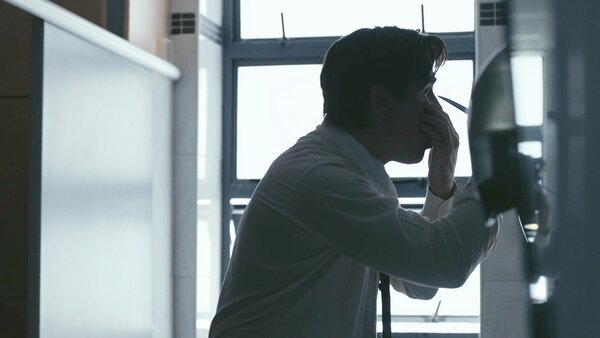
Yorgos Lanthimos's deliriously twisted black comedy The Lobster takes place in a bizarre dystopia where single people are given just 45 days to find a partner or be transformed into an animal of their choosing.
Singletons are encouraged to seek out potential partners with characteristics similar to themselves, and so protagonist David (a brilliant Colin Farrell) eventually settles on a woman (Rachel Weisz) who, like him, is short-sighted.
However, the woman ends up blinded by the leader of the Loners (Léa Seydoux) - single people who live in the forest - and so at film's end, David is forced to decide whether to blind himself in order to remain "compatible" with her.
At a restaurant, David goes to the bathroom and prepares to stab himself in the eyes with a steak knife, yet the movie ends before he does so.
It's absolutely believable that David blinds himself in order to be with the woman, but at the same time it's completely plausible he bails on her and flees.
Hell, perhaps David simply pretends to have blinded himself. Lanthimos sets all three of these endings up without giving preference to any of them.
1. Picnic At Hanging Rock

Peter Weir's brilliant mystery-drama Picnic at Hanging Rock depicts - or rather, doesn't - the disappearance of two schoolgirls and their teacher at Australia's Hanging Rock on Valentine's Day in 1900.
The film ends without the trio's vanishing act ever being solved, while the death of the school's headmistress, Miss Appleyard (Rachel Roberts), can either be interpreted as an accident or suicide.
Though the movie makes it abundantly clear that something incredibly strange is going on at Hanging Rock - with the eerie presence of invisible, seemingly supernatural forces - like its source novel it stops short of granting the viewer any concrete resolution.
A cut final chapter from the novel would've revealed that the girls disappeared into another dimension - a revelation which was quite sensibly excised in lieu of a more provocative ambiguous ending.
Yet audiences are of course free to consider that non-ending as a possibility, or equally that there was no supernatural explanation for the girls' disappearance at all.