10 Overly Pretentious Movies We Should've Walked Out Of

These are the movies the eye-roll was invented for.

With so many predictable and generic movies hitting the cinemas these days, we should be grateful when filmmakers try to do something different and imbue their films with a little more depth and originality. It's a welcome change from predictable genre fare and without a shadow of a doubt something that should be lauded and encouraged. With that said, sometimes a movie comes along with pretensions of greatness which the final product quite simply fails to deliver. It promises commendable goals - an exploration of deep themes and intricate symbolism which transcend the conventional and the mundane - but turns out to be nowhere near as smart as it thinks it is. The profound observation it believes it's presenting is done so with too heavy a hand for the message to be effective and we're left with the distinct impression that those involved have bitten off more intellectual grist than they can chew. The following are ten such movies - films which aim high and try to present audiences with something worthy and artistic but end up being far less important than the filmmakers would have us believe. In short, despite the best efforts to make something deep and meaningful, what we're left with is showy, self-important and utterly pretentious.

10. To The Wonder

Let's face facts €“ love him or hate him, few directors in the history of American cinema have so regularly had their work described as €œpretentious€. Ever since he stepped out of the movie making wilderness and headed into the wilderness to make The Thin Red Line, his movies have divided audiences, with one camp considering them to be beautifully realised cinepoems and another describing them as self-indulgent nonsense. Admittedly there's some nuance in between, but as a broad generalisation it sums up Terrence Malick's fans and detractors neatly. When it came to watching To The Wonder, even long-term fans found themselves scratching their heads and wondering just how far beyond comprehensibility the great director had gone. Ben Affleck and Olga Kurylenko wander aimlessly around Paris; she frequently spins and looks whimsical, he looks on with an unreadable expression. The €œaction€ relocated to America where the cast €“ joined by Rachel McAdams €“ glide their hands over corn fields and spin some more. While Malick is often rightly commended for discarding narrative conventions in favour of expressionistic imagery where tone is paramount, To The Wonder lacks the metaphysical texture of his earlier works. Sure, it looks fantastic, but you can't help but get the impression that Malick is treading old ground, while Affleck looks on from the sideline, bemusement paving the way for sheer bafflement.

9. Somewhere

Following on from a minor injury, Johnny Marco (Stephen Dorff) recuperates in a Hollywood retreat and contemplates the lack of emotion in his life, wondering to what extent his new-found money and fame is turning out to be something of a millstone hanging around his neck. Following the breakdown of his wife he finds himself left with his 11-year-old daughter Cleo (Elle Fanning) to look after, and her presence begins to chip away at his existential crisis and teach him about the responsibilities of being an adult. Perhaps the biggest irony about Sophia Coppola's Somewhere is the fact that it largely goes nowhere €“ whether or not this irony was intentional on her part (it's hard to imagine how one could accidentally make such an aimless movie) is beside the point. Somewhere feels like an independent American movie which aches to be European arthouse but lacks the depth of character and theme to elevate it beyond mediocre at best. It's perhaps impossible for anyone outside of the celebrity orbit to remotely engage with a character so listlessly contemplating his moderate success, with one reviewer at the time of its release noting that few audiences would sympathize with this €œwhining of the privileged€. Daring and minimalist it may be, but in this case the gambit doesn't pay off.

8. Crash

Paul Haggis first came into the Hollywood spotlight after being nominated for the Academy Award for Best Adapted Screenplay for Million Dollar Baby, a movie which could be said to presage his aspirations for pretentious noteworthiness. Taking on the role of director and working from his own script, the multi-award winning Crash certainly fits the bill. Featuring an ensemble cast of interweaving characters, Crash's pretensions of being a deep and meaningful portrayal of racism in present day Los Angeles were clear from the start. Described as a "passion piece" by Haggis, he somehow manages to cram in every possible cliche under the sun - Crash features a procession of one-dimensional characters all of whom exist primarily to crudely hammer home the "racism is bad!" message. Crash represents Oscar-baiting movie making at its most obvious, and sure enough the Academy lavished the film with awards across the board - after all, this is precisely the kind of self-congratulatory material that Hollywood loves to praise as a mark of its liberal aspirations. Far from offering a richly textured portrait of the vibrant multi-ethnic mix of L.A. life, all Haggis offers is simplistic avatars lacking in subtlety and depth.

7. Shadows And Fog

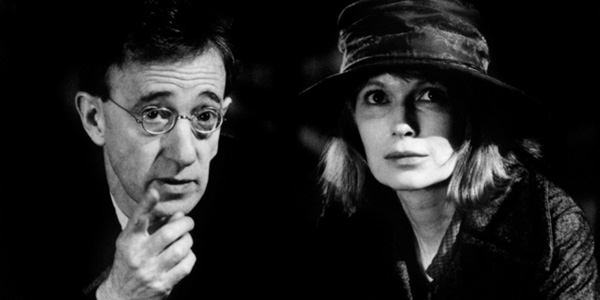
Woody Allen has been known on more than one occasion to venture too far up his proverbial backside in his movies, betraying an overzealous intellectualism which renders some of his films dry, overbearing and loaded with self-importance. He's often at his best when he's playing light and loose with his material, rather than when he's obviously trying to emulate the master directors of old, most notably Ingmar Bergman and Federico Fellini. Shadows and Fog, his 1991 homage to the expressionist silent film masters F. W. Murnau, Fritz Lang and G. W. Pabst, is perhaps the epitome of this tendency for Allen to stretch homage to the point of no return and render it utterly redundant. Despite a fantastic cast including Jodie Foster, Kathy Bates, John Malkovich and, erm, Madonna, Shadows and Fog misses the spot at every turn - a tepid patchwork affair whereby few other Allen movies have felt quite so undercooked and overblown. Audiences tempted to indulge themselves in Shadows and Fog would do far better to go straight to another source of his inspiration and pick up an omnibus of Franz Kafka's writings - at least there the broody, moody imagery is supported by the kind of intricate plotting and complex characters Shadows and Fog can only dream of.

6. Gerry

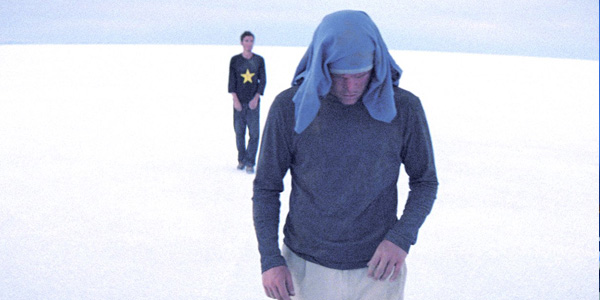
The Hungarian filmmaker Bela Tarr is one frequently cited when discussing the works of so-called "pretentious" directors. Featuring incredibly long lingering takes, Tarr's films are inaccessible to all but the most patient - and some might say forgiving - of audiences. That Gus Van Sant's Gerry bears a huge debt to the work of Bela Tarr is obvious enough regardless of the fact that the director expressly stated so himself. Two hiking companions played by Matt Damon and Casey Affleck, both of whom go by the eponymous name "Gerry", get lost in the wilderness without food and water and struggle to find their way back before they die. While such a simple tale is expected to be told with an eye for the minimalist, Van Sant's imagery lacks to requisite depth and juxtaposition to elevate it above its simple conceit - you only have to watch a movie like Nicholas Roeg's Walkabout to see how effectively similar material can be moulded into something truly profound in the hands of a superior director. That said, Van Sant's most pointless vanity project still remains his completely unnecessary remake of Alfred Hitchcock's Psycho, while the long take minimalism which diminishes Gerry worked considerably better in his other movie Elephant.

5. Film Socialisme

Few directors in the history of cinema have so frequently courted the epithet "pretentious" as often as Jean-Luc Godard. The enfant terrible of the French New Wave movement which emerged in the late 1950s, Godard has consistently challenged the formal conventions of filmmaking throughout his career, often to great effect (see Breathless, Pierrot le Fou, Band a Part, Contempt and many more besides) but sometimes with results which are less than satisfying. Film Socialisme undoubtedly falls into the latter category of Godard's cinematic oeuvre. Posing a "magisterial" essay on the collapse of European civilisation (something most audiences were probably wondering how they'd managed to allow such a monumental event pass them by without them noticing), Godard's all-encompassing treatise on the past, present and future plays out more like a self-conscious art installation, excusing itself for its lack of clarity with its visual ambiguity. All of which would be fine and well if the imagery was more provocative and intriguing than it is, but sadly that's far from the case. The deleterious effects of globalisation on the modern stage have been far more effectively evoked in a number of documentaries, and Film Socialisme is too avante-garde for its own good and ends up swamping the message in an impenetrable montage.

4. Babel

Alejandro González Iñárritu's Babel concluded his Death Trilogy just as Gerry opened Gus Van Sant's own trilogy on the subject, but where Gerry laboriously focused on two characters in a minimalist setting, Babel opts for broader brush strokes and attempts to portray the interconnected nature of existence through globally refracted prisms. Featuring multiple stories which span Japan, Morocco and Mexico, Babel features an international ensemble cast including Brad Pitt, Cate Blanchett, Gael Garcia Bernal and Rinko Kikuchi as people caught up in the inevitability of fate and destiny. It is a movie in which seemingly inconsequential actions can have unforeseen consequences to people you may never meet - an intellectual attempt to explore the social and cultural ramifications of the Butterfly Effect. Unfortunately, Babel misses the mark considerably, and Iñárritu's free-wheeling approach to characterisation which worked so effectively in 21 Grams here misses the mark and leaves audiences with a sprawling, aimless and ultimately un-engaging movie. Overpraised at the time of its release, it's a hard film to like and is a victim of its over-earnest seriousness, leaving the audience feeling as disconnected from the movie just as the characters within it are from one another.

3. Melancholia

From its startling slow motion opening sequence, complete with music from the prelude of Richard Wagner's Tristan und Isolde, it's immediately clear that Melancholia, Lars Von Triers's 2011 movie starring Kirsten Dunst, Charlotte Gainsbourg and Alexander Skarsgård, considers itself as a weighty and significant movie. Admittedly, the same could be said for most of Von Triers's filmography, a director who never shies away from controversy and experimentation. As the title clearly suggests, this is a film about depression both personal and universal. Newly weds Justine and Michael (Dunst and Skarsgård) arrive at a sumptuous stately home in the countryside along with numerous guests including Justine's sister Claire (Gainsbourg). As Justine sinks further and further into irreconcilable depression, the rogue planet known as Melancholia approaches Earth, a head-on collision seemingly imminent. That the film emerged from therapy sessions Von Triers underwent to deal with his own depression isn't of itself a cause for criticism - with a tendency towards the upbeat in cinema in general, movies which tackle uncomfortable negative emotions are often a welcome breath of fresh air. That said, conflating the emotional breakdown of a character with the apocalyptic destruction of the planet is clearly heavy-handed, and a rare, exceptional performance from Kirsten Dunst isn't enough to salvage Melancholia from being oppressively pessimistic.

2. The Fountain

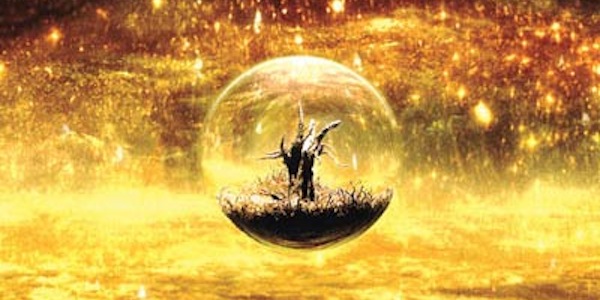
Love and death are ubiquitous themes found throughout movies - they resonate with audiences regardless of their backgrounds or beliefs, and just as we all seek to understand meaning to life in the face of death so too do we often define our lives by the moments we have loved and cherished. Few movies have attempted to explore these themes in such an ambitious and, ultimately flawed, way as Darren Aronofksy's The Fountain, a film which flopped at the box office but has since gathered a cult following. The Fountain is split into three juxtaposing time lines, each of which star Hugh Jackman and Rachael Weisz as characters from the past (a Spanish conquistador and his queen), present (a scientist and his dying partner) and future (a space explorer searching for his lost love). Cross-cutting between these three eras, The Fountain strives for metaphysical meaning and is replete with recurring Biblical motifs such as the Tree of Knowledge and musings on the duality of nature. Unfortunately, as much as Aronofsky has clearly injected a great deal of passion into this project, the result is mixed and often confused, with beautiful imagery crushed under the weighty philosophical ambitions and left floundering, its multi-layered narrative nowhere near as profound as was clearly the intention. Aronofksy deserves credit for attempting something more meaningful amidst the "culture of superficiality" - it's just a shame that The Fountain failed to reach the heights intended.

1. The Matrix Revolutions

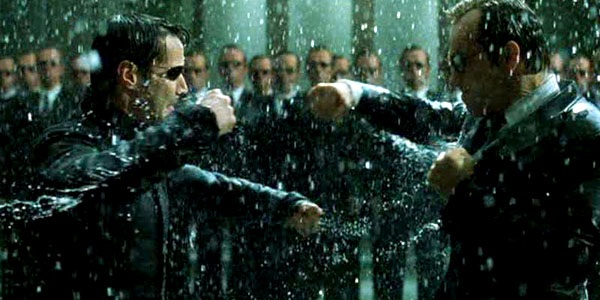
Few mainstream blockbusters have received quite so much unwarranted critical cross-examination as the Matrix trilogy, which went from the intriguingly entertaining roller-coaster of the first movie and quickly descended into grade school-level philosophising by the final instalment, where the tight plotting and intense, engaging action scenes of the original all but disappeared in favour of narrative drivel and cartoonish spectacle. To describe the over-the-top CGI laden action sequences as incongruous when placed alongside exposition which seeks to explore the nature of faith and knowledge is an understatement, and the Wachowski's metaphysical ambitions - neatly hinted at in the first movie - quickly descend into the hackneyed and contrived. It doesn't help matters that The Matrix Revolutions is so clumsily scripted, with some of the dialogue verging on the laughable. Despite all its pretensions at delivering an enclosed philosophical viewpoint packaged up as a neat, high-concept sci-fi action movie, The Matrix Revolutions turned out to be little more than a run-of-the-mill lowbrow sequel which fell well short of its lofty ambitions. Movies don't get much more pretentious than this. Agree or disagree with the movies on this list? Which pretentious movies have you seen which you wish you'd walked out on? Let us know in the comments below!

Contributor
Contributor

Andrew Dilks hasn't written a bio just yet, but if they had... it would appear here.