10 Paradoxes That Should Break Back To The Future

Besides Marty hanging out with Doc being a little creepy.

If you've ever had a fantasy about time travel, chances are it's been sparked by Back To The Future. Even if the scenario in your head is in no way related to hitting on your mother's younger self or fighting cowboys, then the mechanics of you how you get back to that point (you sicko) have been the same as they are in Robert Zemeckis's classic trilogy of blockbuster sci-fi films. The rules of time travel as they exist in Back To The Future are by no means watertight or foolproof, but they were never meant to be. They're just fun films. That's why they can be applied to day dreams so easily. It's also why said day dreams and, consequently, the films can be torn down so easily. Give even the slightest amount of serious thought to all of the timeline-altering, paradox-creating actions that occur throughout all three films, and suddenly it becomes a wonder the entire universe didn't collapse in on itself. Sure, Doc Brown pays lip service to the idea that they could create rips in the very fabric of reality, but he's still all for messing with history and creating a time machine out a train in 1885. The guy's not that much of a genius. Neither is Zemeckis, but nobody was asking him to be. He just wanted to make a fun film about time travel. It's just that the time travel doesn't stand up to even a tiny bit of scrutiny. Prepare to have your head explode as you try and get it around the ten paradoxes that should break Back To The Future.

10. Why Does The Clock Tower Need Saving?

Let's ease into this with a Back To The Future paradox that should be fairly simple to get your head around. So in the first film, right at the start, there's a bit where Marty's making out with Jennifer in the middle of town (which, ew, PDA much), only to be interrupted by an indignant old woman shaking a donation tin, yelling "save the clock tower!" over and over. Then she hands over a pamphlet and explains that the crummy clock tower, the face of which hasn't worked in years, is due for demolition. For some reason people want to say it, despite the fact that it's a sorry excuse for a clock. But here's the thing: the clock tower shouldn't need saving. The reason the clock stopped turning is because it was struck by lightning all the way back in 1955, and is frozen at the time the strange natural phenomenon happened. That bolt of lightning is later harnessed to provide the DeLorean with the appropriate amount of jigawatts for Marty to get back to the future (hey, that's the name of the film!), with Doc Brown using a cable to loop the power down into the car. Which means the clock tower doesn't get struck. So it doesn't need saving. So why does that campaign exist?

9. There Are Two DeLoreans In The Third Film

So that's the first film spoilt for you, now onto Back To The Future: Part Three, aka the one nobody remembers anything about except it's in cowboy times and that's the one with the train or something, right? The final entry in the trilogy is full of confusing plot holes (like why would Biff's ancestor look exactly like Biff but with a big silly moustache, did Robert Zemeckis look identical to every male in his family), along with its fair share of legit time travel paradoxes that the film never really bothers to explain. One of the most glaring is how exactly Marty and Doc got back to the Old West in the first place. There has to be two DeLoreans in 1885. There's the one that Doc was driving at the end of the second film, which was struck by lightning and sent him back to the Old West in the first place. That's the one he stashes away in a cave for Marty to find, repair, and jump back in time to rescue him. Right? So that means when Marty has travelled back to 1885, there's the DeLorean he's driving, and the one that Doc Brown has already hidden out in the desert. Which should probably mess with the fabric of the time-space continuum in some way, since the series established that two of the same person existing at once will muck stuff up. Not for inanimate objects, though?

8. Marty's Parents Should Recognise Him

Now the big problems start to appear. Back To The Future never purports to be a totally realistic depiction of time travel €“ it's no Primer €“ but it does have a sort of internal logic to it that manages to bear up to a tiny bit of scrutiny. Overthink it and, inevitably, it'll all fall apart. That's true of basically any time travel story. Except there's also a pretty significant plot hole/paradox in the fact that Marty's parents don't recognise him when he returns to 1985. The mysterious "Calvin Klein" clearly had a big effect on the couple, being the one who got them together and all, and you wouldn't forget that mysterious stranger in a hurry. So maybe not when Marty's born, but has grown to the age that he was when he travelled back in time and nearly accidentally seduced his mum, at the very least they should both notice the striking similarities between their son and that guy who showed up and played a weird guitar solo at their school prom. The worst case scenario is that old George would assume that this kid wasn't his at all, but in fact must be the progeny of that very same mysterious stranger, with the assumption being that Lorraine had clearly been engaging in a clandestine affair with this Calvin Klein character for decades.

7. How Does Marty Remember Things

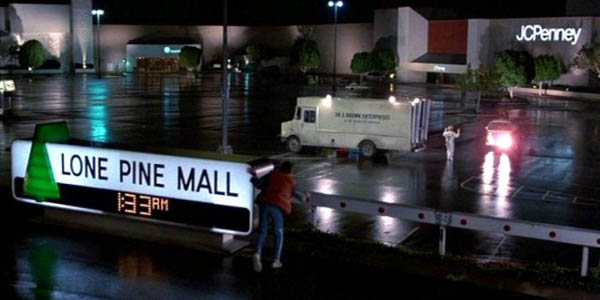
One of the other big paradoxes from the first film - although it applies just as much throughout the whole series - is how come Marty remembers everything. It's established in Back To The Future that things can be erased from the timeline, as if they never existed, as shown when it looks like George and Lorraine might not get together at the Enchantment Under The Sea dance and Marty's hand starts to disappear. He still remembers that his siblings exist, though, despite them having disappeared from the photo he keeps of them and, thus, reality. So surely if these things stop existing, they should also disappear from Marty's memory, because they technically never existed? Which implies that Marty is some sort of god brain that exists out of the usual three dimensions of human understanding, and can view time as a series of branching, alternate realities which all exist at once, rather than experiencing time as a linear thing. Like Matthew McConaughey at the end of Interstellar, kind of. He should also not remember that Lone Pine Mall used to be Twin Pines, or be surprised at this home life now being mint, since he now grew up with that.

6. Biff Couldn't Possibly Mess Up The Timeline

Right, so the catalyst for the second Back To The Future is that Biff messes up the entirety of history by half-inching a sports almanac, car jacking the DeLorean, and sending himself back to 1955 where he gives his younger self the book of results and instructions to make millions through placing bets. Then that causes a dark alternate 1985 where Biff is Marty's abusive step-dad who somehow runs the world from a dystopian casino lair, and he's forced Lorraine to get a boob job because the Oedipal complex wasn't confusing and icky enough for everyone involved as it was. Except, having created that alternate timeline, Biff has thus eliminated the 2015 where he stole the almanac and time machine in the first place. He changed the future, with Doc locked up in an asylum and Marty supposedly off in the Swiss alps or whatever. So he couldn't have returned the DeLorean to Marty and Doc in 2015, for them to travel back and realise the timeline had been tampered with: the 2015 Old Biff went back to would have been similarly dark and dystopian. And his messing with the timeline would mean he never had the chance to go and break stuff in the first place. Head hurt yet?

5. Marty And Jennifer Shouldn't Exist In The Future

Speaking of the second film, the entire plot shouldn't actually take place. The first Back To The Future ends with a frantic Doc Brown insisting Marty needs to head to 2015 with him, because some bad stuff is going down with his kids. Jennifer comes along because she wants to know what's up with her future children, too, and it turns out to involve some cases of mistaken identity and youthful follies and the like. Except none of that part of Back To The Future Part II should even occur, since jumping in the DeLorean has removed Marty and Jennifer from the timeline. So how do their older selves exist, and how do they have kids, and how are the kids mucking things up so badly? None of that should exist. You can perhaps explain away this one by suggesting that the existence of the future implies that Marty and Jennifer will at some point return to 1985 safe and sound (which spoils the end of the film somewhat), but taken in conjunction with the previous paradox of Biff's dark alternate timeline, that also doesn't really hold up. Plus it's established in the first film, when Doc's dog goes a minute into the future, he doesn't exist in he timeline for that minute.

4. Doc Should Know He's Going To Die, Marty Can't Save Him

Now stuff starts to get really, truly brain-melting. Back one more to the third film in the series, where the whole crux of the plot is Marty going back to 1885 to rescue Doc Brown who is not only stranded in that time period, but is also due to be shot in the back and killed by Biff's ancestor, Buford "Mad Dog" Tannen. Right there you've got a paradox, because Marty finds that out in conjunction with the 1955 Doc Brown, who should by all rights evaporate from the timeline there and then. Dude sees his own grave. That's pretty hardcore, but it's also a hell of a paradox. That's not the end of it, though. So that's admittedly confusing, but in Back To The Future Part III we're dealing with two separate Doc Browns: the young 1955 model who helps Marty out, the older 1985 super genius who has found himself stranded in the Old West. Which surely means that the older Doc Brown would know he was due to be shot in the back, since younger Doc Brown read it in a newspaper. They're one and the same person. The young Doc Brown grows up to be the old one, who knows he's going to be shot and killed before he ever gets stranded in 1885, so surely with that knowledge he should be able to stop it without Marty's intervention? That would make for a shorter film...

3. The Idealised 1985 Should Ruin Everything

Now here's a paradox that, in theory, should derail the entire franchise in one fell swoop. So by messing with the past so much in the first film Marty returns to a 1985 that's almost unrecognisable to the one he left. Yeah there's the hi-larious Lone Pine Mall gag and the thing with the clocktower, but his family life has improved to an insurmountable degree. He's now not living with an alcoholic mother and a deadbeat dad in a crappy house on the wrong side of the tracks, but he and his siblings have apparently grown up in the lap of luxury, with George as a bestelling author and Biff as his emasculated servant. It's pretty sweet. It also breaks Marty as a character. Marty presumably didn't have a great time growing up. All of those experiences lead into his character, though: he didn't do well at school, so he hung out with Doc Brown; his family couldn't afford a car, so he skateboarded everywhere; stuff like that. Make his entire life a cake walk like it was in the fixed timeline, and none of those time travel shenanigans should ever have happened. There's a whole bunch of ripple effects, but take one for example: he probably grew up in a family that could afford to buy him a car for his sixteenth birthday, so he never got used to skateboarding, so the skateboarding bit in 1955 couldn't have happened, so he should've been pounded by Biff and his gang. And so on.

2. So Many Martys

That one you can explain, but in doing so it just makes the whole thing a million times more confusing. Right, so the end of the first film confirms that two people can exist at the same time, but it's a bad idea for them to interact. That's why when Marty travels back to 1985 a few minutes before Doc gets shot by the Libyans, he has to make sure that his past self doesn't see him. That would cause a paradox, see? But that also implies that when this event first played out, there was also a Marty watching then. Else none of this would've happened. Which means that there are probably an infinite amount of Martys, travelling around time and narrowly avoiding each other. And each of those Martys probably affected the timeline in different ways. The crappy McFly home life seen at the start of the film could very well have been down to a different Marty tampering with things in the wrong way. For the film to work at all there always has to be a Marty that's back in 1955 messing with things, and one in the present, and another watching the one in the present go back in time, and so on. Not only does that bring up the infamous Grandfather paradox, but the implication that there's loads of Martys out there - cos there are two existing at once - that have to be dealt with. Two can't exist at once. So where does New Marty go?

1. The Whole Thing Plain Doesn't Make Sense

In Doctor Who, the TARDIS stands for Time And Relative Dimensions In Space. It's explained fairly early on that the time machine travels not only through history, but also through space. Which makes sense, because otherwise all of the Doctor's adventures could occur in different time periods, but always in the same surroundings. Kind of like how in Back To The Future travelling back in time in the DeLorean plops you in the exact same location, just at a different time. Which when you get into the science of it, doesn't make sense. Because the world doesn't stay still like that. The location of the Twin Pines/Lone Pine Mall in 1985 is technically the same as the field in 1955 Marty crashes into after hitting 88 miles per hour, but in terms of physics and stuff, it's not the same location at all. After all, the Earth rotates around the sun, the sun rotates around the galaxy and the galaxy moves in the universe, meaning that if the DeLorean truly existed in the same space when it was send back in time, there's more chance it would be on the other side of the world, or even floating off in space. The gravitational pull wouldn't affect an eighties sports car travelling through time, right? Maybe Zemeckis would've been better off with his original concept of a time travelling fridge...

Contributor
Contributor

Tom Baker is the Comics Editor at WhatCulture! He's heard all the Doctor Who jokes, but not many about Randall and Hopkirk. He also blogs at http://communibearsilostate.wordpress.com/