10 Reasons Rogue One Is The Smartest Star Wars Movie Ever
It's just really clever, to be honest.
As a wise old friend once said, "only a Sith deals in absolutes." And whilst it's always apt to note the ironic inflections of Revenge of the Sith's most quotable line, it does denote something supremely important: nuance, or rather the lack of nuance, is one of Star Wars' most contentious aspects; its moral dichotomies a key exemplar of its own cinematic reverence. The rebels, so we were led to believe, are the vanguards of the Republic's utopian ideals, personified in extreme by the boyish charms of a young farmhand from Tatooine. They're the good guys, that's blatant.
But Rogue One begs to differ. In fact, it does a whole lot more than differ, it contravenes the entire status-quo of the original trilogy. Rogue One is not a cynical film by any means, but it is impeccably nuanced, so much so that I've been compelled to wake up early on a Monday morning to clutch my keyboard and do all the words humanly possible to convey just how intelligent the first 'Star Wars Story' actually is. It's just that good.
What Gareth Edwards and co. have accomplished is a blueprint to the successful creation of a fully-armed and operational Star Wars prequel. It's equal parts charming and terrifying, but that only adds to its many qualities, chief among which is its ability to juggle a myriad of complex themes to a successful, and indeed gruesome, end. Quite simply, there's no other film like it.
Spoilers follow, obvs.
10. The Morally Ambiguous Alliance

Contrary to what the marketing gurus over at the House of Mouse would have you believe, Rogue One isn't a simple tale of good vs evil. Obviously the delineation between the Rebels and the Empire is made stark by the fact that, you know, the latter has an actual planet killer in their arsenal, but the Alliance to Restore the Republic isn't without its own flirtations with the Dark Side, epitomised in full by Rebel Intelligence and its not-so-merry band of spies, assassins, and saboteurs.
We first get a taste of the Alliance's seedy activities when Cassian Andor (Diego Luna) unceremoniously blasts his rebel contact in the face in order to escape from an impending imperial force, and the ambiguity only unravels further as General Draven (Alistair Petrie) conspires with Andor to assassinate, rather than extract, Galen Erso (Mads Mikkelsen). Add in another rebel faction under the stewardship of Saw Gerrera (Forest Whitaker) - a man regarded as an extremist by both the Rebels and Empire alike - and you get the sense that this rebellion isn't the fairy-tale resistance we all initially perceived.
Apart from emboldening the prevailing sense of desperation that permeates Rogue One's narrative, the decision to fundamentally alter the ideological makeup of the alliance engenders a dramatic parallel between the Original Saga, and the events that immediately precede it. By the time Jyn and her rag-tag band of rebels have beamed the Death Star plans to the alliance fleet, you get the sense that we're dealing with a different kind of rebellion altogether - one that can actually afford to hope, and to straddle a lighter path than what was wholly capable before.
Indeed, as Rogue One's transformative influence on the saga begins to impact, its revisionist approach to the Alliance's history is bound to comprise a part of its most memorable aspects.
9. Using Jedha As An Analogue Of Contemporary Conflict

Late on in the first act the film ventures to Jedha, a desert planet under the thumb of a heavy imperial presence. It also happens to be home to Saw Gerrera's rebels, whose methods verge on the... unsavoury, to say the least.
It's no surprise that Jedha, then, invokes some of the most visceral images of the franchise to date. One scene, depicting an ambush on an Imperial convoy in a densely-populated area, featured some particularly harsh imagery, shining a light on the impact of the Civil War on the galaxy's civilian populace. The firefights strive not to hark back to the engagements of the Original Trilogy in this case. What they do emulate, however seemingly, are frontline news reports from contemporary conflicts; shots are shaky, chaotic, and violence is directed indiscriminately. There is no adventurous element to be found, because it is, however bluntly, distressing by design.
To the extent that Star Wars can be considered real at all, Jedha is by far the realest it has ever been. Modern conflict, torture, and psychological trauma intersect in a sequence that I've noticed isn't really dominating online conversation. I get that the Death Star kind of lays waste to everything just a few minutes later, but there's a whole lot more to that first act than fancy choreography and Gerrera's creepy tentacle monster-thing.
8. Everything About K-2SO

Oh gosh, just how amazing was this wee guy? Well, maybe not wee, but you get my point, K-2SO was just a fantastic character all around.
Like, if you could take the primordial sass of C-3PO, make it bearable, and place it in the shell of an electronically bonafide badass, you'd have K-2SO. Everything about Alan Tudyk's reprogrammed Imperial battle droid was just top-notch, providing a cynical blend of comic relief that in no way impeded upon the film's ability to convey a steady sense of dread from beginning to end.
This is more important than you may think, as Rogue One's success largely depended upon its ability to perpetuate a kind of onscreen claustrophobia; the Empire slowly tightens its grip over the course of the film, and humour that felt overtly placed within the narrative would've imparted a dissonance largely detrimental to this atmospheric effect.
But lastly, how can we not talk about the character's heroics in the story's closing moments? Shutting down the blast doors in one last act of defiance encapsulated the ferocity of the closing act's events and, in no small way, brought to bare a reality Jyn, Cassian, and the rest of the rebels on Scarif would have to confront: that victory, however small, comes at an immense cost.
7. It Shows Star Wars At Its Most Visceral

Before Rogue One, the mantle of the most violent Star Wars film belonged to the entertaining though obviously problematic prequel, Revenge of the Sith. Like Rogue One and, to a lesser extent, Episode V, the third Star Wars prequel marked a discernible shift in tone for the franchise. The Jedi were executed en masse by the clones they had befriended years earlier, and the ending made it abundantly clear that hope, at least then, was a luxury no one could afford.
Whereas Episode III possessed slight hints of the war genre throughout its proceedings, Rogue One pays homage to those films through and through. There's a reason why it feels as though the film plays out like The Dirty Dozen in space, and it's because it wears these roots on its sleeve. On Scarif in particular, a U-Wing gunner lays waste to an Imperial encampment in much the same way Robert Duvall did in 1979's Apocalypse Now, sans Wagner's Ride of the Valkyries. On the ground, the firefight waged between the rebels and stormtroopers plays out in true Spielbergian fashion, as we see our beloved protagonists succumb to their wounds in much the same way Tom Hanks and his band of G.Is did in Saving Private Ryan.
The parallels here are obvious, but they serve a purpose in adding to Rogue One's inescapable sense of uniqueness within the wider Star Wars canon. This isn't your average Star Wars film, it's a whole other beast altogether.
6. It's The Most Diverse Film In The Saga
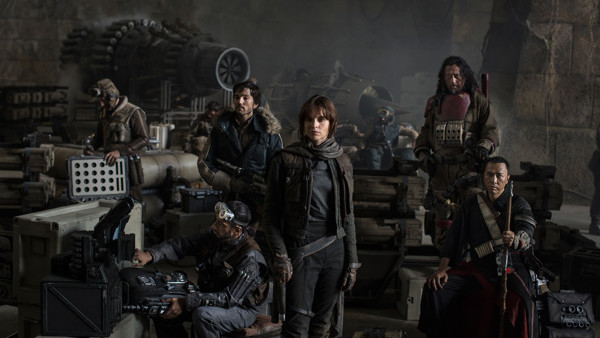
I know that we all may love Star Wars, but let's face it, when it came to diversity it never really set an example. The trio of heroes from Episodes IV to VI were all white and predominantly male. Their adventures, blinkered in a heteronormative narrative, are still typical of Hollywood today. And if you're a person of colour, LGBT* or a woman, and happen to like Star Wars, then finding unproblematic representation in the saga has, until recently, proven to be difficult. Following a precedent set by The Force Awakens, Rogue One makes a bold statement in placing diversity front and centre to its message of rebellion.
If you tend to avoid that side of the internet that so so enjoys making deplorable behaviour synonymous with geek culture, then you'd be forgiven for missing the whole '#DumpStarWars' malarkey that erupted on Twitter following - sigh - Donald Trump's November 8th election victory.
Basically, like the decent human beings most creatives tend to be, the writers of Rogue One deemed it fit to label the Empire as a white nationalist group, which is true, because that's been of staple of Star Wars canon for a heck of a long time. (were those red, white and black flags not a big enough giveaway, guys?) Following this, they tweeted solidarity with POC and LGBT* Americans experiencing a disgusting spike in hate crime in the aftermath of the election, creating an image of a safety pin emblazoned across the logo of the Rebel Alliance. It wasn't long before everyone's favourite internet Nazis, the Alt-Right, caught onto this however, and thus the hashtag was born. Rogue One's diverse cast only vexed them further.
I don't know about you, but if you're p*ssing off Nazis, usually that's a sign you're doing something right. And of course, Rogue One has done something right; it's given Star Wars fans - a diverse group of races, sexes, genders and religions - heroes that break the mould of Hollywood's never ending love affair with pale, stale, male protagonists. It's important to remember that representation matters, and the significance of Rogue One's diverse cast is something all fans should be able to appreciate. After all, what is Star Wars if not a symbol against oppression?
5. It Depicts The Force In A Whole New Light

Out of all of Rogue One's many heroes, it has to be Chirrut Îmwe (Donnie Yen) who's the most memorable. A force-sensitive monk from the planet Jedha, Îmwe's connection to the force is Rogue One's first and only connection to a world before the Empire. As a member of the Whills and not a Jedi himself, Chirrut's connection to the force is one unlike any other and, as an idealist among cynics, trusts in it to deliver balance.
Himself and Baze (Jiang Wen) - former guardians of the Khyber Crystals found within the Jedha temple - offer fresh perspectives in relation to the force, straddling a line between total devotion to the hokey religion, and rejecting it altogether. Chirrut in particular exemplifies the ethereal nature of the galaxy's spiritual binding agent, performing acts that are, whilst undoubtedly impressive, not completely miraculous. And because there are no mind tricks, force blasts or lightsabers to be found, the audience - whilst already in possession of the knowledge that a tangible, mystical power pervades the mythos - are thus forced to concede to the heavy-handed incredulity of Baze, and in turn, the rest of the galaxy that resides within this post-Republic milieu. The Jedi are dead, ostensibly, and so is the force.
Far be it from Chirrut to eschew his devotion to the order in the face of such scepticism, he believes that he himself is very much one with the force. Whilst he may not be able to influence the decisions of others through tricks of the mind, bring down a star destroyer with a flick of his wrist or channel lightning from his fingertips, it is clear that the force is a reality to Chirrut. It protects, nourishes, and enlightens - not as a tool of destruction, but one of peace. When Baze himself is confronted with death, it is a new hope - one granted to him by his belief in the force - that allows him to pass peacefully, soundly assured that he will meet his long-time friend when he does so.
It's kind of beautiful, to say the least, and is an aspect of the saga I sincerely hope we revisit in the future.
4. Darth Vader Takes On A Truly Terrifying Persona

Good. Lord. Darth Vader. Where do I even begin?
Speaking as a twenty-something adult millennial, his final appearance properly messed me up. Genuinely, I've not been this scared of old bucket-head since watching A New Hope way back when I was three; Vader's malice, at least then, was only ever implicit. Of course, he force choked his way to victory on many an occasion, but you got the sense that this was Darth restrained, that an evil hidden behind the suit had the potential to be unleashed, but never was. Rogue One, in all its darkness, finally offers a window into this unbridled horror, and it's, well, horrific.
From the very first moment we encounter Vader in Rogue One he is made to look like a thing of horror, locked in a bacta tank with a Frankensteinien tinge that imbues Star Wars' fantastical strain of sci-fi with a ferocious shot of Gothic nightmare-fuel. It only gets worse from there however, as Vader leaves his Mustafar fortress to confront the rebels themselves above Scarif. What follows is an indescribably brutal massacre against a group of rebels desperately trying to abscond with the Death Star plans in tow. Vader makes short work of the rebels, trapping them in an air lock before brutalising them with an array of swings, jabs, and force slams.
It is, to say the least, slightly terrifying. But I guess that's kind of the point; Vader is meant to be a symbol of terror for the Rebellion, not a fierce critic of sand, lovelorn at the loss of a childhood sweetheart. In correcting that mistake, Rogue One's contribution to the saga is invaluable.
3. Victory Comes, But At An Immense Cost

At its heart, Rogue One is a tale of triumph against the odds. These few rebels, who embark on their mission to Scarif without any belief that the Alliance will come to their aid, ultimately succeed in planting the first breach in the Empire's armour. There's a heavy price to pay for this victory however, as every last member of the Rogue One callsign perishes in the fighting.
It's not an easy thing to watch these characters, some of whom deserve to be labelled among the best in the Star Wars canon, die one by one as the battle progresses. What's even more heartbreaking about these deaths, however, is that throughout the film, even going into it, you get the sense that none of them are going to make it. It's a testament to the strength of Rogue One's character-driven narrative that, despite this knowledge, each and every last one of them, from Jyn to Bodhi, are so incredibly endearing. But, more importantly, it illustrates a brutal reality of victory; that it always comes at a price.
Apart from the fact that the sacrifice of Rogue One's crew adds an appropriate level of poignancy to the events of A New Hope, it strips away the fantastical nature of Star Wars itself. Rather than experiencing a modern-day myth play out across our cinema screens, we are witnessing the lives of ordinary individuals caught up in extraordinary circumstances. It grounds the film remarkably, and again, exemplifies its nuances by confronting the pain so synonymous with fighting for what's right.
2. The Destructive Scope Of The Empire Is Fully Realised

Chalk it up to budget constraints or the limits of what was achievable onscreen in 1977, but, I have to say, you never really got the sense that the Empire was a truly oppressive force. Sure, they had a fleet (a big fleet), but their oppressive nature was never truly shown off to the extent to which you could see them as an omnipotent force of oppression. (ignoring for a second that, you know, they blew up Alderaan)
Leave it to Rogue One to change that, as the planet-trotting war flick makes a point of illustrating just how pervasive Imperial authority truly is. We see prison systems, troopers around every corner, massive fleets, a Death Star (obviously), and the way in which the Empire permeates everyday life in a post-Republic galaxy. They're not simply a minor hindrance to the efforts of rebel smugglers, they're a totalitarian organisation that can project force on an alarming scale, something that is displayed as much by the film's gigantic set-pieces as it is by the way in which characters act. It's not just temples and cities that the Empire is laying waste to in this sense, but the very idea of hope itself, typified in full by the shady methods of the Rebel Alliance at this time.
Physically, mentally and politically, the Empire in Rogue One is an unconquerable force. It's what makes even the smallest victory feel gigantic, and why the first anthology film will be remembered as the franchise's darkest.
1. It Forces A Reappraisal Of The Entire Saga

Rogue One is just a beautiful film. But I've already said that. A lot. And whilst I'd love to prattle on for another two-and-a-half thousand words on the subject, I'd imagine that it would get a tad tedious. Just a tad though.
The main thing to consider when you leave the cinema having seen Rogue One (and this goes for any film, by the way), is how it made you feel. Cinema, of course, has that wonderful ability to convey huge swathes of emotion over the course of two hours. But when it comes to a franchise like Star Wars - something inherently nostalgic and wondrous to a great many people - the feeling you get when you leave the cinema is already a foregone conclusion. Right?
You'll probably leave, goosebumps all over, gawping over the amazing visuals, memorable characters, and wonderful narrative. Rogue One is different though, and, far be it from it to illicit a response solely consumed by mere nostalgia and its ability to give you the fuzzies, it leaves you with an altogether different kind of feeling; one that is, for lack of a better term, simply mind-blowing. The way it so effortlessly turns one of cinema's most lampoonable contrivances into such an emotive crux in the saga, is a masterstroke on Chris Weitz, Tony Gilroy, John Knoll, and Gary Whitta's behalf. Not only have they turned in a near-perfect Star Wars experience, they've managed to make the 1977 original - a milestone in contemporary popular-culture - even better. Like, just how do you even do that? It's bonkers.
Of all the amendments to the Original Trilogy, Rogue One has to be my fave.
What did you like most about Rogue One? Do you think it's the best Star Wars film yet? Be sure to sound off in the comments below!