10 Star Wars Changes George Lucas Made That Were Completely Justified
If it ain't broke, George Lucas can still fix it.

The original Star Wars trilogy has undergone some serious cosmetic changes over the past three decades or so; some of those changes have been laughably pointless, and some have actively opposed the larger themes of the movies. For example, Greedo shooting first contradicts the characterisation of Han Solo, a man who had previously needed no motivation whatsoever for murdering someone in cold blood. After all, he's Han Solo; he's a badass.
Unfortunately, due to some notably terrible changes (*cough* Jedi Rocks *cough*), all of George Lucas' edits have been royally trashed by fans of the original trilogy. For the most part, that's fairly justifiable; after all, altering something as culturally significant and beloved as Star Wars is difficult to defend. In fact, it could be considered a fairly heinous offence to the preservation of art; some might even call it a crime against humanity.
But, are all of George Lucas' changes really that bad? Well, despite what most diehard fans of the original trilogy will tell you, the answer is no. Some of the changes are downright offensive for sure, but there are a few that are completely sensible.
To go one step further: some of the changes to the Star Wars films actually improve them, make them more enjoyable to watch, make them better movies overall.
*ducks thrown objects*
10. Empire Strikes Back: New Wampa Design & Added Shots

Luke's encounter with the Wampa in Empire Strikes Back is a standout moment from the original trilogy; it's the first time we get to see Luke use the force to move something with his mind, and it's the first time he ever really uses the lightsaber on another living thing.
The scene itself is nothing short of harrowing; the dreaded Wampa, lurking somewhere out of sight, ready to pounce at any given moment; Luke, strapped to the ceiling by his feet, utterly helpless, completely defenceless and at the mercy of his monstrous captor. As a child, watching for the first time in the dead of night, it was terrifying. I didn't think anything could make it scarier.
Of course, some context would have made it scarier; some idea of the stakes involved, perhaps a few extra shots of the Wampa itself, chowing down on some bones, blood dripping from its nauseating, gargantuan mouth. Would that be too much to ask? Well, in 1997, with the help of Industrial Light & Magic and artist Howie Weed, we got just that; the Wampa was redesigned, reshot and inserted back into the film with much more screen time. Thank the maker!
9. Empire Strikes Back: Cloud City Expanded

As far as film locations go, Cloud City is pretty impressive, at least conceptually. Essentially, it's a sprawling city in the skies of Bespin, tucked away in the clouds away from unwanted Imperial attention, overseen by the utterly charming, and completely dashing, Lando Calrissian.
In the original version of the Empire Strikes Back, Cloud City also happened to resemble a seemingly unending series of analogous corridors with little sign of life. Honestly, the city may as well have been subterranean; there were no windows, few glimpses of the city outside and even fewer signs of life beyond the winding, bland corridors that were the subject of every shot and the backdrop for every scene. It was downright claustrophobic!
That is, until George Lucas expanded Cloud City, knocking down a few walls and installing some windows to really accentuate the scale and magnificence of the city, granting those tight corridors some breathing room in the process.
8. Return Of The Jedi: Added Scene In Jabba's Palace

There have been some horrendous changes to Return of the Jedi, changes that I would honestly struggle to even remotely defend. The entire Jabba's Palace sequence has been absolutely ruined, every positive memory crushed beneath the heavy boot of a creator with little respect for his own films.
However, there was one addition that seemed quite fitting, an additional scene featuring Oola, the slave dancer who's dropped into the Rancor pit after failing to please Jabba the Hut. The additional scene depicts Oola's tumble in more detail, showing her reaction as the Rancor cage is slowly lifted and her fate sealed.
It's a small addition but it serves an important function: by registering her reaction in more detail, we're able to sympathise with the character. Thus, Jabba is made to seem all the more villainous and depraved as a result.
7. A New Hope: Removal Of Cardboard Cutouts

The cardboard cutouts at the end of A New Hope always bothered me; they're just so blatantly apparent, standing there, barely articulated for the entire world to see. It's a tiny detail, admittedly; in fact, it doesn't really take away from the majesty of the moment. It's just really annoying, like a tiny stain on an otherwise perfect canvas.
As you can see from above, even the smallest alteration can make all the difference. The change is unobtrusive, but it drastically improves the presentation of the entire scene. No longer will I be distracted by those irritating, poorly detailed cutouts, ruining the triumphant conclusion of the first film.
6. Empire Strikes Back: Replacement Of The Emperor

Ian McDiarmid is a fantastic actor who most fans will forever associate with the prequel trilogy. Though he's more heavily featured throughout Phantom Menace, Attack of the Clones and Revenge of the Sith, McDiarmid actually made his debut in the Star Wars franchise back in 1983, playing The Emperor in Return of the Jedi.
Seeing as how McDiarmid has played the character in four of the five films that have featured him, it only makes sense that he be added to Empire Strikes Back. After all, he's played the character in both the original and prequel trilogies. It just makes sense to complete the set, bring everything full circle and insert some much needed continuity into the casting.
5. Better Lightsaber Effects

This improvement mainly applies to the first film, but the lightsabers have been drastically enriched throughout Empire Strikes Back and Return of the Jedi as well. They just looked so washed out before, especially during the initial confrontation between Ben Kenobi and Darth Vader. In fact, at one point during the fight, Vader's lightsabers doesn't even look red; it looks like it's had the colour sucked out of it, drained of all personality and uniqueness.
In comparison to the 2011 Blu-ray version of the films, the originals just can't hold a candle. The lightsabers appear revitalised and powerful; the colours look more prominent and even the shape of the beam looks straighter and more elegant.
4. A New Hope: Close The Blastdoors! Open The Blastdoors!

There's a fair amount of humour dispersed throughout A New Hope. Even during some of the more intense moments of nail-biting action, the film never quite abandons the whimsical, fun tone of the classic space adventure genre. After all, it wasn't until Empire Strikes Back that the series took a slightly darker turn, emphasising themes of betrayal and hopelessness in the face of insurmountable odds. A New Hope isn't nearly as brooding or dreary.
For that reason, it's surprising just how many opportunities for humour were passed up in the original version of the film. Thankfully, these opportunities were later capitalised on in the special additions, giving a few select scenes the comical edge that they always deserved.
One prime example: In the original version of the film, Han Solo and Chewbacca narrowly escape a gaggle of Stormtroopers through a closing blastdoor. Trapped on the wrong side of the doors, the Stormtroopers radio in to a command post to "open the blastdoors!" In later additions, an extra line was added to make this encounter slightly funnier. Just before Han and Chewy make their escape, one of the Stormtroopers can be heard requesting to "close the blastdoors!" only to have that decision immediately backfire as the two heroes vanish through the closing doors.
3. A New Hope: Biggs Darklighter's Inclusion

In the 1977, original version of Star Wars, Biggs Darklighter was something of a mystery, an enigmatic figure who was mentioned casually in conversation but rarely seen. Early on in the film, we learn that Biggs and Luke are close friends who grew up on Tatooine together; we also learn that Biggs had left his home to join the Rebellion against the Empire. During the final battle of Yavin, we even hear Luke say "Blast it, Biggs! Where are you?" before Biggs' X-Wing is blasted into pieces. As if to make matters worse, despite the two characters apparently being childhood friends, Luke barely even registers Biggs' untimely death.
In the 1997 version of the film, all that changed. An extra scene was added to the film that depicts Luke and Biggs reuniting in the hangar bay, finally embracing one another after being separated for so long. After Biggs' death, more emphasis is also placed on Luke's response, depicting him as mournful and empathetic, rather than indifferent.
2. Return Of The Jedi: Extended Ending

The Rebellion against the Empire clearly affected the entire galaxy. It wasn't just about a gang of young-adults with daddy-issues raging against the machine; it was a far-reaching attempt to shift the balance of power. Yet, at the very end of Return of the Jedi, at the very end of the original trilogy, all we get are some fireworks in the skies of Endor and a fairly tame party with the Ewoks. Is it just me who thinks that's a little underwhelming?
Thankfully, in later additions, the ending to Return of the Jedi was extended to include even more scenes of festivities taking place across the galaxy. Thanks to the change, we get to see Tatooine, Naboo, Bespin and Coruscant united in celebration at the downfall of the Galactic Empire, unified and optimistic about what the future may bring.
1. A New Hope: Stormtrooper Corridor Chase
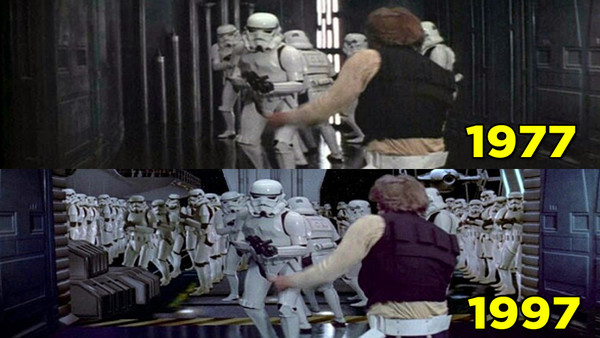
One of my favourite moments from the original Star Wars, a scene that's been parodied and replicated to death, made even better. To be completely honest, the original version doesn't even make that much sense; the Stormtroopers just turn around and realise that they actually outnumber their attackers.
In this version from 1997, Han chases the Stormtroopers down the corridor only to emerge in a crowded hangar bay, complete with a stationary TIE fighter in the background. It may not make as much sense, considering the fact that the Stormtroopers don't appear to be aware of Solo's presence despite the base being on alert, but it's certainly more entertaining. It takes an already clever gag and makes it better. This is the version that needs to be seen.