10 Surprising Movie Character Traits Everyone Missed
Bane loves to knit. Who knew?

Subtle tics and quirks are an easy way for filmmakers and actors to make their characters feel truly alive rather than simply props for the sake of telling a story.
And while character traits are usually obviously laid out for the audience to easily digest - say, Tony Stark's (Robert Downey Jr.) fondness for eating in the middle of a conversation - sometimes directors can imbue their films with a more impressively low-key brand of character development.
These 10 films, all terrific works in their own right with brilliantly defined characters, nevertheless dared to take things a step further by rewarding those few audience members who really paid close attention.
It's entirely possible to watch these movies dozens of times and never pick up on these below-the-radar character flourishes, adding inessential yet undeniably intriguing shade to characters you're probably already huge fans of.
And so, we're left to wonder how many other minor character bombshells are sat out there just waiting to be discovered in cinema's all-time great films...
10. Elastigirl Speaks Out The Right Side Of Her Mouth (Just Like Holly Hunter) - The Incredibles

The Incredibles' Elastigirl is of course voiced by the brilliant Holly Hunter, whose distinctive drawl is a perfect fit for the series' stretchy superheroine.
But Hunter's recognisable twang is actually a by-product of her tendency to speak from the right side of her mouth, due to a childhood case of the mumps rendering her deaf in her left ear.
Brilliantly, Pixar actually decided to incorporate this physical aspect of Hunter's vocal performance into Elastigirl herself, and so those who pay close attention will notice that Helen Parr is animated to speak from the right side of her mouth.
It's easy to completely ignore this if you're well-accustomed to Hunter's voice, but it's yet another incredible testament to Pixar's ludicrous attention-to-detail.
9. David Never Blinks - A.I. Artificial Intelligence

Haley Joel Osment gives a heartbreakingly terrific performance in A.I. as David, a childlike android programmed with the ability to love, and a character who original director Stanley Kubrick initially believed no actual child actor could believably play.
And yet, Osment's remarkably nuanced performance totally sells the audience on his uncanny nature, perhaps defined best by subtler physical tics which most audience members wouldn't ever consciously pick up on.
In addition to teaching himself a stiffer posture, Osment also suggested to director Steven Spielberg that David should never be seen blinking, and so undertook the challenge to never once blink during a take.
And indeed, throughout the entire film you'll never see David blink, which is actually pretty ironic considering the obvious advanced technology involved in bringing David to "life," and how comparatively simple a blinking routine would clearly be.
Nevertheless, on some level it gets into the audience's mind that something's a bit off about David, and this certainly helps hammer that home.
Of working under such conditions, Osment said, "It was hard not to blink, because robots always keep their eyes open. The trick is not to think about it a lot. After the first week, I didn't blink even after they yelled, 'Cut,' at the end of a scene."
8. Kyle Reese's Unique Relationship With Dogs - The Terminator

One of the subtler aspects of the Terminator series' lore is revealed in the very first movie, when Kyle Reese's (Michael Biehn) "flashback" to the future war shows the resistance fighters using dogs to detect Terminators.
Not only do the canines bark when an infiltrator is near, but it's shown that human soldiers got into the habit of offering their hands to the dogs upon returning to base in order to verify their identity.
In a sly callback - or call-forward? - Kyle shows just how deeply entrenched this habit is when he goes to the Tiki Motel with Sarah Connor (Linda Hamilton) mid-way through the movie.
At the check-in desk, he sees a dog and instinctively offers his hand to it to sniff. Sure, Reese is perhaps just practising good manners with a dog, but knowing the crucial role the animals play in the future war, it's impossible to remove his action from that wider learned context.
7. Baby Reads The Kids' Menu Because Of His Childhood Trauma - Baby Driver

Trust an Edgar Wright movie to be full of neat little details.
His action-thriller Baby Driver features a memorable meet-cute between getaway driver Baby (Ansel Elgort) and cute waitress Debora (Lily James) in a diner, where Deb informs a flustered Baby that he's actually looking at the kids' menu, much to his embarrassment.
While viewers might initially assume this to be a throwaway moment intended solely to show how preoccupied Baby is, it actually confirms just how thoroughly traumatised Baby still is from the childhood car accident which killed his parents.
It's basically a subtle visual cue to imply Baby's arrested development, stuck in the habit of a child, made all the more devastating given that Deb not only works in the diner just as his mother did, but even bears a decent physical resemblance to her.
On the other hand, perhaps this is also just Wright being a little playful, because it's only fitting that a guy called Baby would look at the kids' menu, right?
6. Pennywise Changes His Eye Colour To Put His Victims At Ease - It

Despite initial skepticism about Bill Skarsgård's ability to live up to Tim Curry's chilling prior portrayal of Pennywise the Dancing Clown, he did an exemplary job, aided of course by the tireless efforts of the entire lavish production.
Perhaps the most interesting character trait of the child-eating villain is displayed in his very first scene, where he preys upon doomed young Georgie (Jackson Robert Scott).
While desperately attempting to present an affable demeanour to Georgie after first startling him, Pennywise's signature yellow eyes change colour to a more inviting blue.
However, there's an added layer to this deception as made clear in Stephen King's novel: he switches to a blue eye colour because it's the very same colour eyes as Georgie's brother (Jaeden Martell) and mother.
At even an unconscious level, this puts Georgie at greater ease with Pennywise as he attempts to lure him in, and of course, it totally works.
5. Charlie Says "Definitely" A Lot (Just Like His Brother) - Rain Man

Dustin Hoffman won the Best Actor Oscar for his sublime performance as Raymond Babbitt in Rain Man, a character defined by many memorable traits, not least his incessant use of the word "definitely."
But before his self-serving younger brother Charlie even meets Raymond, there's an early nod to repeat viewers that the two are siblings.
When Charlie learns that most of his father's $3 million estate is going to Raymond - at the time an unknown beneficiary - he repeatedly invokes the word "definitely" also.
It means nothing to people watching Rain Man for the first time, naturally, but makes for one hell of a penny-dropping moment on a repeat viewing, that both brothers, estranged as they are, share such a specific language-based tic.
4. Marla Singer's Bad Makeup Informs Her Character - Fight Club

Fight Club's Marla Singer is unquestionably the character of Helena Bonham Carter's career, a deeply disturbed yet compulsively watchable human trainwreck hurled headlong into David Fincher's masterful thriller.
And though the film is absolutely jam-packed with brilliantly subtle moments of character work, perhaps one of the most unfortunately unspoken is something as simple as Marla's makeup.
There's no mistaking Marla's careless, grungy sense of style throughout the film, topped off by her smoky eye makeup in particular.
To achieve this look, Carter asked her makeup artist to apply all of her facial slap with her non-dominant hand, in order to ensure it retained a rough-hewn, uneven quality.
The end result certainly speaks for itself, and like other entries on this list, it's a subtle character morsel which says a lot about who Marla is without having to actually say anything at all.
3. Tony Montana's Poor Dinner Etiquette - Scarface

Scarface isn't a movie full of subtleties: its strength lies more in its shameless, stylish aggression, accentuated by Al Pacino's thermonuclear performance as Cuban refugee-turned-drug lord Tony Montana.
But there is one below-the-radar character beat which says a lot about who Tony is, when he and Omar (F. Murray Abraham) head to Bolivia to meet with cocaine kingpin Sosa (Paul Shenar).
After dinner, the men are brought lemon water for washing their hands, but an oblivious Tony immediately grabs the lemon slice and bites into it, unaware of what it's actually intended for.
Though we as the audience are of course already acutely aware of Tony's humble origins and social status, it's nevertheless an amusing character trait to underline how much of a fish out of water he truly is in this situation, no matter his ambition.
2. Bane Loves To Knit - The Dark Knight Rises

Tom Hardy did a remarkable job of bringing Bane to life in The Dark Knight Rises, no matter that the majority of the character's face is covered and we're privy to only small morsels of information about his backstory and personality.
But nothing the character gets up to in the movie proves more peculiar than his baffling decision to randomly knit on occasion - all the more so as it's easy for audiences to watch the film time and time again without ever noticing.
It's most easily noticed during the kangaroo court scene late in the movie, and while it's never explained beyond being a mere character eccentricity, it's actually one of the film's many references to Charles Dickens' classic novel A Tale of Two Cities.
Bane is actually paying homage to the book's villain Madame Defarge, who herself has a fondness for knitting, even if it's more likely to just confuse casual viewers who happen to notice it.
1. HAL "Cheats" At Chess - 2001: A Space Odyssey
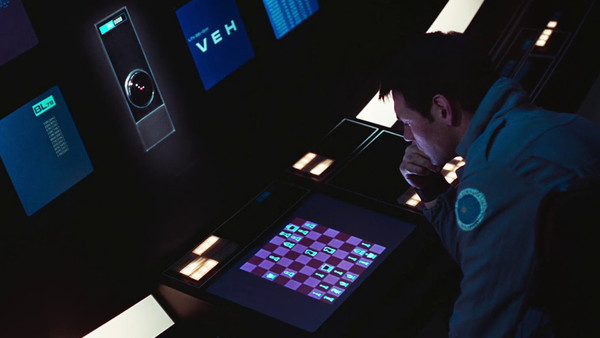
Stanley Kubrick's 2001: A Space Odyssey is an all-timer sci-fi classic for many reasons, not least the presence of its villainous malfunctioning computer, HAL 9000 (Douglas Rain).
If HAL serves as David Bowman's (Keir Dullea) opposition throughout the film, the computer's greater sense of duplicity is hinted at prior when it takes on Dr. Frank Poole (Gary Lockwood) in a game of chess.
The match ends with HAL's victory, naturally, though those who pay extremely close attention to the scene will notice that HAL actually "cheats" in order to win.
He tells Poole, "I'm sorry Frank, I think you missed it: queen to bishop three, bishop takes queen, knight takes bishop, mate," prompting Poole to resign the game without questioning HAL.
But in actual fact, HAL should've said, "queen to bishop six," which would've allowed Poole to continue playing a short while longer, even if HAL's victory was more-or-less inevitable either way.
Given Kubrick's penchant for infuriating attention-to-detail in his movies, it's unlikely this was a simple mistake.
More likely, it was a concerted attempt to sew the seeds of HAL's malfunction, albeit subtly enough that only seasoned chess players would likely ever notice it - and even then, probably assume it was a continuity error.