10 Theories That Improve The Indiana Jones Movies

Not that they really need improving, but...
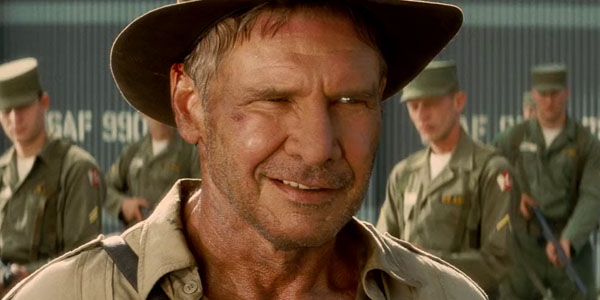
The Indiana Jones franchise is probably one of the most beloved adventure franchises of all time, and fan theories surrounding it are abundant to say the least. Whether explaining plot holes in the films, or tying the franchises to other universes (be sure to look out for fan theories that link Indiana Jones to Gremlins and even The Avengers), there's plenty of creativity behind them. With Harrison Ford getting back behind the controls of the Millennium Falcon for Star Wars: The Force Awakens later this year, rumblings of another Indiana Jones movie continue to bubble to the surface. While Disney has basically said there has been no news (and that there's no script), that hasn't stopped speculation about a sequel with a much older Jones, a reboot, and/or Chris Pratt (currently found in Jurassic World) taking the reigns. Will it happen? Probably, eventually, since Disney now owns the property, and while Star Wars was the biggest part of the LucasFilm deal, Harrison Ford's "other" franchise is certainly nothing to scoff at. Will it be a reboot, or will Ford come back one last time to play an even older Dr. Jones? That's another matter entirely. In the meantime, lets take a look at ten theories that (arguably) make Indiana Jones even better.

10. Kingdom Of The Crystal Skull Is A Radiation Induced Fever Dream
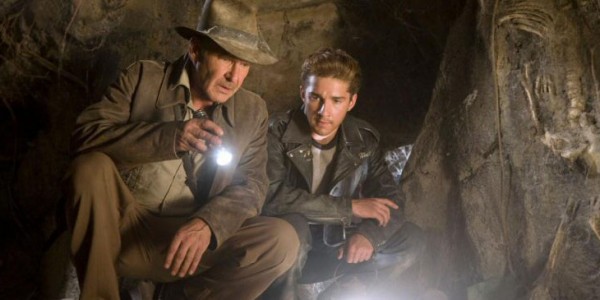
For some, Indiana Jones and the Kingdom of the Crystal Skull is an abomination, a movie that never should have happened. Why? It's difficult to pinpoint, exactly. For many, it's the fact that instead of religious iconography, the movie concerns itself with matters of the extraterrestrial - and apparently, never the twain shall meet. Although that seems a little dramatic - after all, Raiders of the Lost Ark had the Ark of the Covenant melting faces off Nazis - it's a common point of contention. Others find fault with Shia Labeouf playing Mutt, Indy's son, and with the contentious fridge scene, when our hero survives a nuclear blast at a testing site by taking refuge in a lead-lined refrigerator. However, that scene gives rise to a theory that attempts to explain away the rest of the movie: that the events following it are actually part of a radiation induced fever dream. In other words, Indy hallucinated the whole thing, and there were no crystal skulls, aliens, or Mutt. If you're an Indiana Jones purist, this might be the theory you want to latch onto. Even if Temple of Doom was probably the series' low point in retrospect.

9. Indiana Jones Is Actually Dead

If you can't quite handle the fact that Indiana Jones survived a nuclear blast inside an old fridge, then this might be the theory for you. Like the fever dream theory, it removes the rest of Kingdom of the Crystal Skull from the equation - only in this theory, Indy is dead, perhaps seeing these events in the final moments before he passes on, casting himself as a hero one last time, and imagining himself with a family, and a happy ending. It is a little bit of overkill no doubt, but if you really dislike the fridge scene, it's at least an option. However, ask yourself this: if Indiana Jones was going to fantasize about a happy family life, would he really dream up Shia Labeouf as his son?

8. Indy Was A (Divine) Witness To The Events Of Raiders Of The Lost Ark/Last Crusade

This theory can somewhat be blamed on Big Bang Theory, due to an episode of the show pointing out that Indiana Jones was completely irrelevant to the events of Raiders of the Lost Ark. Essentially, the idea is that the Nazis would have sought out the Ark anyway, found it, and eventually opened it, killing themselves in the process. After the episode aired, the show was blamed for "ruining" the movie for fans, though it was a rather silly argument to make: it didn't ruin anything, and the movie is just as great as it always was. It's about the journey, after all, not just the end result. Plus, it gave birth to this theory: instead of being the cause of a lot of conflict in the movies, if the events were predetermined, then maybe through some divine intervention, it was all meant to happen - and Indy was meant to witness it. It seems a stretch, until you realize that with the heavy reliance on religious themes and mystical power, it actually is possible within the rules of the Indiana Jones universe. The same can be said about Last Crusade: arguably, the Nazis would have found the grail eventually, even if Indy was a little more key to events in this movie. They had Henry Jones Sr. after all. And eventually, one has to think that they would have made it to the grail's resting place, and Walter Donovan still would have chosen poorly and drank from the wrong cup. Beyond that, there's no doubt someone would have tried taking the grail past the seal, causing the destruction of the temple, just as in the movie. Yet Jones was still there, taking part, and bearing witness to another of the greatest historical finds of all time - something the old knight seemed to suggest he was destined to do.

7. Temple Of Doom Symbolizes Heartbreak

For all the grief that Kingdom of the Crystal Skull gets, Temple of Doom still had the least popular romantic interest for Indy, not to mention the whole "rip the still beating heart out of someone's chest" angle that seems more unbelievable in this day and age than any number of ancient alien theories. And that mine cart ride, while fun, wasn't any more believable than Crystal Skull's raft ride. In short, it's probably the most problematic of all four films, if you remove the nostalgia factor. So it's not surprising that fans have come up with numerous theories to soften the blow of this prequel (it's actually set before Raiders of the Lost Ark), one of which deals more with the thematic than physical. Need an explanation for Indy's tumultuous on-screen romance and a ripped out heart? Look no further than simple heartbreak. As the theory goes, this is all symbolic. And it's based on real life events. George Lucas has gone on record to state that he was going through a difficult divorce while writing the script. He and his wife were done. The character of Indy on screen was reflecting real life happenings. In short, Temple of Doom is a break up movie. Maybe knowing that isn't a huge improvement, but at least it's an explanation for what happened in the franchise's maligned second installment.

6. Indiana Jones, E.T., And Star Wars Take Place In The Same Universe

Take this one with a great big grain (make it a boulder) of salt, but there has been a fan theory making the rounds for a few years now which hypothesizes that the events of Indiana Jones, E.T., and Star Wars take place in the same shared universe. Say what? This is pretty much the result of a couple of Easter Eggs which fans have read too much into. Simply put, in E.T., the titular character comes across a Yoda-costumed kid at one point and acts as if he recognizes him. Meanwhile, in the Star Wars universe, members of E.T.'s species of aliens (called Grebleips) turn up in the Galactic Senate in The Phantom Menace. Finally, in Raiders of the Lost Ark, hieroglyphs portraying R2-D2 and 3CPO are seen. The events in Star Wars took place "A long time ago" - so timeline wise, Indy could find an artefact referencing characters from that time. And who knows how long E.T.'s race has been around. So of course fans have tried to tie them all together. And admittedly, it's kind of cool, but really, these were just early Easter Eggs from before the time of DVDs (save Episode 1). Besides, this isn't the only tie-in: R2-D2 can also be found in Close Encounters of the Third Kind, yet no one seems to be suggesting that it is also part of the shared universe (at least not yet!).

5. The Main Focus Of Temple Of Doom Was Saving The Children, Not The Stones

It's not always all about the MacGuffin. Or perhaps it's just that the MacGuffin isn't always what you think it is. If you're not familiar with the term, a "MacGuffin" is the core concept driving the events of a fictional story. A motivator. It's a plot device - in Indiana Jones, it's the Ark, the Grail, the Crystal Skulls. And, in Temple of Doom, the MacGuffin is the Sankara Stones. The stones, believe it or not, do have a real life counterpart in the Hindu faith, though they are not called the Sankara Stones. However, these magical stones - which brought prosperity to an Indian community in Temple of Doom, until stolen, along with the town's children - were not even the main point of the movie, according to one fan theory. Instead, the theory goes, the "real" MacGuffin of the movie was the kidnapped kids themselves. To bolster this claim, proponents point to the presence of Short Round, Indy's sidekick for the film, who would have made him more sympathetic to the plight of the children. It's the kids that really matter, and the retrieval of the kids makes Indy a hero. Since the return of the children did have more gravity than a glowing stone anyway, this theory actually makes a fair bit of sense.

4. Indiana Jones Knew Aliens Existed Prior To Crystal Skull
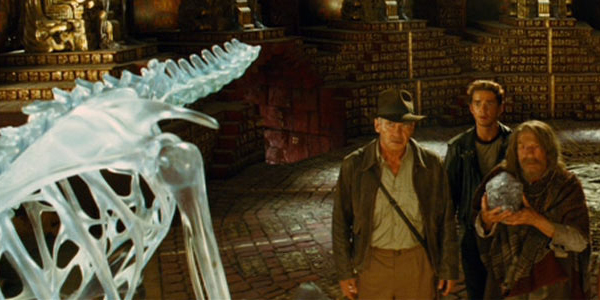
There are a lot of Kingdom of the Crystal Skull fan theories out there - and not all of them are simply trying to erase the existence of the fourth film in the franchise. In one particularly interesting theory, Indiana Jones is suggested to know about the existence of aliens prior to the events of the film. Here's how it goes: According to the theory, Jones seemed a little too receptive to the existence of extra-terrestrial life in the movie. On top of that, having dealt with some pretty crazy supernatural powers before, he would have been open to the idea of extreme possibilities. While it doesn't exactly change much about the movie itself, the theory goes so far as to suggest that Indy had seen prior evidence, perhaps while working for the government. And it portrays Indiana Jones as a man more open to the idea of alien involvement in past human civilizations than many fans of the franchise.

3. Indiana Jones Is Responsible For The Events Of Raiders Of The Lost Ark

A counter-point to the Big Bang Theory's theory (that Indiana Jones' actions in Raiders of the Lost Ark were inconsequential to the outcome of the story) is that Indiana Jones was actually the cause of the Ark being found in the first place. In this theory, without Indiana Jones, the Nazis wouldn't have found the Ark at all. It's pretty simple, really: the Nazis, while on the trail of the Ark, were digging in the wrong place. It wasn't until Dr. Jones came along and got involved that he inadvertently led them to the coveted artifact. In fact, had Indy simply left, along with the amulet in his possession that was the key to uncovering the Ark, the Nazi's wouldn't have been able to retrieve it at all. Of course, then they wouldn't have had their faces melted off. So the fact that Indy is actually responsible for these events taking place is clearly the more appealing theory of the two.

2. Crystal Skull Makes The Entire Series More Plausible - Because Alien Technology Is Behind It All

Which is really more believable - that ancient religious artefacts have mystical super powers, or that aliens walked the earth at some point during the early stages of civilization? It's really up for the debate, and probably has a lot to do with your feelings about religion, but as far as this particular theory goes, it leans towards the "aliens could be real, and what we know as God is simply... extra-terrestrial." Now, consider that if aliens have been here all along, these religious icons Indiana Jones keeps uncovering, which bear super powers, might actually be alien in origin - disguised, as it were, as something more in line with what early humans believed. The main flaw in the theory? Why would they even bother?

1. The Rogue Explorer Who Gave Indiana Jones His Hat Was... Abner Ravenwood

There is actually some factual (well, written) evidence for this theory. Remember that Abner Ravenwood was Miriam's father, and a sort of mentor to Indy. It was his lifelong dream to find the Ark of the Covenant. Then recall the roguish explorer/archeologist from the beginning of Indiana Jones and the Last Crusade, who gave a young Indy (played by River Phoenix) his hat after reclaiming Coronado's crucifix from him. Now consider that we don't really know about much about Abner, or Indy's connection to him, other than he once had Indy as a student. Could they Abner Ravenwood and hat guy be one and the same? Well, at least one theory says yes. If you find that a stretch, finally, consider this (the aforementioned evidence): in early drafts of the script for Indiana Jones and the Last Crusade, this character was actually referred to as Abner Ravenwood. It was changed closer to the point the movie filmed, and the explorer's name became a mystery, other than being listed as "Fedora." Still, Abner Ravenwood makes a lot of sense as being the man in question, and were it true, it would help tie the entire franchise together. Any theories of your own? Add them below!

Contributor
Contributor

Primarily covering the sport of MMA from Ontario, Canada, Jay Anderson has been writing for various publications covering sports, technology, and pop culture since 2001. Jay holds an Honours Bachelor of Arts degree in English from the University of Guelph, and a Certificate in Leadership Skills from Humber College.