10 Tiny Movie Details That Give Away Character Secrets
Right under your nose.
The very best movie characters are filled with hidden depths, such that just when you think you have them figured out, a repeat viewing unveils yet another layer of complexity to their persona.
And while most movies like to understandably play their character development big, broad, and easily understood, sometimes filmmakers dare to trust audiences enough to pick up on incredible hidden subtleties themselves.
But then there are those films which hide their meaty character work underneath layers of subtext, or brilliantly leave them in such close proximity to the audience that they actually gloss over them entirely.
Each of these 10 movie characters are defined by their shocking secrets, but they're secrets which ultra-attentive viewers actually could've uncovered a good while before their jaw-dropping reveal.
Granted, you'd require supernatural powers of observation to notice these tiny details and link them to the subsequent big reveal, but everything you needed to figure it out was nevertheless there waiting to be discovered.
If you did pick up on any of these hints yourself, take a bow...
10. Jigsaw's Gun Is Empty, Confirming He Isn't Dead - Saw

The original Saw's unforgettable final plot twist reveals that Jigsaw (Tobin Bell), the mastermind behind the film's various macabre traps and "tests," was actually in the grotty bathroom with Adam (Leigh Whannell) and Dr. Gordon (Cary Elwes) all along.
As it turns out, Jigsaw was masquerading as the "dead" body in the middle of the bathroom, as a man who apparently shot himself due to the poison coursing through his body.
And though Jigsaw stands up at the very end of the film to reveal his ruse, the movie actually gives the twist away far earlier if you're really paying attention.
Mid-way through the film, the gun the man apparently used to shoot himself is examined, and we see that it's empty.
Without even shell casings visible in any of the gun's six chambers, it's clear that the gun hasn't been fired in suicide, because who could've possibly cleaned it out afterwards?
But of course, Adam and Gordon were in an impossible, heavily panicked situation, so you can't really criticise them for not putting two and two together here.
9. Mr. Orange Rats Out Mr. Pink For Not Tipping Because He's A Cop - Reservoir Dogs

Quentin Tarantino's Reservoir Dogs is centered around the fallout of a botched diamond heist, with the eventual reveal that one of the thieves, Mr. Orange (Tim Roth), is actually an undercover cop.
But Mr. Orange's duplicitous nature is slyly revealed in the first minutes of the movie when the gang heads to a diner for breakfast and Mr. Pink (Steve Buscemi) launches into a memorable spiel about his no-tipping policy.
Mob boss Joe Cabot (Lawrence Tierney) then asks the team who didn't tip, and without any hesitation whatsoever, Mr. Orange rats out Mr. Pink.
Furthermore, when Joe asks why Mr. Pink didn't tip, Orange keeps chiming in with more information until Joe actually tells him to "shut up."
It's a subtle but brilliant way to let the audience know that Orange is a bit of a motormouth and, ultimately, a lot more than that.
8. The Party Guests All Arrive In Black Cars, Foreshadowing Their Use Of Black People As "Vehicles" - Get Out
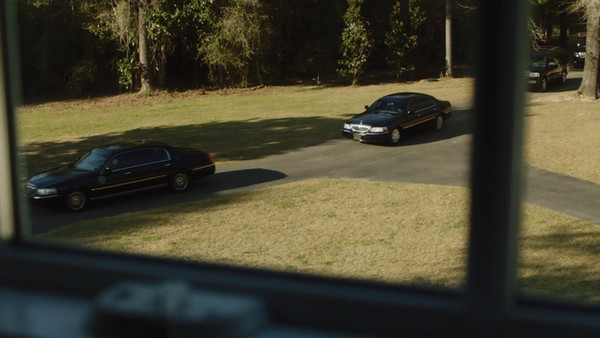
Jordan Peele's Get Out is surely one of the most meticulously layered and expertly engineered horror films of the last decade.
Jam-packed with terrifically satisfying symbolism, it's a movie that continues to reveal new surprises on third, fourth, and even fifth viewings.
Perhaps the most sneaky feat of foreshadowing in the entire movie occurs when guests start arriving for the Armitage's house party, and every single car that pulls up just so happens to be black.
Given that the film's plot ultimately revolves around a family of wealthy, old white people kidnapping young black people and taking control of their bodies - using them as vehicles, even - it's hysterical that Peele lays this out in such blatant-yet-abstract terms so early on.
And even if you think this is a bit of a reach on our part, Peele himself confirmed it was totally intentional in the below interview.
7. Snape Deflects McGonagall's Spell Into The Death Eaters Because He's Actually A Hero - Harry Potter & The Deathly Hallows - Part 2

Fans of the Harry Potter books were of course well aware of the fact that Severus Snape (Alan Rickman) was a benevolent double agent several years before movie-only audiences found out in the franchise-capping Harry Potter and The Deathly Hallows - Part 2.
For those who stuck purely to the films, Snape being a hero all along was a supremely shocking and affecting moment - just as it was in the books, naturally - yet one that was also quite brilliantly foreshadowed earlier in the film.
Just as the Battle of Hogwarts begins, Professor McGonagall (Maggie Smith) fires a spell at Snape, who promptly deflects it into the Death Eaters stood behind him.
While in the moment this simply seemed like a clumsy act of self-defense, within the eventual context of Snape's true nature, it's clear he took the opportunity to redirect McGonagall's attack against him into an assault on their actual mutual enemy - the Death Eaters.
6. Sammy Jankis Briefly Morphs Into Lenny, Hinting At Lenny's Big Secret - Memento
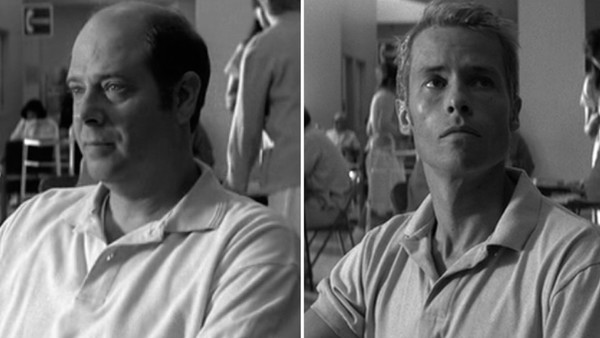
Christopher Nolan's ingenious thriller Memento follows Leonard Shelby (Guy Pearce), an amnesiac who attempts to track down those responsible for murdering his wife.
The film is framed by a series of black-and-white sequences where Shelby relays the story of an insurance case he handled for a man named Sammy Jankis (Stephen Tobolowsky).
Sammy similarly suffered from amnesia, which ultimately caused him to accidentally administer an insulin overdose to his wife, killing her.
The end of the movie implies that this story is actually Leonard's, who accidentally killed his own wife under similar circumstances. He then constructed an elaborate, false revenge narrative in order to assuage his own guilt over the killing.
It's a fantastically shocking reveal, albeit one that is also implied by a fleeting shot earlier in the film.
During one of the black-and-white sequences where we see Sammy in the hospital, he's replaced with Leonard for a few fractions of a second before the shot cuts away.
It's easily missed even on repeat viewings, but provides an extremely compelling hint of the reveal to come.
5. Well-Placed Fruit Foreshadows That Einhorn Is Finkle - Ace Ventura: Pet Detective

Ace Ventura: Pet Detective is largely responsible for shooting Jim Carrey to superstardom in the mid-1990s, and the narrative is honestly one of the most dementedly off-kilter of any mainstream Hollywood comedy released that entire decade.
Perhaps the most eyebrow-raising subplot in the entire movie - and one that, under a modern lens, seems rather problematic - involves the revelation that Miami PD Lieutenant Lois Einhorn (Sean Young) was formerly Ace's (Carrey) primary murder suspect, an American football player named Ray Finkle.
Finkle had sex reassignment surgery to become a woman - which wasn't fully completed - while assuming the Einhorn name, leaving Ace thoroughly disturbed in the process.
But the Crying Game-inspired twist is actually spelled out mid-way through the movie when Ace visits Einhorn's office and a strategically placed banana, with one apple on either side, is visible on the edge of Einhorn's table, nodding towards Einhorn's true physiology.
The twist itself may have aged rather badly, but that's a top notch foreshadowing sight gag right there.
4. Adelaide Snaps Her Fingers Off-Beat, Suggesting She's A Tethered - Us

Jordan Peele strikes again with his solid sophomore horror flick Us, which revolves around a family facing off against their own insanely creepy doppelgängers (aka The Tethered).
And just like Get Out, nothing in the film is done by accident: every minor detail is carried out by design, to the extent that Peele literally spells out the big twist in the first few minutes of the movie.
The end of Us reveals that mother Adelaide (Lupita Nyong'o) was actually her own doppelgänger, Red, all along, having been switched as a child, and the character we assumed to be Red was actually the real Adelaide.
This is brilliantly indicated by the opening the movie, when as the family is driving to the coast for their vacation, "Adelaide" tries to snap her fingers to the song "I Got 5 on It", only for her snaps to be out of time with the music, hitting beats 1 and 3 instead of 2 and 4 as you'd expect.
This immediately makes something seem "off" about her, to the extent that some even predicted the twist from the trailer alone. Given that Adelaide was a dancer as a youngster, there'd be no reason for her to fail to hold the correct beat.
3. Truman's Best Friend Marlon Keeps Restocking The Vending Machine With The Same Candy Bars, Because He's An Actor - The Truman Show

The Truman Show revolves around Truman Burbank (Jim Carrey), a man unaware that his entire life unfolds within the controlled confines of a reality TV show.
As the movie's opening titles sequence makes clear, every single person in Truman's world is a paid actor, even his best friend Marlon (Noah Emmerich), who manages to convince Truman for a good while that his suspicions are incorrect.
And while we as the audience know that Marlon - or rather, Louis Coltrane, as is his real name - is an actor from the first few minutes of the movie, there's a brilliant hint to Truman in the first act of the film that "Marlon" isn't who he says he is.
When Truman visits him at the convenience store where he works, Marlon is stocking a vending machine with candy bars, yet because he wasn't expecting Truman to show up, he doesn't have enough candy bars to keep stocking the machine for the entirety of the "scene."
And so, whenever Truman turns away from him for a moment, Marlon removes a couple of the bars and puts them back into the machine, giving only the most superficial impression that he's still working.
Obviously a real employee would've had a full box of candy bars to put in the machine, but because this is a TV show with a presumably huge catering department, there's no real need to fully stock it.
Of course, had Truman been paying much attention at all, he would've noticed the deception and realised Marlon was in on it too.
2. The Narrator Can't Hear His Boss Because He Hit Himself In The Ear The Night Before - Fight Club

David Fincher's Fight Club boasts one of the most stunningly executed plot twists in cinema history, that our unnamed protagonist, The Narrator (Edward Norton), and Tyler Durden (Brad Pitt) are in fact the same person, the latter being an idealised second personality that exists within the Narrator's mind.
There are a number of sly clues throughout the film which ultimately make repeat viewings a tremendously rewarding joy, and one especially sneaky one that you might not yet know about.
We all remember the iconic scene where Tyler asks the Narrator to hit him as hard as he can, leading to Tyler hilariously being hit in the ear.
In the very next scene set the next morning, we see the Narrator at work, unable to hear what his boss says to him for a beat, as he tells the audience, "After fighting, everything else in your life got the volume turned down."
With our knowledge that the Narrator actually hit himself in the ear the night before, though, it makes perfect sense that his hearing would be impaired the next day, especially as the afflicted ear - his left one - is facing his boss when he starts speaking to him.
If that's not some galaxy brain, God-tier foreshadowing, what is?
1. Sam's Shirt Hints At Him Being A Clone - Moon

The terrific Sam Rockwell-starring sci-fi drama Moon follows Sam Bell (Sam Rockwell), a man who begins to mentally and physically unravel as he reaches the end of a three-year mining stint on the far side of the Moon.
It's eventually revealed that Sam is, in fact, one of hundreds of identical clones of the original Sam Bell, and his frayed sanity is a result of each clone's in-built, three-year lifespan.
Basically, Lunar Industries awakens a new clone when the previous one is "retired" - that is, incinerated - as is cleverly foreshadowed in the film's opening title sequence, where "Sam Prime" is wearing a shirt reading, "Wake me when it's quitting time."
The relevance this statement has to Sam's true nature speaks for itself, even if at this point in the movie it seems like nothing more than a goofy throwaway slogan.