10 TV Shows That Wanted To Be Star Trek
They say imitation is the highest form of flattery - Star Trek must have been VERY flattered here.

The shows on this list both draw inspiration from and out and out borrow from, Star Trek's many iterations through the years. With so many episodes to draw from, from the Original Series onward, there is simply so much material out there that serves as the template for so much of what followed. Each decade seemingly has another contender for the newest Trek-inspired show.
From the time it was released, Star Trek was inspiring other franchises to do their best to capture the magic of the Enterprise, even though the Original Series lasted a paltry three seasons, often outperformed in the ratings by contemporaries like Lost In Space.
Yet, Roddenberry's vision was so clear that in the years that followed, other writers and producers would look to his show as a template for their own. Whether that meant traveling the stars through a wormhole, or finding themselves lost thousands of years in the future, these picks both honour, and occasionally outright steal, the building blocks that made Star Trek what it was.
They may not be part of the official canon, but some of these examples could easily be a part of the Federation - albeit, a little bit farther away than even Voyager was flung.
10. Space Precinct
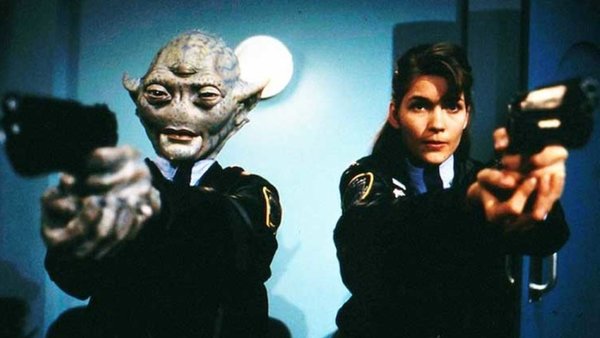
Space Precinct was a Gerry Anderson production from the early '90s. Anderson had made previous series like Space: 1999, Captain Scarlet, Stingray, and Thunderbirds. This however was a live-action sci-fi mixed with a police procedural. Anderson had created shows in the past that were primarily targeted at a younger audience, which is where the problems began for Space Precinct.
The network didn't know what to do with it. It was popular in Europe, but not so much in America. Despite the outlandish make-up and prosthetics, which were nothing short of impressive, the show aimed at dealing with adult-oriented storylines. Taking its cue from Star Trek, it tried to paint a fantastical future with as much realism as it could, thoroughly confusing the networks.
It then suffered the fate of Star Trek The Original Series' third season. Unsure how to market the show, the networks scheduled it to air either late at night or early in the morning. This led to a low viewership, which in turn led to the show's cancellation after just one season.
9. Buck Rogers In The 25th Century
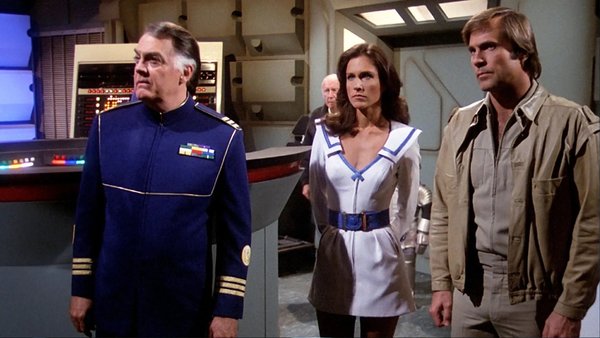
Glen A. Larson, in his first appearance on this list, created Buck Rogers In The 25th Century, which revolved around the central character of Buck dealing with being both out of time and fighting extra-terrestrial threats to Earth. Originally, it was a standalone film, though this was re-edited as a backdoor pilot once the studio decided to push ahead with the series.
It received two seasons' worth of stories, with the second of these being the more heavily Star Trek-influenced one. The first season had Buck located primarily on Earth, working as an unofficial agent for 'The Federation's security. The show also featured space travel via Stargates, though it was also referred to as Warp travel.
In the second season, Buck was now leading a crew aboard the Searcher. The ship's mission was to seek out the lost colonies of mankind - an idea that Larson had already used in Battlestar Galactica. It was this year that the Star Trek ideas really sunk in. Buck was modeled closely on James T. Kirk, with his crewmate Hawk serving as Mr. Spock. Colonel Wilma Deering was redesigned to resemble Uhura, often shown in miniskirts, sitting at the communications array.
The show was canceled due to lower ratings, difficulties with the main actor, and rising costs.
8. Sliders

Sliders debuted in 1995, ran for five years, and was mostly successful for its lifetime. Several Trek stars would appear - including John Rhys Davies and Jerry O'Connell, two of the leads from the beginning.
The show explored the nature of parallel worlds, moving from week to week, attempting to get to a home they feel is lost. There are shades of Star Trek: Voyager in the premise. Voyager too was lost in a far-flung part of the galaxy, trying each week to get home. Though Sliders has more in common with Scott Bakula and Dean Stockwell's Quantum Leap than anything else, the Trek connections are present.
In addition to this, the show was in part developed by Tracé Torme, who had worked on Star Trek: The Next Generation as a scriptwriter. According to Rhys-Davies, the show began as an exception premise that explored the nature of reality, not unlike the human condition that was so frequently explored in Star Trek. However, the show's cancellation by Fox after its third season, and subsequent acquisition by the SyFy network, resulted in a more action-oriented show, which he felt ruined the potential that it had.
The show was finally canceled for a second time at the end of the fifth season, with an unresolved cliffhanger.
7. Seaquest DSV

Seaquest DSV arrived in 1993, airing on NBC. It focused on the submersible vehicle Seaquest, which had been designed and built by its captain, Nathan Bridger, who was played by movie star Roy Scheider. The first season, though set in the near future, was almost as educational as it was entertaining, opting to deal with real-world scientific issues.
When the second season returned, Scheider was deeply frustrated to find that the network opted to move the show in a more science-fiction direction. Aliens were introduced to the storylines, including the finale which saw the vessel abducted and brought into the future. Scheider was publically vocal about his displeasure, which prompted the showrunners to release scathing responses.
Though the show attempted to skew toward a straight, darker tone, much like the then-airing Star Trek: Deep Space Nine, Scheider asked to be released from his contract due to, as he called it, the show's attempt at becoming a 'fourth generation Star Trek', leaving the show as a sort of '21 Jump Street meets Star Dreck.'
He was replaced with Michael Ironside for the third season, but failing ratings resulted in the show's cancellation.
6. Stargate SG-1

Stargate SG-1, the first spin-off to the 1994 film, is at times one of the most loving tributes that Star Trek has ever received. SG-1 famously lampoons itself on occasion, being self-aware enough to make reference to the other franchise that it takes so much inspiration from. This is evident in the number of references that Jack O'Neill makes to Trek through the years.
One of the funnier references was his request to name the new Earth starship the Enterprise, only to be slapped back by Samantha Carter. This however is nothing compared to the tribute shown in the two hundredth episode, aptly named 200.
An episode that deals with a series of vignettes, one part has Mitchell, Carter, Teal'c, and Jackson on board the Odyssey, portraying over-the-top caricatures of William Shatner, James Doohan, and the rest of the Original Series cast. For a show that made so many knowing nods through its runtime, this was one of the funniest scenes in the franchise, offering that chance for long-time Trekkies to laugh at themselves as well.
The two further spin-off series were less Star Trek related but still managed to throw in the odd transporter jokes from time to time.
5. Battlestar Galactica
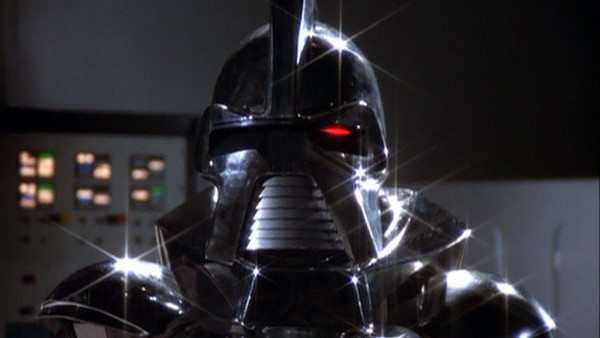
Battlestar Galactica owes more than a passing debt to both Star Trek and Star Wars. Coming in the '70s, it borrows heavily from both, though the apocalyptic setting was its own individual contribution to the genre. The series, opening with the destruction of most of mankind, is a parable about the dangers of over-reliance on technology. This is seemingly at odds with Roddenberry's vision.
However, it stars Lorne Greene as Commander Adama - a no-nonsense leader, from whom all of the crew draw their strength. There are clear hints of James T. Kirk in the character, coming on the heels of both the Original Series and the Animated Series.
The series is deeply rooted in the '70s aesthetic, so in a way it also served as something of an inspiration for Star Trek: The Motion Picture, though the effects available on a TV budget were, to put it mildly, lacking. The ambition was greater than the execution. Having said that, Battlestar Galactica is far from a failed copy of Star Trek.
The idea behind the show, drawn from Glen A. Larson's own religious upbringing, would go on to inspire Trek-writer Ronald D. Moore to reboot the franchise in 2003. The result was one of the greatest television series of recent years, offering a grim look at humanity from the inside out.
4. Earth: Final Conflict

Earth: Final Conflict is in fact a Gene Roddenberry original, though the creator died years before the show would ever see the light of day. He had, however, been approached years previously to develop the project when it was known as Battleground: Earth. The success of the Star Trek films and the then-upcoming The Next Generation made Roddenberry too busy to work on it.
Majel Barrett retained the notes to the show and it was from these that Earth: Final Conflict was born. The show opens three years after the arrival of Taelon to Earth. This seemingly benevolent race has brought technological advancements to humanity, though a sinister plot lies behind their kindness.
The Taelon are the dark side of the Vulcans. The Vulcans arrived on Earth bringing technological advancements, though they were less sinister than the Taelon. They were simply prickly, while the Taelon were pricks.
The series then morphed into an alternate version of the Cardassian Occupation of Bajor, with frequently appearing resistance cells attempting to take the Taelon down. Various other alien races appeared throughout the show, with many aiding, and others collaborating with the Taelon themselves.
The show was well-received, and its success led to the creation of the next entry on this list.
3. Andromeda

Andromeda was another idea from Roddenberry's vault that was given life in the '90s. Majel Barrett produced the show, with former Deep Space Nine writer Robert Hewitt Wolfe serving as showrunner. It centered around Captain Dylan Hunt and his ship, the Andromeda Ascendant.
The premise for the show saw a huge Commonwealth of Worlds spread across three galaxies. The parallels to the Federation are obvious here, though Andromeda took a darker turn. In the pilot, Hunt winds up on the edge of a black hole, where he and his ship are frozen in time. When he is saved by the crew of the Eureka Maru, 300 years have passed. The crew agrees to serve under him, much like the Maquis in Star Trek: Voyager.
The show then became a mix of episodes of the week, like the Original Series and The Next Generation, with overarching plotlines that ran throughout the show, like Deep Space Nine. In the second season, Hewitt Wolfe was released from his contract, later explaining that his refusal to make the show more Hunt-centric led to his firing.
The show was an obvious inspiration for Firefly that followed, while itself being inspired by the Trek that had come before. It lasted five seasons.
2. Babylon 5

This entry may ruffle some feathers, and for good reason. There has been a long-standing rivalry between the Babylon 5 and Star Trek fandoms. Each side accuses the other of plagiarism, though there is little evidence to support it. However, the similarities between Babylon 5 and Star Trek: Deep Space Nine cannot be overlooked, though it is not quite that to be discussed here.
In many ways, Babylon 5 is both classic Trek - new aliens every week, an overarching threat of interstellar war, silly hairstyles - and something quite bold and different. The setting of the station, like Deep Space Nine, allowed the series to tell serialized stories, dealing with the consequences of character actions, while still moving the story forward.
Though the beginning of the show was fraught with issues and accusations, the two franchises warmed to each other. Actors were shared between them, serving as olive branches not just to the showrunners, but to the two fandoms who were at times ready to go to war with each other. Any excuse to see Walter Koenig in that interesting hairpiece is a treat, let's be honest.
1. The Orville

The Orville is creator Seth McFarlane's long-gestating love letter to Star Trek. To say that it is inspired by the franchise is the understatement of the century - McFarlane, time and again, has been vocal about his love for Gene Roddenberry's long-running saga.
The Orville came at a time when Star Trek was continuing to get darker. In many ways, it's the antithesis of Star Trek: Discovery, and a more slapstick comedy version of The Next Generation, from which it took many markers and directions. While the comedy aspect is quite different from what one might see on the Enterprise, the show is meticulous in how it presents this brighter future.
It relies heavily on its ensemble cast, something that Star Trek is at its best when it manages. The interpersonal relationships often feature strife, which was against Roddenberry's hope for the future, though in line with just about every writer on Trek. The visuals are a callback to the actual models of the '80s and '90s, without relying too heavily on CGI. Its episodic nature is straight of the classic Star Trek playbook.
The series is considered by many, like Galaxy Quest in the movie universe, to be an unofficial entry in Trek canon - quite a feat, coming from a self-confessed fanboy who just wanted to see a brighter future.